Top Tech Analyst Warns: OpenAI’s Ad Business Grew 10x in 6 Months. Google Search Is the Most Exposed
A top Wall Street analyst is sounding the alarm on a fast-growing OpenAI revenue stream that targets the exact same advertiser budgets powering Alphabet's most profitable business.

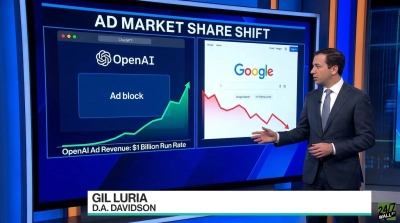
OpenAI’s advertising business is still tiny compared with Google Search, but D.A. Davidson analyst Gil Luria says the growth trajectory should have Alphabet investors paying attention.
Luria told CNBC on Monday that OpenAI’s advertising business has reached roughly a $1 billion annualized revenue run rate, up from about $100 million just six months ago.
That’s still a tiny fraction of Google’s Search advertising business, but Luria warns OpenAI’s ad business will likely take pieces of Alphabet’s (NASDAQ:GOOGL | GOOGL Price Prediction) existing market share rather than create new incremental demand.
OpenAI’s Ad Run Rate Has Jumped From $100 Million to $1 Billion
Google Search remains the dominant intent-based ad surface on the internet. Alphabet reported Google Search & other revenue of $63.27 billion in Q2 fiscal 2026, up 17% year over year. Luria’s estimate is that Google’s search advertising will generate roughly $250 billion this year.

“Google’s search advertising will maybe be $250 [billion] this year. So $1 billion starts taking little bits of share. And let’s not forget that was $100 million run rate just six months ago,” Luria said. In his view, OpenAI is in a position to have an advertising business in the tens of billions, which could start to pose a threat to Alphabet.
Why Google Search Is the Most Vulnerable Ad Budget
Luria argues that a ChatGPT ad is the closest existing substitute for a Google Search ad because both reach a user at the moment of active information-seeking with clear intent. “Buying an ad on ChatGPT is the most equivalent to buying Google Search,” he said, adding that share will come “mostly from Google Search, because that’s the most equivalent ad from the ad buyer’s perspective.”
However, Alphabet’s CEO Sundar Pichai told analysts that “Since expanding AI mode globally last October, we have surpassed 1 billion monthly active users” and that the Gemini App has 950 million monthly active users. Chief Business Officer Philipp Schindler said Google “continues to be encouraged with monetization performance on queries that show AI Overviews, even as we’ve expanded overviews to more commercial queries.”
So Alphabet is fighting back against the increased competition from OpenAI.
Finite Attention Puts YouTube and Meta in the Fight As Well
Luria also drew a line between the enterprise AI market, which he treats as expandable, and the consumer ad market, which he called more zero-sum. “The consumer segment is finite because we only have so many hours in the day, and advertisers can only catch us to the extent that we’re engaged,” he said. If time shifts into AI conversation, it comes out of traditional media, social media, and YouTube, making Google doubly exposed through Search and YouTube.
Meta (NASDAQ:META) sits on the other side of that finite-attention pie. The company reported Q2 Family of Apps ad revenue of $59.4 billion, up 27% year over year, with ad impressions up 14% and average price per ad up 12%. CEO Mark Zuckerberg said, “On a dollar basis, our Ads business is reporting faster year-over-year revenue growth than any other company’s reported ad business.“

Key Takeaways
OpenAI’s $1 billion advertising run rate is still small next to Google Search. The risk for Alphabet is the trajectory and the similarity of the product: both platforms monetize users actively looking for information. If ChatGPT advertising grows into the tens of billions, Luria argues Google Search could be the first place those dollars come from.
Contact [email protected] for any questions or corrections.
Thomas Richmond is a financial writer and content strategist with 5+ years of experience covering stocks and financial markets. He has published over 500 articles focused on individual stock analysis, helping investors better understand business fundamentals, stock valuations, and long-term opportunities.
Thomas previously served as a Content Lead at TIKR, a stock research platform, where he helped scale the company’s blog to hundreds of articles per month and contributed to a weekly newsletter reaching more than 100,000 investors.
Outside of work, Thomas enjoys weight lifting and soccer.