Forget Ads: Alphabet’s CEO Says This Is Now the Biggest Growth Driver
For two decades, Alphabet (NASDAQ:GOOGL | GOOGL Price Prediction) was an advertising company that happened to own a cloud business. On the Q1 2026 earnings call, CEO Sundar Pichai reframed the story in one sentence. “Revenue from products built on…

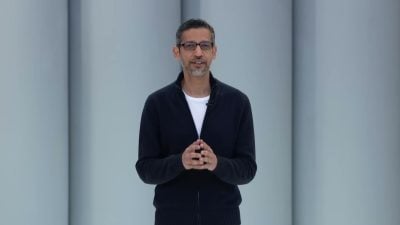
For two decades, Alphabet (NASDAQ:GOOGL | GOOGL Price Prediction) was an advertising company that happened to own a cloud business. On the Q1 2026 earnings call, CEO Sundar Pichai reframed the story in one sentence.
“Revenue from products built on our gen AI models grew nearly 800% year-over-year. Enterprise AI solutions have become our primary growth driver for the first time.”
That declaration marks a fundamental shift in the engine of Alphabet’s growth. Google Cloud revenue grew 63% to over $20 billion, with operating income tripling to $6.6 billion and segment margin expanding to 33% from 18% a year ago. Cloud growth has now accelerated four quarters in a row, from 32% to 34% to 48% to 63%.

The Backlog Tells the Real Story

The number that startled analysts was the backlog. Pichai said “Google Cloud revenues grew 63% with backlog nearly doubling quarter on quarter to over $460 billion.” For context, that backlog was $155 billion just two quarters earlier. Management said just over 50% of it is expected to convert to revenue over the next 24 months.
That is contracted demand. And it is being driven by enterprise commitments large enough that Pichai disclosed multiple billion-dollar-plus deals signed in the quarter and $100M-$1B deal momentum doubling year-over-year. Gemini Enterprise paid monthly active users grew 40% quarter-over-quarter, and existing customers outpaced their initial commitments by 45%.
Ads Keep Growing, Just No Longer the Headline
The pivot is not at advertising’s expense, at least not yet. Search and other revenue rose 19% to $60.4 billion with queries at an all-time high, and YouTube advertising came in at $9.9 billion, up 11%. Pichai framed AI Overviews and AI Mode as drivers of Search growth. The 800% figure deserves the caveat he did not give: it is growth off a small base. But the trajectory and the backlog are substantial.
The Infrastructure Bet Behind the Quote
Pichai also admitted the constraint that makes the backlog so striking: “We are compute constrained in the near term. As an example, our Cloud revenue would have been higher if we were able to meet the demand.”
That is why capital expenditures more than doubled to $35.7 billion in the quarter and full-year 2026 CapEx guidance was raised to $180 to $190 billion, with CFO Anat Ashkenazi telling investors 2027 spend will significantly increase compared to 2026. The cost shows up in free cash flow, which fell 47% year-over-year to $10.1 billion.
The market is buying the pivot. GOOGL is up 17% year to date and 121% over the past year. The question for the rest of 2026 is whether enterprise AI revenue scales faster than depreciation from the buildout. Pichai just told investors which line of the income statement to watch.
Contact [email protected] for any questions or corrections.
Joel South covers large-cap stocks, dividend investing, and major market trends, with a focus on earnings analysis, valuation, and turning complex data into actionable insights for investors.
He brings more than 15 years of experience as an investor and financial journalist, including 12 years at The Motley Fool, where he served as an investment analyst, Bureau Chief, and later led the Fool.com investing news desk. He has also co-hosted an investing podcast and appeared across TV and radio discussing market trends.