Jensen Huang Says the $3.5 Billion MediaTek Deal Is Not Circular. The Decade Long Roadmap Is the Real Tell.
Jensen Huang calls NVIDIA's $3.5 billion MediaTek investment anything but circular, but the ten-year horizon buried in his explanation points to a competitive pressure he is not saying out loud.


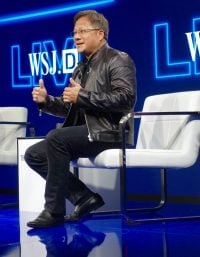
Jensen Huang appeared on Bloomberg alongside MediaTek CEO Rick Sy on September 1 to defend NVIDIA’s $3.5 billion investment in MediaTek through convertible bonds, the largest direct investment the company has ever made outside the United States. Shares of Taiwan-listed MediaTek jumped roughly 10% on the news. Huang used the appearance to push back on the growing view that NVIDIA (NASDAQ:NVDA | NVDA Price Prediction) is propping up its own customers with capital that eventually cycles back as GPU orders.
“This is not circular because obviously they do their own business and we do our own business. And the MediaTeks are incredibly profitable, incredibly successful,” he said. The more revealing line came a moment later. “It’s a decade long,” Huang added, describing the partnership. The tenor of that commitment says more about NVIDIA’s plan than the denial does, because a ten-year horizon and a convertible structure are the fingerprints of a position trade rather than a revenue transaction.
Convertible Bonds Signal a Position Play
Convertibles let NVIDIA take economic exposure to MediaTek without consolidating the partner or paying a full equity price. For a company sitting on $22.443 billion in cash after returning roughly $26 billion to shareholders in Q2 alone, $3.5 billion is easily absorbed and functions as a placeholder for a much larger co-development agenda.
MediaTek already builds the custom Arm CPU in the GB10 Grace Blackwell desktop AI chip, which sits inside NVIDIA’s automotive DRIVE stack. A ten-year commitment implies co-development of future Vera CPU derivatives, edge AI SoCs, and consumer silicon, where NVIDIA’s merchant GPU model has a narrower reach.
Rick Sy framed the money the same way. “The proceeds will basically go in to make those things happen better and further. The key here is really the collaboration agreements that we have built and expanded with NVIDIA,” he said.
The multiyear memory deal with SK hynix (NASDAQ:SKHY) and the 20-year leases at the PORTS-Pike Ohio campus hosting OpenAI compute point in the same direction. NVIDIA is stitching together partners who own capabilities it cannot vertically absorb, and MediaTek is the SoC piece of that map. That same buildout has to be powered, cooled, and networked by somebody, which is the argument behind a free report on seven suppliers riding the AI infrastructure wave without being chipmakers themselves.
Circularity Question, Answered Fairly
Circular financing is a real concern when a supplier funds a customer’s ability to buy the supplier’s product. NVIDIA has committed nearly $50 billion to frontier AI labs and helped mobilize over $500 billion of third-party capital through Apollo, BlackRock, Blackstone, Brookfield, Goldman Sachs, and KKR. Some of that capital ends up being used to buy NVIDIA silicon.
Colette Kress addressed the criticism directly on the Q2 call. “We’re not making loans,” she said, describing take-or-pay commitments as underwriting floors that let neoclouds finance construction.
The MediaTek case is different in kind. MediaTek is a profitable operating company whose SoC demand exists independent of NVIDIA’s capital. The real test of circularity is whether the customer would still buy without the money, and that test passes here.
Grant Huang makes the point because the more useful question is why he is buying position now, and the answer is competitive.
Custom Silicon Is the Real Pressure
Broadcom (NASDAQ:AVGO) reported $10.80 billion in AI semiconductor revenue last quarter, up 143% year-over-year, and Hock Tan is guiding to $16.0 billion next quarter with a target of in excess of $100 billion in fiscal 2027. That business is custom accelerators for Google, Meta, OpenAI, and Anthropic.
AMD (NASDAQ:AMD) posted $6.72 billion in data center revenue, up 107%, and Lisa Su has secured commitments, including up to 2 gigawatts of MI450 GPUs, from Anthropic.
Huang leaned on the general-purpose argument. “NVIDIA’s GPU is a general purpose accelerator. We accelerate the entire lifecycle of AI from data processing to pre-training to post training to AI inferencing,” he said.
That claim holds for training and mixed workloads. It gets weaker as inference standardizes, because that is precisely where custom silicon competes best on cost per token, and that is where a MediaTek partnership hedges the exposure by extending NVIDIA into edge, automotive, PC, and low-power inference markets it cannot easily win with a rack-scale merchant GPU.
Contact [email protected] for any questions or corrections.
Omor Ibne Ehsan is a writer at 24/7 Wall St. He is a self-taught investor with a focus on growth, cyclical, and dividend equities that have strong fundamentals, value, and long-term potential. He also has an interest in high-risk, high-reward investments such as penny stocks.