3 of Wall Street’s Safest High-Yield Dividend Stocks With Over 25-Year Increase Streaks
Not all Dividend Aristocrats are created equal, and three companies spanning payroll processing, supplemental insurance, and integrated energy have quietly stacked 25-plus years of annual raises through completely different cash engines.


Dividend Aristocrats get lumped together as if they are one defensive blob of consumer staples names, but the label actually spans wildly different business models. The three companies below sit in payroll processing, supplemental insurance and integrated energy, and each has stacked annual dividend increases well past the 25-year bar the headline demands.
The CEO of Aflac (NYSE:AFL | AFL Price Prediction) explicitly cited “43 consecutive years of dividend increases” on the company’s Q2 2026 call, and the payment histories for the other two on this list reach back to 1999 with step-ups nearly every year since.
That is the point: Aristocrat status is a discipline that cuts across sectors.
Automatic Data Processing: Payroll’s Compounding Machine
Automatic Data Processing (NASDAQ:ADP) currently yields 2.42% at a share price of $281.16. The forward annualized dividend sits at $6.80 after the quarterly rate stepped up from $1.54 to $1.70 earlier this year. The dividend history file shows a clean progression of annual increases in the regular quarterly rate from $0.07625 in 1999 to $1.70 in 2026, which comfortably clears the 25-year threshold.
Coverage is the reason income investors keep buying it. FY2026 diluted EPS came in at $11.04 against a $6.64 trailing dividend, and operating cash flow was $5.44 billion against just $196.6 million of capex. The balance sheet is investment-grade quiet, return on equity runs at 72.2%, and management funds buybacks on top of the dividend. CFO Peter Hadley described capital return this way: “this deliberate return of capital to shareholders comes in addition to our longstanding commitment to growing our dividend and to the levels of investment that we are making in our business.”
The bull case: Boring in the best way. ADP is guiding FY2027 to 5% to 6% revenue growth and 9% to 11% adjusted EPS growth, with client retention already at 92.1% and Retirement Services crossing $1 billion in annual revenue for the first time. That is the profile of a compounder that funds larger dividends year after year.
The risk: valuation. At 26 times trailing earnings and 23 times forward, ADP is priced as a premium compounder, and any slip in bookings growth or margin cadence would compress the multiple faster than the dividend can grow.
Aflac: Supplemental Insurance With a 43-Year Increase Streak
Aflac trades at $117.24 and yields 2.08% on a quarterly dividend of 61 cents, with an annualized forward rate of $2.44. The recent step-up from 58 cents to 61 cents per quarter is the increase that extends the record in 2026. CEO Dan Amos was direct on the Q2 call: “We treasure our 43 consecutive years of dividend increases and remain committed to extending this record in 2026.”
Dividend safety here starts with capital. TTM diluted EPS is $9.27 against a $2.38 dividend per share, so payout coverage is roughly a quarter of earnings. Aflac Japan reported a pre-tax margin of 34.3% in the quarter, holding-company unencumbered liquidity was $3.3 billion, adjusted leverage stayed 21.8% within the 20 to 25% target, and regulatory capital was an estimated ESR of 226% in Japan and combined RBC slightly above 600%. That is a capital fortress by any insurance standard.
The bull case: Aflac converts capital strength into steady buybacks and dividend hikes. CFO Max Broden confirmed “we’ve repurchased $983 million of our own stock and paid dividends of $309 million in Q2.” Combined shareholder returns reached $1.3 billion in the second quarter and $2.6 billion for the first six months. Adjusted ROE ex-currency was 16.6%, and dental and vision inside the US group business grew 47% in the second quarter.
The risk: The yen. Aflac’s largest earnings engine reports in yen, so a stronger dollar directly compresses reported revenue and EPS, and US group disability claims have been running hotter than plan, pressuring the segment’s margin.
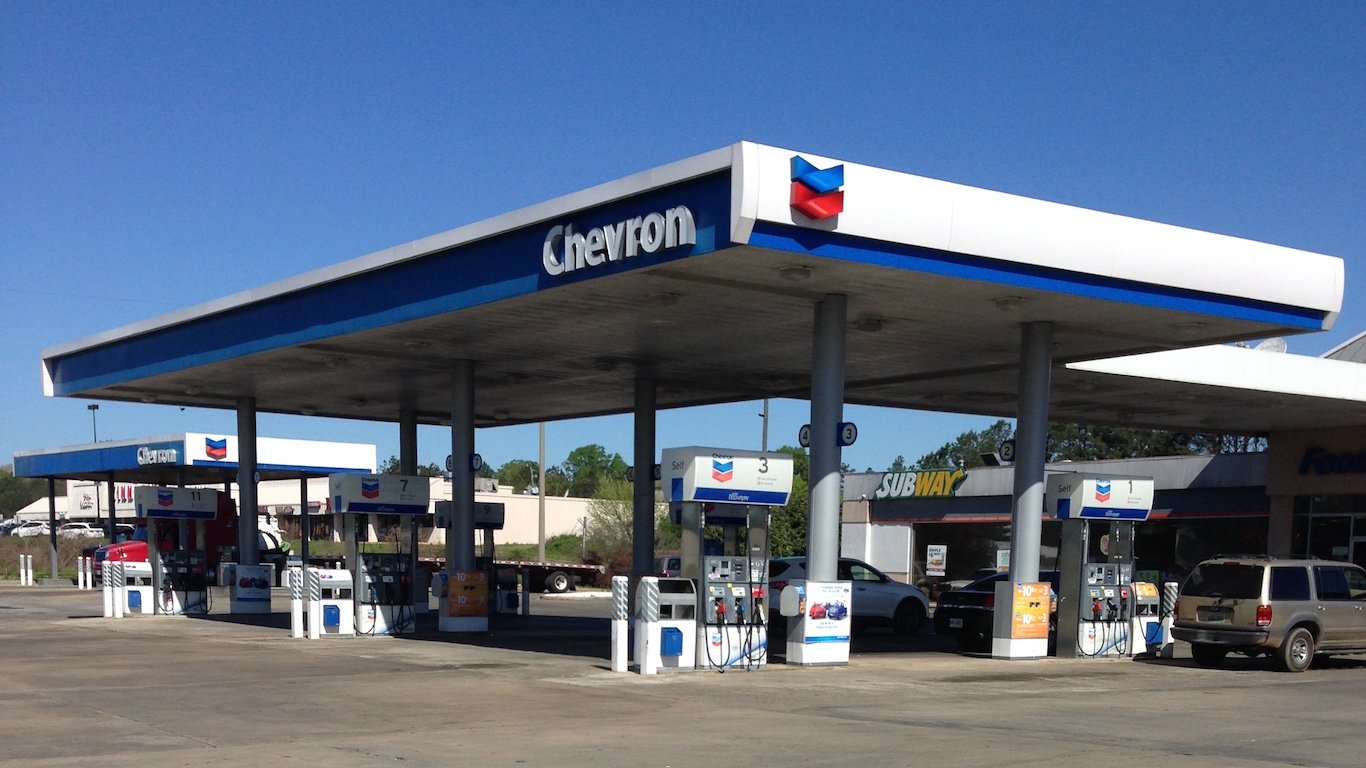
Chevron: Integrated Energy With the Highest Yield in the Bundle
Chevron (NYSE:CVX) is the higher-yielding piece of this trio at 3.36%, with a quarterly dividend of $1.78 (annualized forward $7.12) and shares at $211.78. The payment history shows a clear climb in the quarterly rate from 65 cents in 2000 to $1.78 in 2026, with successive annual step-ups more than sufficient to clear the 25-year bar.
Coverage in the current cycle looks excellent. Q2 2026 delivered adjusted earnings of $12 billion, or $6.06 per share, with adjusted free cash flow of $15.4 billion and cash flow from operations excluding working capital of nearly $20 billion. Chevron reduced debt by more than $8 billion in the quarter, taking net debt to CFFO to 0.6x. Interest coverage on the trailing basis is 13.7x, and structural cost cuts hit $3 billion of annual run-rate savings, achieved six months early.
The bull case: Chevron has bolted contracted cash flow onto its commodity base. Project Kilby is a 20-year take-or-pay power purchase agreement with Microsoft for 2.67 gigawatts of firm behind-the-meter capacity, and management describes it as delivering “mid-teens returns and long duration contracted cash flows that are independent of commodity price cycles.” Wirth added: “Consistent with our longstanding financial priorities, we intend to reward our shareholders today tomorrow and long into the future.” Chevron has now returned more than $5 billion to shareholders for 16 consecutive quarters.
The risk: Commodity cycles. This is where CVX diverges sharply from ADP and AFL. Chevron’s cash flow rides Brent, and the EIA’s May 2026 Short-Term Energy Outlook shows OPEC surplus capacity and non-OPEC supply growth that can cap prices even as demand climbs. Management set 2030 targets “at flat commodity prices that are lower than today,” which acknowledges that softer oil prices would slow buybacks before slowing the dividend.
3 Streaks, 3 Different Cash Engines
The Dividend Aristocrat badge means the same thing at all three companies: management has raised the dividend every year for at least 25 years and treats that record as untouchable. What backs the checks is completely different. ADP compounds off recurring payroll fees and 92%+ client retention. Aflac funds the payout with a fortress-capital insurance book and yen-denominated earnings. Chevron underwrites the highest yield in the bundle with integrated oil cash flow, now supplemented by contracted cash flows independent of commodity price cycles.
Owning all three is how an income portfolio gets diversification inside the Aristocrat label rather than three flavors of the same defensive name (for readers who want to push the streak even further, we ranked ten companies with 50-plus years of consecutive raises by valuation in a free Dividend Kings report).
Contact [email protected] for any questions or corrections.
Joel South covers large-cap stocks, dividend investing, and major market trends, with a focus on earnings analysis, valuation, and turning complex data into actionable insights for investors.
He brings more than 15 years of experience as an investor and financial journalist, including 12 years at The Motley Fool, where he served as an investment analyst, Bureau Chief, and later led the Fool.com investing news desk. He has also co-hosted an investing podcast and appeared across TV and radio discussing market trends.