The Fed’s Out of Patience — Officials Sound Ready to Halt the Markets Gains With Rate Hikes
Three Federal Reserve officials already voted to raise rates in July, and the hawkish camp has grown louder since then. What that means for your portfolio depends on a shift in Fed thinking that most investors have not yet priced…

The Federal Reserve is no longer debating whether inflation deserves attention. It is debating how much more restrictive policy needs to become. That matters for investors because the stock market has benefited from expectations that interest rates would eventually move lower, while a renewed tightening cycle would push in the opposite direction.
At the July 28–29 meeting, policymakers held the federal funds target at 3.50% to 3.75%, but three members wanted a hike. Since then, the hawkish camp has widened. The September 15–16 meeting now carries a different risk: instead of discussing when rates might fall, investors must consider whether they could rise again.
Three Fed Officials Already Wanted Higher Rates
At the July meeting, Cleveland Fed President Beth Hammack, Minneapolis Fed President Neel Kashkari, and Dallas Fed President Lorie Logan dissented, preferring a 25-basis-point increase. The official FOMC minutes show that they were not alone in worrying about inflation: several other participants also favored a quarter-point hike.
More importantly, the minutes revealed broader concern about what happens next. Many participants said policy tightening would probably be necessary if inflation failed to decline, while some argued financial conditions were not restrictive enough to return inflation to the Fed’s 2% target.
In simple terms, July’s 9–3 vote may have kept rates steady, but it vastly understated the hawkish pressure inside the room.
Barr And Warsh Raise The Stakes
The more important development is that additional officials are now sounding comfortable with higher rates.
Fed Governor Michael Barr said on Sept. 1 that inflation had remained too high for more than five years. He left the door open to waiting if incoming data provided confidence that inflation was moving toward 2%, but said the Fed should act decisively to raise rates if inflation was not moderating sufficiently.
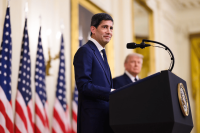
Fed Chair Kevin Warsh delivered a similar message at the Federal Reserve Bank of Kansas City’s Jackson Hole symposium on August 28. He noted that PCE inflation was running at 3.7% over 12 months and 4.1% over six months, both well above the Fed’s 2% objective. His standard was straightforward: policymakers need confidence that underlying inflation is moving toward 2% at sufficient speed. Otherwise, he said, “we have work to do.”
That language matters because Warsh is the chair. He did not promise a September hike, but he made clear that inflation — not an assumed path toward lower rates — remains the Fed’s predominant concern.
The Hawkish Camp Is Getting Wider
Boston Fed President Susan Collins has also moved closer to the hawkish side. Although she is a non-voting member this year, Collins said in late August that she could support an increase if inflation failed to show sustained improvement and that tighter policy could be warranted soon.
Governor Christopher Waller had already begun shifting in July. He said that if another hot core-inflation reading arrived, the FOMC would need to consider tightening monetary policy in the near term. At the time, core PCE inflation had climbed from 3% in December 2025 to 3.4% in May.
The investing thesis is becoming clearer: higher-for-longer interest rates are no longer the main risk. A renewed hike is.
That does not mean the Fed will automatically raise rates on Sept. 16. The July minutes emphasized that incoming data would drive the decision, and officials remain divided over the inflation outlook.
Key Takeaway
In short, investors should not treat the July 3.50%–3.75% federal funds range as a ceiling. Three officials already wanted a hike, several others see tightening as necessary if inflation remains elevated, and Barr and Warsh have reinforced that message in recent weeks.
That creates a higher hurdle for stocks, particularly richly valued growth companies whose future cash flows are more sensitive to interest rates. But don’t sell all of your stocks because the Fed might raise rates. Instead, recognize the Fed needs to restore full confidence that it can guide inflation back to 2% before any rate cut talk is back on the table.
Contact [email protected] for any questions or corrections.
After two decades of patrolling the dark corners of suburbia as a police officer, Rich Duprey hung up his badge and gun to begin writing full time about stocks and investing. For the past 20 years, he’s been cruising the markets looking for companies to lock up as long-term holdings in a portfolio while writing extensively on the broad sectors of consumer goods, technology, and industrials. Because his experience isn’t from the typical financial analyst track, Rich is able to break down complex topics into understandable and useful action points for the average investor. His writings have appeared on The Motley Fool, InvestorPlace, Yahoo! Finance, Money Morning, and, of course, 24/7 Wall St. He has been featured in both U.S. and international publications, including MarketWatch, Financial Times, Forbes, Fast Company, and USA Today.