Vertiv Stock Keeps Cooling Off. One Analyst Says a 100% Rally Is Coming
Vertiv has quietly shed nearly a third of its value from its peak even as earnings beats pile up and estimates keep climbing higher. One analyst has a target so far above current prices it sounds almost absurd, but the…

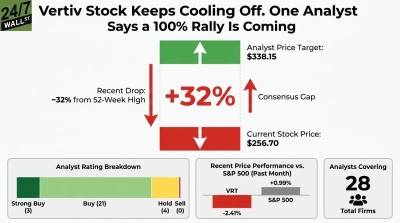
Vertiv (NYSE:VRT | VRT Price Prediction) closed the most recent session at $256.70, while the average Wall Street price target sits at $338.15. That leaves a consensus gap of roughly 32% between where the stock trades and where analysts think it belongs.
Vertiv sells the power and thermal plumbing that keeps AI data centers alive: UPS systems, switchgear, chillers, coolant distribution units, and liquid-cooling loops that sit between hyperscalers and the GPUs they are racing to deploy (we profiled seven of these infrastructure suppliers, from power to cooling, in a free report here: 7 Stocks Powering the AI Boom). That positioning turned VRT into one of the market’s cleanest AI infrastructure names and made it a favorite of momentum funds after it joined the S&P 500 in March 2026.
The gap matters because the stock has quietly come undone from its highs even as the operating story keeps getting better. That disconnect has Wall Street increasingly vocal, with one shop calling for a rally of roughly 100% from here.
A 32% Drawdown Off the Highs Nobody Is Talking About
Vertiv has shed about 32% from its 52-week high of $379.86, a drawdown large enough to qualify as a bear market in a single name. Shares are down 2.41% over the past month and 2.7% over the past week, extending a slow bleed that began after the April peak near $319.
The catalyst had nothing to do with earnings quality. Vertiv’s Q2 2026 report was the fifth straight beat, with $1.52 in adjusted EPS, $3.27 billion in revenue up 24.12% year over year, and adjusted operating margin of 22.6%, up 410 basis points. Management raised full-year EPS guidance to $6.65 to $6.75. Yet shares opened the next session near $232 after filing at $270.
The market seized on management’s comments about “minor timing shifts” in Q2 revenue tied to multi-phase project execution and supply-chain congestion. Investors read that as a crack in the AI capex story. Layer in tariff overhangs, an EMEA segment that grew only 1.7%, and profit-taking after a scorching run, and the selloff snowballed.
Why Loop Capital Sees a 100% Rally From Here
Analysts remain firmly constructive. Of 28 firms covering VRT, 3 rate it Strong Buy, 21 Buy, 4 Hold, and none Sell. The consensus EPS estimate for 2026 has climbed to $6.71 from $6.48 just 30 days ago, and the 2027 number has moved to $9.10. Recent revisions are running heavily to the upside, with 21 upward revisions versus only three cuts over the past month for 2026.
The loudest bull is Loop Capital Markets, which carries the highest active published Street target of $500.00. From here, that implies close to a 100% move. Loop’s thesis models aggressive long-term revenue and margin expansion driven by Vertiv’s dominant market share in liquid cooling (CDUs, chillers) and power management infrastructure for next-generation AI data center architectures. In plain English: Loop believes VRT is the toll booth for the 800-volt DC power and closed-loop liquid cooling transition already being validated with NVIDIA GB300 and Vera Rubin platforms.
Management’s own commentary supports the bull case. CEO Gio Albertazzi told investors “the momentum is strong. It’s broad-based, and it’s accelerating,” pointing to a Q2 backlog and pipeline that continue to expand across hyperscale, colocation, and neocloud customers. A $1.45 billion deal to acquire a microgrid firm, announced this week, deepens VRT’s grid-tie capability just as AI power constraints tighten.
The bull timeline is concrete. Q3 organic growth is guided to 34% to 36%, which would give the market a clean data point on whether the H2 backlog conversion story is real. Loop’s $500 needs that ramp plus continued mix shift toward higher-content liquid-cooling deployments.
Vertiv Fell Alone While Its Power Peers Held Firmer
The AI power complex sold off unevenly. Vertiv is the outlier, having given back more than any close peer despite posting the cleanest fundamentals.
Eaton (NYSE:ETN) trades at $390.85 against a $475.57 average target, implying about 22% upside. Coverage skews bullish with 22 Buys, 4 Holds, and 1 Strong Sell. ETN is down 10.59% in the past month but still 23.73% YTD; Wall Street’s implied upside here is meaningfully smaller than VRT’s.
Generac (NYSE:GNRC) sits at $180.76 versus a $283.88 target, or roughly 57% upside, with 14 Buys and 7 Holds. GNRC has fallen 12.52% in the past week on data-center backlog concerns, giving it the widest peer-group gap outside of Loop’s outlier VRT call.
Super Micro Computer (NASDAQ:SMCI) trades near $37.00 against a $42.38 target, implying just 14.5% upside. The rating deck reflects lingering doubt: 5 Buys, 11 Holds, 3 Sells. SMCI’s setup is the weakest of the group on both upside and analyst posture.
Across the primary and its peers, GNRC carries the largest consensus upside, but the standout single-analyst call sits with Vertiv thanks to Loop’s $500. On a rating-quality basis, VRT’s Buy-heavy book is the cleanest in the group.
How the VRT Numbers Actually Stack Up
Vertiv trades at $256.70 with a $338.15 consensus target across 28 analysts, implying about 32% upside to the group average and closer to 95% to Loop’s Street-high $500. Targets are one data point among many.
Performance tells the dislocation story. VRT is up 58.52% YTD and 107.22% over one year. The S&P 500, by comparison, is up 12.21% YTD and 19.51% over the same twelve months. VRT has vastly outrun the index over a year yet has stalled recently, down 2.41% in the past month while the S&P added 0.99%.
Valuation runs rich. Shares trade at a 42x forward earnings multiple on $6.71 in 2026 EPS. That is the price of a name growing organic sales in the 30s with expanding margins and a net cash balance sheet.
Where I Actually Come Down on Vertiv Here
Vertiv looks compelling at these levels if the bull case holds. Q3 delivers the guided 34%-plus organic growth, the H2 timing shifts resolve as management promised, and liquid-cooling attach rates keep climbing as GB300 and Vera Rubin platforms roll out. That path gets consensus to $338 comfortably and gives Loop’s $500 a real runway toward 2027 as EPS scales toward $9.10. But the risk/reward inverts if the bear case bites. Multi-phase project complexity turns into recurring push-outs, tariffs squeeze the price-cost equation, hyperscale capex digestion arrives sooner than expected, and a 42x forward multiple compresses fast on any growth wobble.
My lean is constructive. Estimates are moving up, not down, and the operating results support the bullish revisions. Loop’s 100% rally call is aggressive and depends on 2027 execution, but the base-case 32% gap to consensus looks like the market punishing complexity commentary while the underlying thesis remains intact. Investors who can stomach a high-beta name with a rich multiple are being offered a better entry than they’ve had in months.
Contact [email protected] for any questions or corrections.
Alex Sirois is a financial writer with experience spanning both retail and institutional investing. He has written for InvestorPlace and held roles at BNY Mellon and Bernstein, giving him a perspective that bridges Main Street portfolios and Wall Street analysis.
Alex holds an MBA from George Washington University and has built his career across multiple industries, including e-commerce, education, and translation — a breadth of experience that informs how he breaks down complex financial topics for everyday investors. His writing is conversational, actionable, and grounded in long-term, buy-and-hold investing principles.
At 247 Wall St., Alex focuses on delivering analysis that is both accessible and useful, with a clear emphasis on helping readers make more informed decisions with their money.