Vertiv Has Cooled For 3 Months: A Wall Street Strategist Says It Will Rebound 45% Very Soon
Vertiv shed nearly 10% in a single session and has been sliding for three months, yet one Wall Street firm just set a street-high target that implies the selloff created an opening most investors are missing.


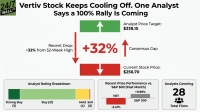
Vertiv (NYSE:VRT | VRT Price Prediction) trades at $262.83, while the average Wall Street price target sits at $338.15, leaving roughly 29% of implied upside between the current price and the consensus.
Vertiv designs the power, cooling, and IT management gear that keeps hyperscale data centers running, which puts it squarely in the AI infrastructure trade that has driven capex to record levels. That exposure is why analysts have obsessed over every order number, and why the recent cooling in the shares is drawing so much attention.
One boutique voice has gone further than the crowd. GLJ Research recently set a street-high target of $381.00, roughly a 45% jump from where the stock sits today.
A Sharp Session Turned a Slow Fade Into a Selloff
The most immediate damage came in a single day. Shares fell 9.63% in the most recent trading session, sliding from $290.83 to $262.83. That drop capped a longer slide from the roughly $319 level where shares traded around the Q1 earnings report in April.
The fundamentals do not obviously justify the fade. Vertiv posted Q2 revenue of $3.274 billion, up 24% year over year, with adjusted operating margin of 22.6% and adjusted EPS of $1.52. What did rattle investors was management’s acknowledgment of timing shifts on large, multi-phase projects and temporary supply-chain congestion. Layer on a fresh batch of investor-alert releases from Pomerantz and Hagens Berman, and a stock priced near peak had reasons to breathe out.
Why the Sell-Side Is Doubling Down on Vertiv
Analysts have largely shrugged off the cooldown because the operating story keeps improving. Vertiv raised its full-year outlook again after Q2, guiding to $14 billion in net sales at the midpoint, adjusted EPS of $6.70, and adjusted free cash flow of $2.5 billion. Q3 guidance calls for organic sales growth of roughly 35% and adjusted EPS of $1.80 at the midpoint.
Coverage skews decisively bullish. Of the analysts tracking the name, 3 rate it Strong Buy, 21 rate it Buy, 4 rate it Hold, and none carry a Sell. EPS revisions have also skewed sharply higher: 16 upward FY2027 revisions in the trailing week versus 4 downward over 30 days.
The GLJ Research upgrade takes the same view to its logical extreme. The firm moved Vertiv from Hold to Buy in August 2026 and set the street-high $381 target, arguing that hyperscaler buildouts of next-generation AI clusters make Vertiv’s high-density power and liquid cooling franchises a structural winner. Broader consensus targets cluster around the $338 to $358 range.
The catalyst path is specific. Watch Q3 organic growth landing in the mid-30s, the $15.0 billion backlog converting on schedule, and EMEA returning to organic growth in the second half as management has guided. Vertiv’s 800-volt DC collaborations with NVIDIA and Foxconn’s Vision Bay unit anchor the longer thesis. All of that buildout has to be powered and cooled by somebody, and we profiled seven suppliers doing exactly that, beyond the chipmakers, in a free report.
Peers Cooled Alongside Vertiv
The whole electrical-infrastructure complex pulled back over the past month, putting Vertiv in familiar company. Still, the setups differ across the group.
Eaton (NYSE:ETN) trades at $415.22 after slipping 6.68% over the past month. Its $478.17 average target implies about 15% upside. Coverage is heavily positive, though one Strong Sell rating anchors the tail.
nVent Electric (NYSE:NVT) sits at $158.54, essentially flat over the past month. The $204.07 target implies roughly 29% upside, and the sell side is nearly unanimous on the buy side after five straight beats.
Generac (NYSE:GNRC) has cooled the hardest, down 9.52% in a month to $186.48. The $283.88 target implies about 52% upside, the largest gap in the peer set.
Hubbell (NYSE:HUBB) fetches $454.97, down 9.89% over the month. Its $565.73 target implies roughly 24% upside, with ratings split between Buy and Hold.
Consensus targets are one input among many. Still, Generac holds the biggest gap in the group, while Vertiv’s ~29% consensus gap (or 45% to GLJ’s street high) sits in the upper tier of a cohort that has broadly cooled together.
Vertiv’s Cooldown by the Numbers
Vertiv trades at $262.83 against a $338.15 consensus target drawn from 28 analysts, with a street-high of $381 from GLJ Research. Year to date, shares are up 62.3% versus 11.81% for the S&P 500 proxy, and are higher by 109.52% over one year.
Analyst posture is lopsided to the bull side:
- Strong Buy: 3
- Buy: 21
- Hold: 4
- Sell: 0
Shares carry a trailing P/E of 66 and forward P/E of 31, with beta of 2.08. That volatility explains both the ferocious rally and today’s single-session drawdown.
My Take on Vertiv After the Reset
The bull case for Vertiv here rests on hyperscaler AI capex holding through 2027 and management converting its $15.0 billion backlog on schedule. The path to GLJ’s $381 target runs through Q3 execution, EMEA returning to organic growth, and Vertiv monetizing its 800-volt DC and liquid-cooling content as content per megawatt expands. Consensus EPS of $9.10 for 2027 gives the multiple room to breathe.
The bear case builds if the timing shifts on large projects are early evidence of a lumpier order pattern, or if the class-action investigations foreshadow disclosure risk. A beta above 2 and a rich forward multiple leave no margin for a stumble.
On balance, I lean constructive. The operating trajectory keeps beating, the raise-and-guide cadence is intact, and the reset has repriced a stock that got ahead of itself without changing the underlying story. The consensus 29% gap is the more defensible target. GLJ’s 45% call is the upside case if execution stays clean.
Contact [email protected] for any questions or corrections.
Alex Sirois is a financial writer with experience spanning both retail and institutional investing. He has written for InvestorPlace and held roles at BNY Mellon and Bernstein, giving him a perspective that bridges Main Street portfolios and Wall Street analysis.
Alex holds an MBA from George Washington University and has built his career across multiple industries, including e-commerce, education, and translation — a breadth of experience that informs how he breaks down complex financial topics for everyday investors. His writing is conversational, actionable, and grounded in long-term, buy-and-hold investing principles.
At 247 Wall St., Alex focuses on delivering analysis that is both accessible and useful, with a clear emphasis on helping readers make more informed decisions with their money.