Johnson & Johnson Is Boring Which Makes Its Dividend Nearly Perfect.
Sixty-four straight years of dividend growth sounds like a headline, but the real story is what keeps that streak alive even as one of JNJ's biggest drugs faces a brutal competitive hit.

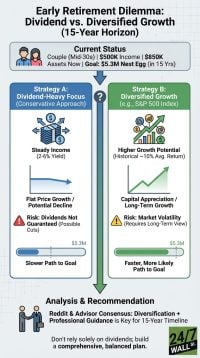
Johnson & Johnson (NYSE:JNJ | JNJ Price Prediction) just paid investors $1.34 per share on June 9, 2026, and another identical check is already queued for September 8, 2026. The story here is what stands behind the payment: 64 consecutive years of dividend growth, an ocean of free cash flow, and an earnings base that keeps expanding despite a brutal biosimilar hit to STELARA. Boring, yes. But this is what an A-grade dividend actually looks like.
Headline Numbers Behind the Latest Check
The June payment reflected a 3.1% raise from $1.30 to $1.34 quarterly, extending JNJ’s Dividend King status. On an annualized forward basis of $5.36 against a recent price of $275.21, shares yield roughly 1.95%. A modest yield is exactly the point. Investors have already collected the reward in price appreciation: JNJ is up 33.15% year to date and 56.51% over the past year, which naturally compresses the yield.

Coverage That Earns the A Grade
The payout math is where this grade holds up. Trailing 12-month dividends of $5.28 against the 2026 consensus EPS of $11.0525 imply a payout ratio near 48%, well inside investment-grade territory. Cash flow paints an even friendlier picture. In 2025, JNJ generated $24.53 billion in operating cash flow against a $12.38 billion dividend payout. CFO Joe Wolk told analysts the company is “on track for our full-year free cash flow outlook approaching $21 billion” for 2026.
Balance Sheet: Room to Keep Raising
JNJ ended Q2 2026 with $20.42 billion in cash and $49.04 billion in total debt, alongside $171.67 billion in retained earnings. Wolk framed capital priorities plainly: “We also remain committed to returning capital directly to shareholders, primarily through our dividend.”
Growth Engine Feeding the Streak
Q2 2026 sales came in at $25.3 billion, with Innovative Medicine growing 6.8% operationally despite a 460 basis point STELARA headwind. DARZALEX rose 17.6%, TREMFYA delivered its first $2 billion quarter with over 70% growth, and CARVYKTI added 47.7%. Management raised 2026 adjusted operational EPS guidance to $11.50 to $11.65 and reiterated a path to “double-digit growth by the end of the decade.”

Scorecard Verdict: A-Grade Dividend
Six-plus decades of raises, a payout ratio under 50%, operating cash flow that dwarfs the dividend by roughly 2x, and 28 platforms each generating more than $1 billion in annual revenue. The forward analyst estimate of $12.3075 in 2027 EPS gives the next raise plenty of cushion. For income investors who prefer sleep over spectacle, this is the textbook A (we ranked ten members of the 50-year raise club by valuation in a free Dividend Kings report if you want to see where JNJ stacks up against its peers).
Contact [email protected] for any questions or corrections.
Chris Lange is a financial and geopolitical writer with more than a decade of experience covering a myriad of topics. He has published thousands of articles for 24/7 Wall St., with past coverage focused heavily on stocks, IPOs, healthcare, defense, global affairs, and technology.
His work has been quoted, or referenced by a number of outlets including Business Insider, USA Today, Yahoo Finance, MSN, The Motley Fool, and many other publications. A graduate of Southwestern University, he studied business with a focus on investments and has previous experience in banking and startups.
When not reading or writing the news, he is following his passion for Lacrosse, playing chess, or building solar projects with his dad.