Arm Expands Into AI Accelerators With Samsung — But It’s Not the Data Center Goldmine Investors Hope For
Arm's new Samsung chip deal looks like a data center breakthrough, but the business investors are actually paying 298 times earnings for operates on completely different terrain from where this partnership lands.

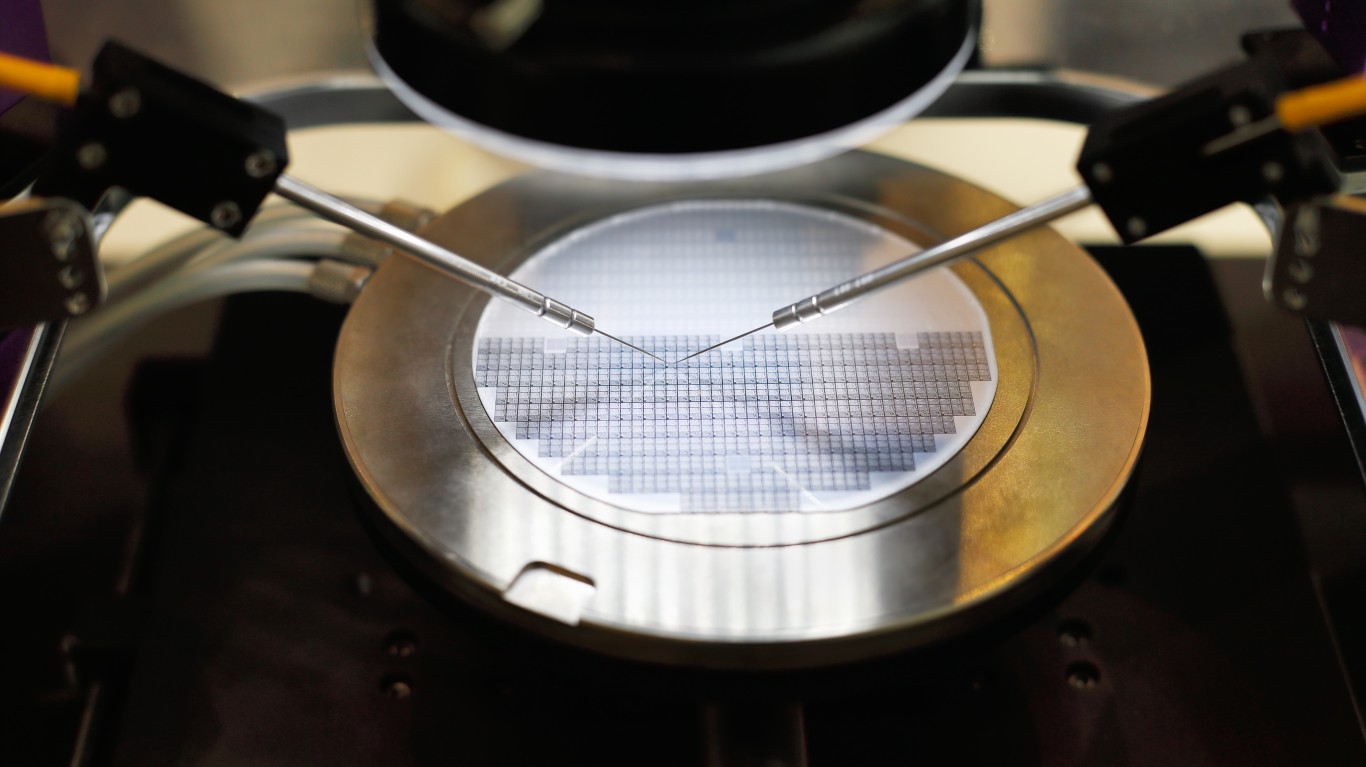
Arm Holdings (NASDAQ:ARM | ARM Price Prediction) is pushing deeper into AI silicon through a new collaboration with Samsung on a 2nm on-device AI accelerator SoC, with Arm supplying the AI accelerator architecture and core design IP while Samsung’s System LSI division handles full SoC integration and its foundry manufactures the chip on the SF2 2nm process. Investors reading the headline as a data center breakout are misreading the deal. The Samsung tie-up targets power-efficient, low-latency inference on phones and consumer devices to reduce cloud dependence, a high-volume but lower-margin segment. Arm’s actual data center bet is the AGI CPU, where CEO Rene Haas said demand now exceeds $2 billion across fiscal 2027 and fiscal 2028. That is the number to benchmark against the incumbents.

Arm: On-Device Wins Are Real, Data Center Ambitions Are Bigger
The Samsung SoC extends Arm’s reach in mobile inference, but the strategic pivot investors are paying for lives in the data center. Arm’s fiscal Q1 2027 delivered revenue of $1.29 billion, up 22.4% year over year, with royalty revenue of $715 million outpacing licensing. On the earnings call, Haas said data center royalty revenue more than doubled year over year once again and that Arm Neoverse shipments have surpassed 1.5 billion cores. Management now targets a $15 billion silicon business against a data center TAM cited at more than $100 billion by 2030.
The bull case: Arm sits inside NVIDIA’s Vera CPU, Google’s Axion, Microsoft’s Cobalt, and Amazon’s Graviton 5, giving it approximately 50% CPU compute share among top hyperscalers. The risk is margin. Arm’s own AGI CPU gross margin is guided to the high 30% range, maybe low 40s for the first generation, a step down from its 92.5% IP-licensing gross margin. The stock is priced for perfection at a P/E of roughly 298, after a 130.62% year-to-date run to $252.09. And the Qualcomm license litigation trial expected Q4 2026 hangs over the royalty base.
NVIDIA: The Incumbent Arm Has to Coexist With, Not Displace
NVIDIA (NASDAQ:NVDA) remains the incumbent Arm must coexist with. Its fiscal Q2 2027 revenue reached $96.22B, up 105.8% year over year, with Data Center revenue of $89.02B. Jensen Huang said demand is growing 100% year over year while NVIDIA expects to fulfill approximately 70% of that demand because of supply constraints. Revenue opportunity per gigawatt is stepping up from roughly $18 billion on Hopper to $40 billion on Vera Rubin.
Critically for the Arm thesis, NVIDIA’s Vera CPU is itself Arm-based. Grace CPU revenue already exceeded $5 billion on a trailing twelve-month basis, and NVIDIA sees demand for approximately 20 billion in total server CPUs. The bull case for NVDA is a platform moat that keeps expanding into CPUs, networking, and financing. The risk is customer concentration and geopolitics: NVIDIA assumes no China Data Center compute revenue in its Q3 guidance, and supply obligations have surged to $279B. Shares trade at a P/E of roughly 46 after gaining 23.67% year to date.
Taiwan Semiconductor: The Toll Booth Every Architecture Pays
Taiwan Semiconductor Manufacturing (NYSE:TSM) fabricates the leading-edge silicon for NVIDIA’s Rubin, Arm’s AGI CPU partners, and Qualcomm’s hyperscaler custom chips. Q2 2026 revenue reached $40.2 billion, up 36.0% year over year, with advanced nodes at 77% of wafer revenue and 2nm debuting at 3% of wafer revenue in its first ramp quarter. Full-year 2026 revenue is expected to grow slightly above 40% in US dollar terms.
Management said high-performance computing represented 66% of revenue and cited a resurgence in the role of CPUs in AI data centers, singling out agentic workloads. Notably, Samsung’s SF2 node is competing for the same generation of AI silicon. That partial disintermediation of TSMC is the strategic subplot behind the Arm-Samsung deal. The bull case is unavoidable throughput: whoever wins the accelerator war, most of the wafers ship from TSMC. The risk is 2nm ramp cost, guided to dilute Q3 gross margin by about 3 to 4 percentage points, plus Taiwan Strait geopolitical exposure. Shares are up 41.85% year to date to $428.91.
Qualcomm: The Peer Entering Data Center Through the Same Door
Qualcomm (NASDAQ:QCOM) is Arm’s closest strategic analog and its most direct new-entrant competitor in AI data center compute. Fiscal Q3 2026 revenue was $9.95B, down 4.0% year over year, with non-GAAP EPS of $2.21. CEO Cristiano Amon confirmed that two near-term custom-silicon wins will begin generating revenue in the December quarter, both with global scale hyperscalers. Management is guiding to $5 billion in fiscal 27 data-center revenue and $15 billion in fiscal 29, with the Arm-based Dragonfly C1000 as its merchant CPU entry.
The bull case: automotive already grew 61% year over year for 23 consecutive quarters of double-digit growth, and hyperscaler custom silicon opens a second engine. The risks are cost and legal exposure. The data-center ramp is guided as a drag of 1.5% to 2% on weighted-average QCT gross margin. The Arm license dispute, with a trial expected Q4 2026, could reshape the economics of Qualcomm’s Arm-based server chips. Shares are essentially flat year to date at up 0.21%, trading at a P/E of roughly 33.
What It All Means
The Samsung SoC deal expands Arm’s mobile inference footprint and gives Samsung Foundry a real 2nm reference design, though it stops short of the AGI CPU opportunity. Investors underwriting Arm at 298 times earnings are paying for the data center silicon business, where the incumbent shipped $89 billion in a single quarter and the closest peer is guiding to $15 billion by fiscal 2029. Arm’s on-device wins are additive to a larger data center story. The competitive gravity of the data center still points through NVIDIA’s platform and TSMC’s fabs (we reverse-engineered what the biggest AI chip winners looked like early in a free playbook here: The Next Nvidia Playbook).
Contact [email protected] for any questions or corrections.
After two decades of patrolling the dark corners of suburbia as a police officer, Rich Duprey hung up his badge and gun to begin writing full time about stocks and investing. For the past 20 years, he’s been cruising the markets looking for companies to lock up as long-term holdings in a portfolio while writing extensively on the broad sectors of consumer goods, technology, and industrials. Because his experience isn’t from the typical financial analyst track, Rich is able to break down complex topics into understandable and useful action points for the average investor. His writings have appeared on The Motley Fool, InvestorPlace, Yahoo! Finance, Money Morning, and, of course, 24/7 Wall St. He has been featured in both U.S. and international publications, including MarketWatch, Financial Times, Forbes, Fast Company, and USA Today.