Qualcomm Lost Apple’s Modem Business. Amazon Just Offered a $60 Billion Escape Route.
Qualcomm is watching Apple walk out the door with its modem business, but a surprise Amazon partnership promises a $60 billion lifeline built on unproven silicon in a market already owned by rivals. Whether that door holds the weight is…

Apple (NASDAQ:AAPL | AAPL Price Prediction) is replacing Qualcomm (NASDAQ:QCOM) modems with in-house silicon, threatening one of Qualcomm’s most valuable franchises. On the fiscal third-quarter call, management said its share of upcoming iPhone launches would be “materially lower” than the prior 20% estimate, with Apple product revenue expected to fall roughly 50% from the September-to-December quarter.
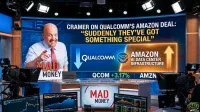
Into that gap walks Amazon (NASDAQ:AMZN). Qualcomm announced a multi-generational product collaboration with Amazon on September 8, 2026, to build next-generation AI data center infrastructure, and warrants issued to Amazon could be worth about $4 billion if commercial milestones are reached. That number is a performance-contingent ceiling, distinct from cash paid or revenue booked. Qualcomm trades near $176.40 with a market capitalization around $188.4 billion, and the question is whether this second door is load-bearing.
What Qualcomm Is Selling
Qualcomm is entering the data center with inference-oriented custom silicon, high-bandwidth compute AI accelerators, CPUs, and optical connectivity, not training accelerators competing head-on with NVIDIA. Inference runs trained models in production, a different competition from training, with different buying criteria and margins.
CEO Cristiano Amon said on the Q3 call that Qualcomm has two custom silicon engagements with “global scale hyperscalers,” both with purchase orders in hand and wafer production started. Initial Amazon-related revenue is expected in the December quarter, and Qualcomm targets $5 billion in data center revenue in fiscal 2027, scaling to $15 billion by fiscal 2029.
The broader diversification target is $40 billion in non-handset revenue by fiscal 2029, with growth accelerating from 24% in fiscal 2026 to greater than 60% in fiscal 2027. Management expects that fiscal 2027 non-handset growth will “replace the entire Apple product revenue within the year.”
Margins, Competitors, and the Warrant Overhang
The catch is mix. Amon told analysts the initial data center ramp will be “significantly lower” margin than baseline, trimming QCT weighted-average gross margin by 1.5 to 2%. Qualcomm’s consolidated gross margin sits near 55.4% today.
Competition is dense. NVIDIA dominates training, Broadcom and Marvell already ship custom ASICs and optics to hyperscalers at volume, and AMD is scaling MI-series accelerators. Qualcomm’s differentiators are power efficiency inherited from mobile, an open software stack anchored by the completed Modular acquisition, and Alphawave-derived SerDes IP for connectivity.
The warrants dilute existing holders only if Amazon hits milestones, meaning Amazon holds the optionality while Qualcomm carries execution risk. Analyst estimate revisions tell the near-term story: 27 downward EPS revisions for fiscal 2027 against three upward in the trailing 30 days.
Is QCOM Stock a Buy?
QCOM is up 13.52% over one year and trades at a forward P/E of 17x, with an analyst target of $193.90. The Amazon headline is real, but the revenue is not yet booked, and margins on that revenue will compress the mix.

Against Broadcom (NASDAQ:AVGO) and Marvell (NASDAQ:MRVL), Qualcomm is arriving late, with silicon customers still wanting to see it in production. Automotive gives real ballast, with 61% year-over-year growth and an updated $7 billion exit-run rate.

The setup looks balanced. The Apple runoff and margin compression are certain; the Amazon offset depends on milestones not yet demonstrated on silicon, and investors should watch December-quarter data center revenue, HBC Gen 1 performance data, and pricing pass-through into gross margin before paying up.
Contact [email protected] for any questions or corrections.
Omor Ibne Ehsan is a writer at 24/7 Wall St. He is a self-taught investor with a focus on growth, cyclical, and dividend equities that have strong fundamentals, value, and long-term potential. He also has an interest in high-risk, high-reward investments such as penny stocks.