Nvidia Is No Longer Just a Chip Company. It’s the Infrastructure Platform for All of AI
Jensen Huang calls it a full-stack AI factory platform, not a chip company, and that distinction is reshaping where billions in hyperscaler spending actually land across five companies fighting over the same supply-constrained foundation.


Every AI story eventually collapses back to one question: who makes the silicon? This is the layer that sits at the physical floor of the AI stack, and it is where supply sets the pace. On its August earnings call, NVIDIA told investors that fiscal 2028 revenue should grow approximately 70% and explicitly described that outlook as “supply-constrained”, with CEO Jensen Huang adding that “our entire supply chain is challenged. And everybody is really running flat out.” The chip designers below have the orders. Getting the wafers, memory, substrates, and power to fill them is the fight.
NVIDIA: From GPU Vendor to Full Stack AI Factory
NVIDIA (NASDAQ:NVDA | NVDA Price Prediction) reported Q2 FY2027 revenue of $96.221 billion, up 105.85% year over year, with Data Center revenue of $89.023 billion and non-GAAP EPS of $2.22 against a $2.0887 consensus. Guidance for Q3 FY2027 is $108.0 billion, plus or minus 2%. Shares closed at $230.36 on September 4, up 23.67% year to date and 34.37% over the past year.
What is actually being sold has changed. Management described NVIDIA as offering “a full-stack AI factory platform” spanning the Vera CPU, Rubin GPU, NVLink and InfiniBand, Ethernet networking, systems, algorithms, and CUDA software. In plain language, NVIDIA now ships the compute, the plumbing that connects it, the racks it goes into, and the software layer developers write against. Revenue opportunity per gigawatt of AI infrastructure has expanded from roughly $18 billion per gigawatt with Hopper to $25 billion per gigawatt with Blackwell to $40 billion per gigawatt with Vera Rubin. NVIDIA also disclosed partnerships with Apollo, BlackRock, Blackstone, Brookfield, Goldman Sachs, and KKR to mobilize over $500 billion in third-party capital for AI infrastructure, plus a SoftBank Energy campus in Ohio hosting NVIDIA compute for OpenAI under 20-year leases.
Bull case in plain language: NVIDIA now captures more dollars per gigawatt every generation, and CUDA keeps the developer base locked in. Management said “NVIDIA Compute is fully utilized across every cloud we serve”, and hyperscalers are sitting on cloud backlogs greater than $2 trillion. Adoption trends support the runway: US firm-level AI adoption has grown from approximately 4% in January 2024 to over 20% by late 2026, currently at 22.4% as of September 2026.
Risk: $279B in supply obligations, no assumed China Data Center compute revenue in the outlook, and concentrated exposure to a handful of hyperscale and frontier-lab customers. The stock trades at 46x trailing earnings.
Broadcom: Custom Accelerators and the Rest of the Network
Broadcom (NASDAQ:AVGO) posted Q3 FY2026 revenue of $29.59 billion, up 85.5% year over year, with AI semiconductor revenue of $16.70 billion, up 221%. Q4 AI semiconductor guidance is $21.7 billion, and management framed a fiscal 2027 AI outlook of approximately $115 billion and fiscal 2028 AI outlook of $230 billion.
Broadcom does two things at this layer. First, it co-designs custom AI accelerators, called XPUs, with a handful of hyperscale customers who want silicon tuned to their own workloads instead of a general-purpose GPU. Second, it supplies the Ethernet switch chips and optical DSPs that move data between those accelerators. XPUs represented 73% of AI revenue during the quarter, and CEO Hock Tan said custom accelerators can run frontier models at “half the cost of a GPU.” Named deployments include Google TPU v8i in high volume, one gigawatt of Ironwood for Anthropic in 2026, and Jalapeno, OpenAI’s first-generation custom accelerator.
Bull case: Broadcom is the largest structural alternative to selling everything to NVIDIA, and its Tomahawk 6 switch silicon is deployed by “pretty much all of the AI hyperscalers”, including customers not using Broadcom XPUs. Shares are up 17.78% over the past year at $357.90, though the stock is down 14.44% over the past month after its post-earnings pullback.
Risk: Broadcom’s AI business rests on six XPU customers. Any slippage in Anthropic, OpenAI, Google, or Meta buildouts flows straight through the model. The company also carries significant indebtedness.
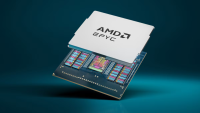
AMD: EPYC, Instinct, and the Helios Rack
Advanced Micro Devices (NASDAQ:AMD) reported Q2 2026 revenue of $11.536 billion, up 50.11% year over year, with Data Center revenue of $6.718 billion, up 107%. Non-GAAP EPS was $1.66. Q3 guidance is approximately $13 billion, plus or minus $300 million.
AMD sells two things at this layer. EPYC server CPUs, which are the general-purpose processors that manage AI systems and run the rest of the data center, and Instinct GPU accelerators, which compete directly with NVIDIA on training and inference. Helios, AMD’s rack-scale platform, bundles EPYC Venice CPUs, MI450 series GPUs, Pensando networking, and Rackham software into a single pre-integrated rack. CEO Lisa Su said “customer pull for Helios is very strong and tracking ahead of our initial forecasts.” Anthropic committed to deploy up to 2 gigawatts of MI450 Series GPUs in Helios racks, and Meta plans up to 6 gigawatts of Instinct capacity. AMD now expects the data-center AI accelerator market to grow more than 45% annually to approximately $1.4 trillion by 2030, per its own management framework disclosed on the Q2 call.
Bull case: AMD is the only credible second-source GPU vendor at scale, and shares reflect that view, up 195.18% over the past year and 123% year to date at $477.57. EPYC continues to take x86 server share.
Risk: valuation is stretched at 180x earnings, HBM memory supply is tight, and US export controls on AI accelerators remain a live constraint.
Marvell: The Custom Silicon and Interconnect Specialist
Marvell Technology (NASDAQ:MRVL) delivered Q2 FY2027 revenue of $2.739 billion, up 36.5% year over year, with Data Center revenue of $2.1715 billion, up 46% and representing 79% of total revenue. Non-GAAP EPS was $0.94. Q3 guidance is $3.150 billion, plus or minus 5%.
Marvell operates in two adjacent parts of the silicon layer. It designs custom XPU chips and XPU-attached silicon (inference accelerators, storage controllers, network interface controllers, memory interface controllers, CXL products) for hyperscalers, and it makes the high-speed optical DSPs and Ethernet scale-out switch silicon that connect AI clusters together. In plain language, Marvell builds the specialized chips that let hyperscalers move data between racks, between rows, and increasingly between data centers, at 800G and 1.6T speeds. Marvell also disclosed an expanded custom silicon partnership with Google that includes a warrant allowing Google to acquire up to 7% of Marvell shares tied to revenue milestones. Management said the custom business will “more than double year over year in fiscal 2028” and accelerate significantly in fiscal 2029.
Bull case: Marvell’s optical DSPs, 51.2T switch silicon, and scale-up optics are on trajectory toward $1 billion annualized revenue run rate each, and CEO Matt Murphy said “the magnitude of our scale-up optics opportunity next year is much larger than we thought just a quarter ago.” Shares are up 249.5% over the past year at $223.55, with an Investor Day on October 6, 2026.
Risk: heavy customer concentration in a small number of hyperscalers, plus the ongoing risk that those same customers vertically integrate more of the design work in-house. $4.96B long-term debt on the balance sheet.
Intel: Xeon, Foundry, and a Live Turnaround
Intel (NASDAQ:INTC) reported Q2 2026 revenue of $16.13 billion, up 25.42% year over year, its strongest revenue growth in more than fifteen years. Data Center and AI revenue was $6.26 billion, up 59%. Non-GAAP EPS was $0.42 against a $0.2175 consensus. Intel Foundry still posted a $2.1 billion quarterly operating loss. Q3 guidance is $15.8 billion to $16.8 billion.
Intel plays two roles here. Xeon server CPUs remain the host processors that pair with AI accelerators, and Xeon 6 was selected as the host CPU for NVIDIA’s DGX Rubin NVL8. Intel Foundry is the second bet: Intel 18A is now in volume production, Intel 18AP is in risk production, and the company is positioning itself as an alternative US-based wafer supplier for advanced logic. CEO Lip-Bu Tan said “AI is driving unprecedented demand for compute” and that server CPU demand “continues to far outpace available supply.” Purpose-built silicon revenue nearly tripled year over year, and CFO David Zinsner said the ASIC business is approaching a $2 billion run rate, with a target of $4 billion.
Bull case: Xeon demand is the strongest on record, 18A is ramping ahead of internal targets, and the US government now holds an equity stake, alongside a $5.0 billion NVIDIA equity investment. Shares are up 289.27% over the past year and 159.62% year to date at $95.80.
Risk: Intel Foundry remains deeply unprofitable, capital intensity is enormous, and management has said Intel 14A depends on securing sufficient external customer demand. The turnaround is real, but so is the execution burden.
What This Layer Says About the Rest of the Stack
The silicon layer is where the AI buildout starts and where it currently stops. NVIDIA has moved past the chip vendor label and now sells the platform that hyperscalers, sovereigns, and frontier labs build on, with revenue per gigawatt rising every generation. Broadcom, AMD, Marvell, and Intel each attack a different piece of the same problem: custom accelerators, second-source GPUs, custom interconnect, host CPUs, and domestic wafer capacity. All five are blue-chip mega-caps with real revenue attached to named hyperscaler deployments, and all five are supply-constrained heading into 2027. Every one of those gigawatts also has to be powered, cooled, and networked by somebody else, which is the angle we took in a free report on seven AI infrastructure suppliers that aren’t chipmakers.
Contact [email protected] for any questions or corrections.
After two decades of patrolling the dark corners of suburbia as a police officer, Rich Duprey hung up his badge and gun to begin writing full time about stocks and investing. For the past 20 years, he’s been cruising the markets looking for companies to lock up as long-term holdings in a portfolio while writing extensively on the broad sectors of consumer goods, technology, and industrials. Because his experience isn’t from the typical financial analyst track, Rich is able to break down complex topics into understandable and useful action points for the average investor. His writings have appeared on The Motley Fool, InvestorPlace, Yahoo! Finance, Money Morning, and, of course, 24/7 Wall St. He has been featured in both U.S. and international publications, including MarketWatch, Financial Times, Forbes, Fast Company, and USA Today.