Cramer Begs Trump Not to Sell Chipmaker That Is Up 311% in a Year
Jim Cramer went on live television to beg the president not to sell a chipmaker sitting on massive gains, and the reason why reveals just how much political risk now hangs over one of the hottest stocks in the semiconductor…

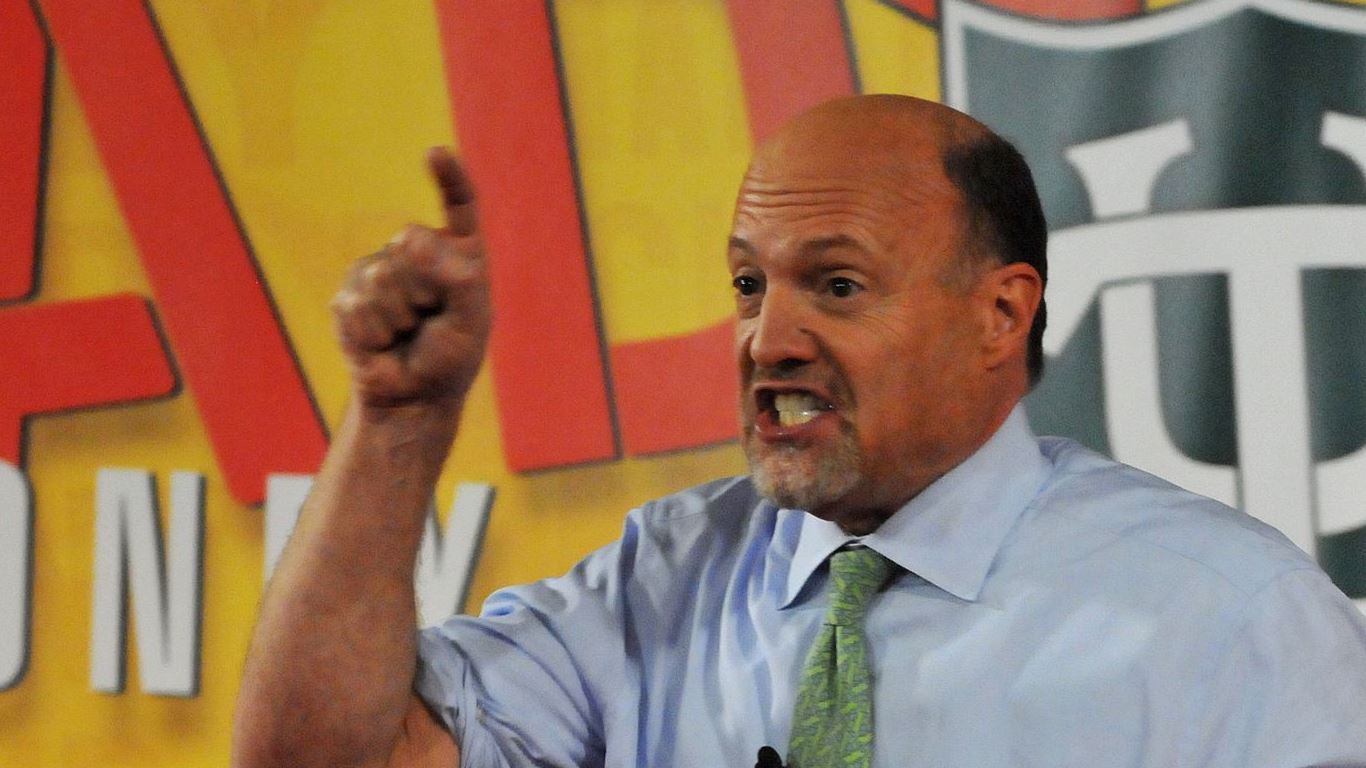
President Trump spent the weekend posting about the paper profit on Washington’s Intel (NASDAQ:INTC | INTC Price Prediction) stake, and on Tuesday morning Jim Cramer, whose charitable trust owns the same stock, publicly asked him to hold. On CNBC’s Squawk on the Street, Carl Quintanilla noted “the president was tweeting over the weekend about his gains, his paper gains on Intel,” and Cramer responded, “Yeah, I love that because my trust owns Intel. Yeah. Please don’t sell it. Remember all the last week of August is when he can sell it.”
Why the Selling Window Matters
Intel traded around $101.07 Tuesday morning, up 311.58% over the past year and up 174.5% year to date. That is the context behind Cramer’s plea: a federal disposition would be one of the largest overhangs the stock has ever faced. Cramer added “I was thinking he’s not going to sell it. I mean, I felt that he’s pounding the table on it.”
Intel’s Turnaround Underneath the Political Story
The gains are backed by fundamentals. Q2 2026 revenue reached $16.13 billion, growing 25.42% year over year and beating consensus by 11.64%. Non-GAAP EPS came in at $0.42 versus a $0.2175 estimate. Data Center and AI revenue rose 59% to $6.26 billion, and Intel Foundry expanded 31% to $5.76 billion, though the segment still posted a $2.1 billion quarterly loss.

The GAAP picture is messier. Intel booked a $12.53 billion non-cash charge tied to its CHIPS Act escrow arrangement, driving a GAAP net loss of $2.16 per share. Intel’s Q2 filing lists U.S. government acquisition of significant equity interests among its risk factors, and CEO Lip-Bu Tan framed the setup as capturing “sustainable growth across our CPU franchise, ASICs, advanced packaging and vast wafer foundry network” (see the SEC 8-K exhibit).
Strategic capital has also come from the private side. Intel’s Q4 2025 materials referenced the completed sale of $5.0 billion of Intel common stock to NVIDIA. NVIDIA (NASDAQ:NVDA) selected Intel Xeon 6 as the host CPU for its DGX Rubin NVL8 systems, tying the Intel narrative directly to the AI infrastructure buildout.
Same Playbook Just Landed on Quantum
The Intel story is expanding. Quintanilla noted “today it’s a definitive agreements of deals on Rigetti and qubits and QNT,” and Cramer said “I want anything that’s quantum. I believe we should leave. Look, I believe that Intel was very much in danger.” His framing was strategic: “I believe we have a race against China… things that make it so that we win the race, whether it be what we’re doing with quantum, whether it be what we’re doing with nuclear, these are all really important.”
Rigetti Computing (NASDAQ:RGTI) had already been in Commerce’s orbit. A May 2026 CHIPS letter of intent covered up to $100 million in planned funding for superconducting quantum work, part of a broader $2.013 billion package covering nine companies. Rigetti’s Q2 2026 revenue reached $5.138 million versus $1.8 million a year earlier. The stock jumped 10.85% on the session to $16.85 yet remains down 23.93% year to date.
AI Peer Backdrop
Intel’s rally is happening while the broader AI stack keeps compounding. Amazon (NASDAQ:AMZN) reported AWS revenue of $42.23 billion, up 37% year over year, its fastest growth in 18 quarters. Qualcomm (NASDAQ:QCOM) shares popped 10% Tuesday on a data center infrastructure deal with Amazon, another sign that AI capex is broadening beyond the three chipmakers investors instinctively name first (we profiled seven of the power, cooling, and networking suppliers riding that same buildout in a free report).
What to Watch
Cramer’s on-air ask does not change the calculus for the Treasury, but it sharpens the market’s attention on two questions. Does the government treat Intel as a strategic long-term holding or as a monetizable position now that the last-week-of-August window has passed? And does the emerging pattern of federal equity stakes in quantum extend Cramer’s national-security thesis into more names? For Intel holders, the setup is a stock that has already run 311.58% in a year with a very visible potential seller on the cap table.
Data Sources
- CNBC Squawk on the Street segment used to source the Trump-Cramer exchange, the selling-window comment, and the quantum framing.
- 247 Wall St. price-performance API used for Intel’s session move, one-year and year-to-date returns, and for Rigetti’s intraday move.
Contact [email protected] for any questions or corrections.
AJ spent 10 years writing about financial markets at The Motley Fool. His coverage centers on technology stocks and the broader macroeconomic trends, from interest rates to geopolitics, that shape where markets are headed next. AJ is drawn to the stories where big-picture economics and individual companies collide.