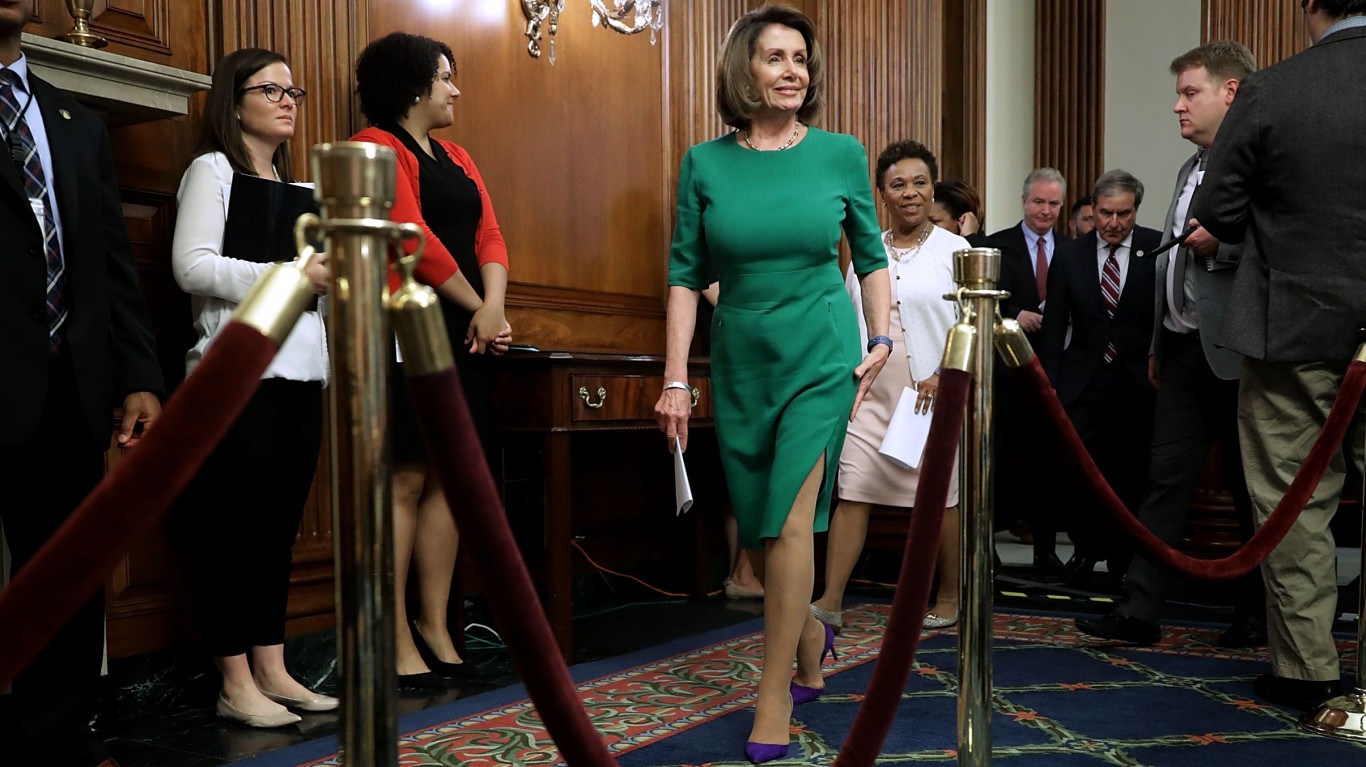
Weeks After Nancy Pelosi Disclosed A $3 Million Bet, Bloom Energy Is Joining The S&P 500 And The Stock Is Soaring
Weeks after a Pelosi household filing disclosed a multimillion-dollar position in a fuel cell company powering AI data centers, that same stock got added to the S&P 500 and went vertical. The timeline raises a question Congress has never fully…


On August 21, 2026, a periodic transaction report filed under Speaker Emerita Nancy Pelosi’s name disclosed a multimillion-dollar position in Bloom Energy (NYSE:BE), the solid-oxide fuel cell maker that powers onsite generation for hyperscale data centers. Weeks later, S&P Dow Jones Indices announced Bloom is joining the S&P 500 in its September quarterly rebalance. The stock has since gone vertical. We covered the Pelosi household disclosure in detail when it hit; this is the sequel.
Pelosi Household Bloom Trades Disclosed in Value Bands
The filing lists four Bloom purchases in the household account. On July 24, 2026, one stock lot in the $1,000,001 to $5,000,000 band and one options lot in the same $1,000,001 to $5,000,000 band. On July 28, 2026, a second stock lot in the $500,001 to $1,000,000 band and matching options at the same $500,001 to $1,000,000 range.
Congressional disclosures require value bands, never exact figures. The widely cited “$3 million” number is the floor of the combined bands. The ceiling implied by the same filing runs to $12 million. Third-party trackers have published higher point estimates by multiplying disclosed share counts by the closing price on each transaction date, but those are estimates, not disclosed figures.
Who Actually Placed the Order
The transactions were executed through accounts owned by Paul Pelosi and reported under House rules governing spousal trades. Her office has stated she owns no individual stocks and had no knowledge of or involvement in the transactions. The STOCK Act requires the filing under the member’s name regardless of who placed the order.
Bought Into Weakness, Then a Blowout
The first tranche landed after a sharp pullback. The second tranche hit on July 28, 2026, the same day Bloom reported second-quarter revenue of $1.07 billion, up 165.5% year over year, beating the $827 million consensus by 28.8%. Non-GAAP earnings per share came in at $0.78 versus $0.41 expected. Product revenue jumped 215%. Management raised full-year guidance to $3.9 billion to $4.2 billion in revenue.

CEO KR Sridhar told analysts that “all the major US hyperscalers, and over a dozen US neoclouds, AI labs, and co-location data center operators have validated and approved our power solutions for their AI factories.” That is the actual engine under this stock: bring-your-own-power for AI compute (we profiled seven of the power, cooling, and networking suppliers riding this same buildout in a free report on the AI infrastructure names that aren’t chipmakers).
S&P 500 Inclusion Adds a $10 Trillion Forced Bid
S&P Dow Jones announced Bloom’s addition alongside two other names in its quarterly rebalance. Quarterly rebalances are routine index maintenance, yet forced buying by index funds tracking roughly $10 trillion in assets creates a real bid.
Bloom’s Explosive Price Action by the Numbers
Bloom shares are up 26.46% over the past week and 206.75% year to date. The stock last printed $266.53, up 5.4% in Tuesday premarket trading. Market capitalization sits near $74.5 billion.
Caveats Investors Should Weigh Before Judging
A well-timed trade followed by good news does not by itself establish advance knowledge, timing skill, or wrongdoing. Disclosed congressional trades are a legitimate public record. Here you have a documented, strikingly well-timed household position sitting inside a broader debate over whether members of Congress and their spouses should trade individual stocks at all. The timeline is on the record. Readers can draw their own conclusion.
Contact [email protected] for any questions or corrections.
AJ spent 10 years writing about financial markets at The Motley Fool. His coverage centers on technology stocks and the broader macroeconomic trends, from interest rates to geopolitics, that shape where markets are headed next. AJ is drawn to the stories where big-picture economics and individual companies collide.