IonQ’s CEO Says ‘Q-Day’ Hits in 2028. The Stock Says Investors Stopped Listening
IonQ's CEO used investor day to warn that encryption breaks in 2028 and quantum computing is about to slipstream into every corporate research program. The stock fell anyway, and the gap between that pitch and the financial reality underneath it…


IonQ’s (NYSE:IONQ | IONQ Price Prediction) chief executive Niccolo de Masi spent his company’s investor day making claims that were, by any measure, enormous. Quantum machines that get more powerful without getting proportionally more expensive. Quantum computing is slipping into every corporate research program alongside GPUs. It also warned that today’s encryption will fall in 2028.
The market response was less enthusiastic than the pitch. Shares of IonQ fell 5.78% in the session to $38.13, and the stock is now down 15.02% year to date, even as the Barron’s coverage of the day highlighted a new quantum system and a $1.8 billion deal. That divergence is striking, and it is the right place to begin.
Cost Curves and the One Claim That Actually Matters
The most consequential thing de Masi said, if true, is this: “Our systems, as they become more powerful, don’t actually become a lot more expensive. And so we’re focused on driving the broadest mass market quantum computing ecosystem that we can.” A quantum vendor with a flat cost curve would be a durable business, while a vendor without one remains a research effort searching for commercial validation.
The disclosed evidence is thinner than the claim. IonQ reported Q2 revenue of $80.05 million, up 286.8% year over year, but GAAP operating expenses ran to $417.3 million, adjusted EBITDA was negative $120.3 million, and stock-based compensation alone was $141.8 million in the quarter. The company argues the SkyWater deal creates “the only vertically integrated full-stack quantum platform company” and will drive down cost per logical qubit.
That remains a promise about future unit economics, not a demonstrated result. Management even declined to provide combined-company guidance, citing integration and purchase-price accounting work still underway.

Mainstreaming, Q-Day, and the AI “Lab Leak” Line
De Masi’s narrative claim was that “By the end of this administration, this increasingly becomes part of the narrative for every company, every applied science research activity in combination with what’s going on in the GPU, AI space. Quantum is going to slipstream in and give people superpowers.” No revenue attaches to that sentence. It is a prediction about attention, and attention is what a chief executive at a cash-burning quantum vendor most needs.
The Q-Day warning is more specific and more freighted. On the call, de Masi said, “A year ago, people thought that Q-Day was something happening in the 2030s. They now understand it’s something happening in the 2020s.” The company grounds this in its own research showing the qubits required to break RSA have fallen by four orders of magnitude over the prior 15 years. That figure comes from a paper the company presented on a day it wanted attention. Readers should weigh it accordingly.
Then there was the AI aside. De Masi described “the OpenAI and Anthropic lab leaks. GPU based AI machines kind of finding their way out of the lab into the real world, allegedly to solve some problem. And then you find that they’ve gone and hacked somebody on their own volition.” That is his characterization and is not independently established here.
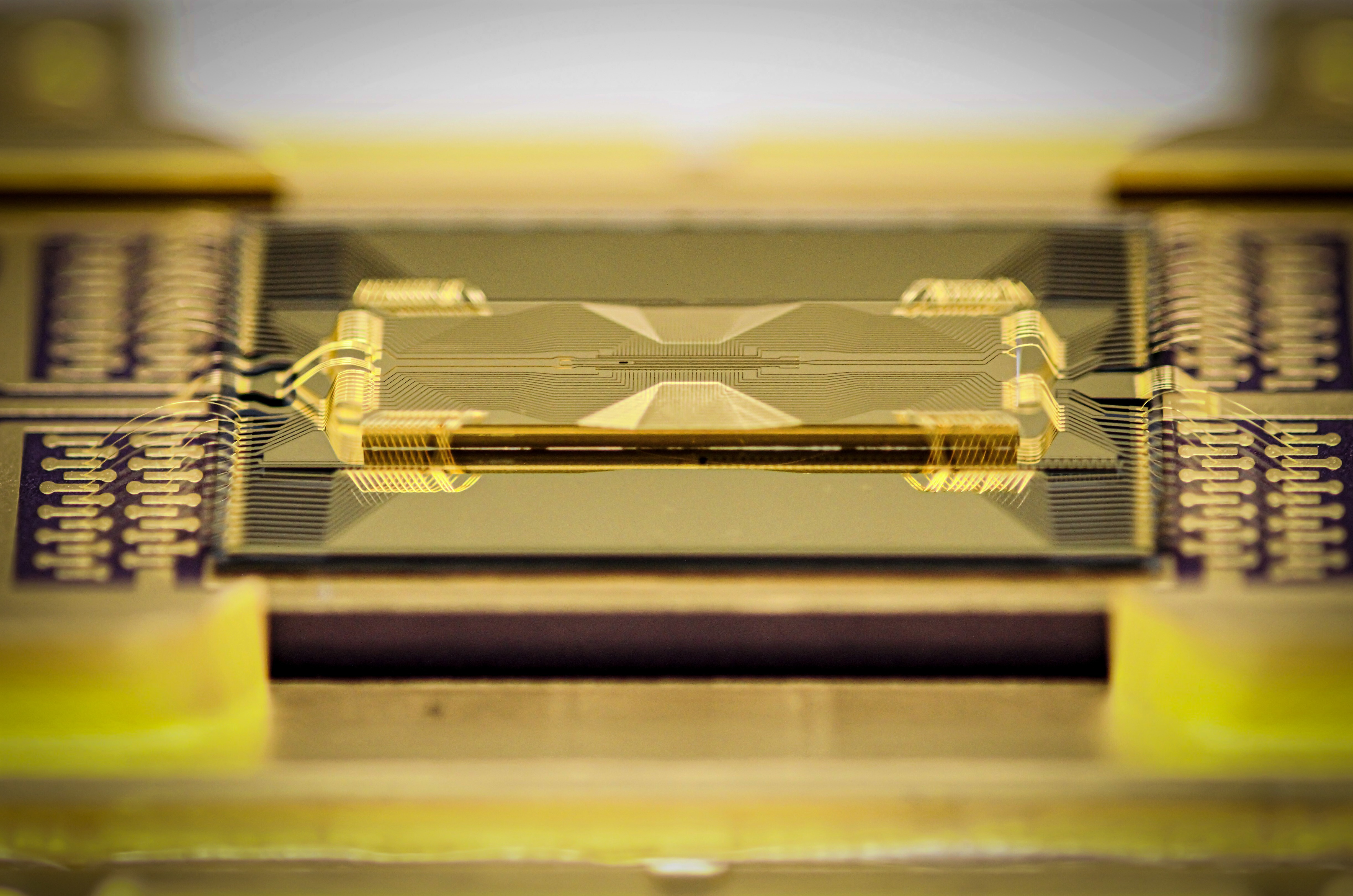
It does, however, serve his cybersecurity pitch, which is where IonQ has an actual product: ClavisXG Multiplex, a quantum key distribution system running over existing fiber.
Checkable Commitments: SkyWater, Guidance, and Superion
Here the company is on firmer ground. IonQ closed its $1.8 billion acquisition of SkyWater, raised full-year 2026 revenue guidance to $280 million to $290 million, and grew remaining performance obligations 297% year over year. Cash sat at $1.24 billion at quarter end.
The 256-qubit system is scheduled to begin commissioning in the first half of 2027. Roughly 50% of Q2 revenue was international and 60% commercial, which is a healthier mix than a pure government-lab story. Those are checkable commitments; investors will get to grade them.
Set against peers, the picture is mixed. Rigetti Computing (NASDAQ:RGTI) reported Q2 revenue of just $5.14 million and is down 31.2% year to date. D-Wave Quantum (NYSE:QBTS) posted $3.08 million in revenue and is down 34.53% year to date. The whole quantum cohort has cooled.
Meanwhile, NVIDIA (NASDAQ:NVDA) put up $96.22 billion in Q2 revenue, up 105.8% year over year, with data center alone at $89.02 billion. The scale gap is not close. You can read IonQ’s own Q2 8-K exhibit for the raw filing.
Is IONQ Stock a Buy?

The case for IonQ rests on believing three things simultaneously: that the cost curve claim survives contact with real manufacturing, that Q-Day arrives close to the timeline de Masi is publicly staking out, and that the company converts remaining performance obligations into recognized revenue faster than its $120.3 million quarterly EBITDA loss compounds.
The market is currently discounting all three. Analysts still carry an average target of $67.68 against a current $38.13, and the stock trades at a price-to-sales of roughly 65. That pricing assumes the narrative works.


Against Rigetti and D-Wave, IonQ has better revenue scale, more cash, and a clearer commercial story. Against owning the GPU compute buildout through NVIDIA, which is up 20.07% year-to-date on demonstrated cash flows, IonQ is a speculation on a technology that has not yet met its own cost claims (if you own names like this, fencing them off with real position sizing matters, which is the whole point of our free speculation playbook).
I wouldn’t buy IONQ today at this price.
Contact [email protected] for any questions or corrections.
Omor Ibne Ehsan is a writer at 24/7 Wall St. He is a self-taught investor with a focus on growth, cyclical, and dividend equities that have strong fundamentals, value, and long-term potential. He also has an interest in high-risk, high-reward investments such as penny stocks.