Oil Just Blew Past $100 a Barrel and These 5 Energy Stocks Are in the Line of Fire.
With Brent crude punching back above $100 on US military strikes against Iranian tankers, five energy stocks suddenly face very different fortunes depending on where they sit in the supply chain.

Brent crude vaulted back above $100 a barrel this week after CNBC reported that US Central Command destroyed five Iranian crude oil tankers Tuesday in retaliation for attempted attacks on an American warship, the latest escalation in a Middle East conflict that has already scrambled global supply. This is a supply-shock story, and the distinction matters because it changes which energy names actually benefit. Below are five US-listed stocks in the line of fire, ranked by the directness of their exposure, with a clear read on the mechanism for each, according to CNBC.
1. ConocoPhillips (COP)
ConocoPhillips (NYSE:COP | COP Price Prediction) is the purest upstream leverage on this list. Q2 2026 revenue jumped to $19.16 billion, up 37.1% year over year, and adjusted EPS of $3.24 beat the $2.96 consensus as Brent averaged $104.52 versus $67.82 a year earlier. Net income roughly doubled to $3.93 billion.
Analysts appear to have taken the hint. The 2026 full-year EPS estimate has moved to $10.4435, with 14 upward revisions against 2 downward in the trailing 30 days. Shares are up 49.35% year to date to $136.85. CEO Ryan Lance is not chasing the price signal with capex, telling investors ConocoPhillips remains “firmly on track to deliver our $7 billion free cash flow inflection by 2029” and that free-cash-flow breakevens should fall from the mid-40s WTI today to the low 30s by 2029. New Kirkuk and Syria positions add growth optionality and geopolitical risk in equal measure.
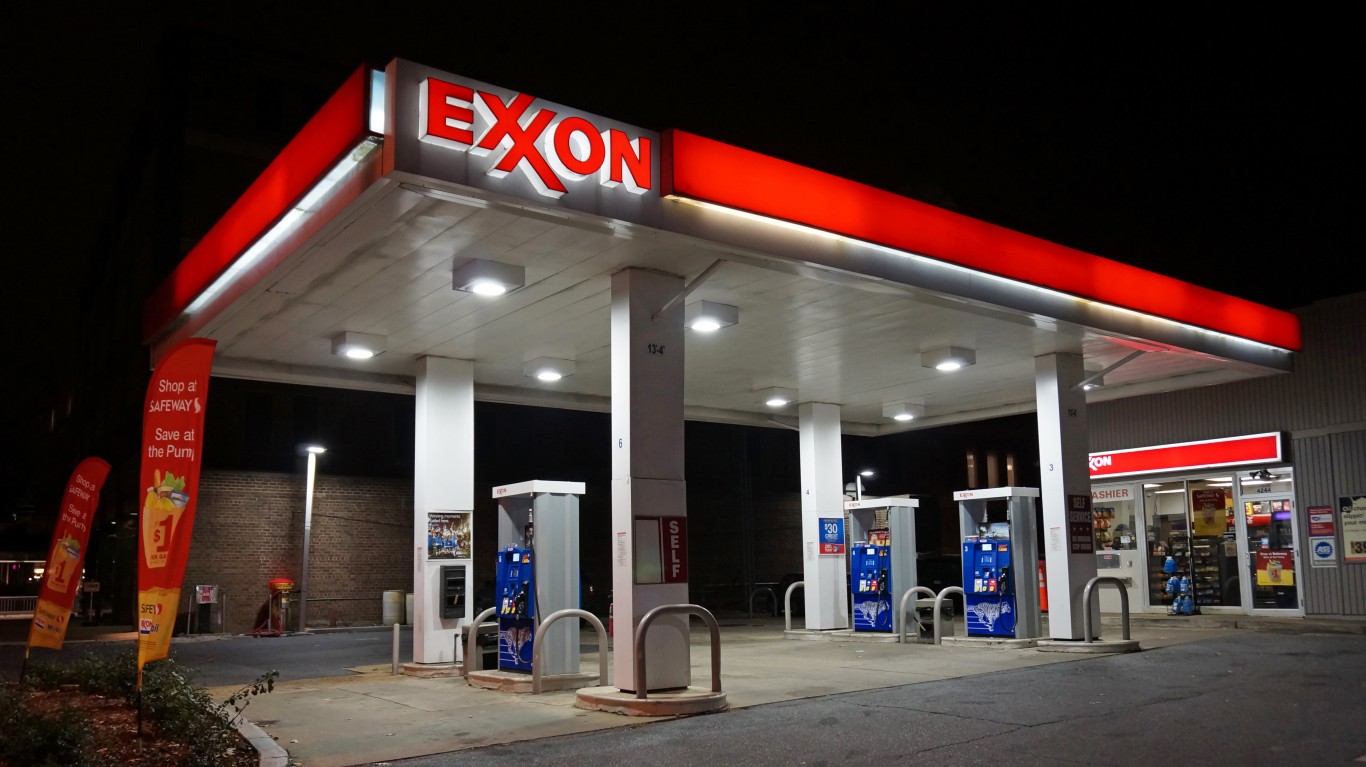
2. Exxon Mobil (XOM)
Exxon Mobil (NYSE:XOM) is the largest single beneficiary in absolute dollar terms, with a $675.3 billion market cap and upstream production of 4.6 million oil-equivalent bpd. Q2 delivered “industry-leading earnings of $14.5 billion” and $23.6 billion in cash flow from operations, even as CEO Darren Woods disclosed “the temporary loss of approximately 10% of our upstream production” tied to Middle East disruption.
The setup for Q3 gets more interesting with this news. Guyana is producing approximately 900,000 gross bpd, and CFO Neil Hansen said Exxon has now “fully recovered the $55 billion of investment”, an inflection that shifts more revenue into free cash flow. Golden Pass LNG shipped its first cargo in April 2026, and the Permian hit more than 1.8 million oil equivalent barrels per day. Shares are up 40.04% year to date to $165.23, essentially at the analyst target of $170.91.
3. Chevron (CVX)
Chevron (NYSE:CVX) is the double-barreled play: upstream torque plus a refining segment already firing. Q2 revenue reached $67.20 billion, up 51.4% year over year, with net income of $12.07 billion and downstream earnings rocketing to $4.87 billion from $737 million a year earlier. Worldwide production hit 4,070 MBOED, up 20% on the Hess deal.
CEO Mike Wirth flagged “Products are tighter than crude around the world, and that’s why cracks have widened out” and expects “some upward pressure on product pricing here into the third quarter and perhaps beyond that.” Chevron reduced debt by $8.41 billion in Q2 alone and hit its $3 billion structural cost savings target six months ahead of schedule. Shares trade at $213.95, up 44.28% year to date, with 2026 EPS estimates lifted to $16.0382 on 19 upward revisions in 30 days.
4. Valero Energy (VLO)
Valero Energy (NYSE:VLO) is the double-edged case out of this group. Refining margin per barrel of throughput nearly doubled to $23.62 versus $12.35 a year earlier, US Gulf Coast ULS diesel margin surged to $43.52/bbl from $14.79, and adjusted EPS of $12.54 beat estimates by 23.84%. Renewable Diesel swung to $717 million operating income from a $79 million loss. Shares have exploded 141.89% year to date to $387.93.
Here’s the catch: sustained $100+ crude eventually compresses gasoline demand and squeezes downstream. COO Gary Simmons cited approximately 5 million bpd of global refining capacity offline and 1.7 to 1.9 million bpd of Russian capacity down, supporting a bullish mid-cycle margin view. That thesis works until it does not. Valero already has California regulatory overhang and shut refining ops at Benicia.
5. Schlumberger (SLB)
Schlumberger (NYSE:SLB) is the paradox on this list. Higher crude typically pulls customer capex, but SLB’s most profitable region is the exact geography being disrupted. Middle East & Asia revenue fell to $2.57 billion, down 14% year over year, with force majeure in Qatar, shut-ins in Iraq and security demobilizations. Net income slid 22.5%.
CEO Olivier Le Peuch is framing this as a delayed setup. He said “The market is starting to exhibit the characteristics of an upcycle” and cited third-party data pointing to FIDs for long-cycle projects rising approximately 30% year-on-year in 2026. Shares are up 47.96% year to date to $55.89 but slipped 3.85% over the past week as tanker headlines rekindled Middle East risk. Analyst target sits at $62.24.
Caveat Investors Should Not Ignore
A geopolitical risk premium can unwind as fast as it was priced in. WTI was at $91.48 on September 1 after touching $114.58 on April 7, and the one-year band has run from $55.44 to $114.58. Buying an energy name on this move means buying part of that geopolitical premium rather than a durable shift in the underlying supply picture. Upstream-heavy names get the cleanest earnings lift; a refiner rides crack spreads until demand cracks; and the services giant needs the shooting to stop before its highest-margin region can rebuild.
Contact [email protected] for any questions or corrections.
Chris Lange is a financial and geopolitical writer with more than a decade of experience covering a myriad of topics. He has published thousands of articles for 24/7 Wall St., with past coverage focused heavily on stocks, IPOs, healthcare, defense, global affairs, and technology.
His work has been quoted, or referenced by a number of outlets including Business Insider, USA Today, Yahoo Finance, MSN, The Motley Fool, and many other publications. A graduate of Southwestern University, he studied business with a focus on investments and has previous experience in banking and startups.
When not reading or writing the news, he is following his passion for Lacrosse, playing chess, or building solar projects with his dad.