Chevron and Exxon Mobil Rise 3% as U.S. Strikes on Iran Push WTI Crude Oil to $86
U.S. strikes on Iran sent oil surging over the weekend, and now traders are betting that two integrated giants respond identically to a crude spike, but their businesses tell a more complicated story.

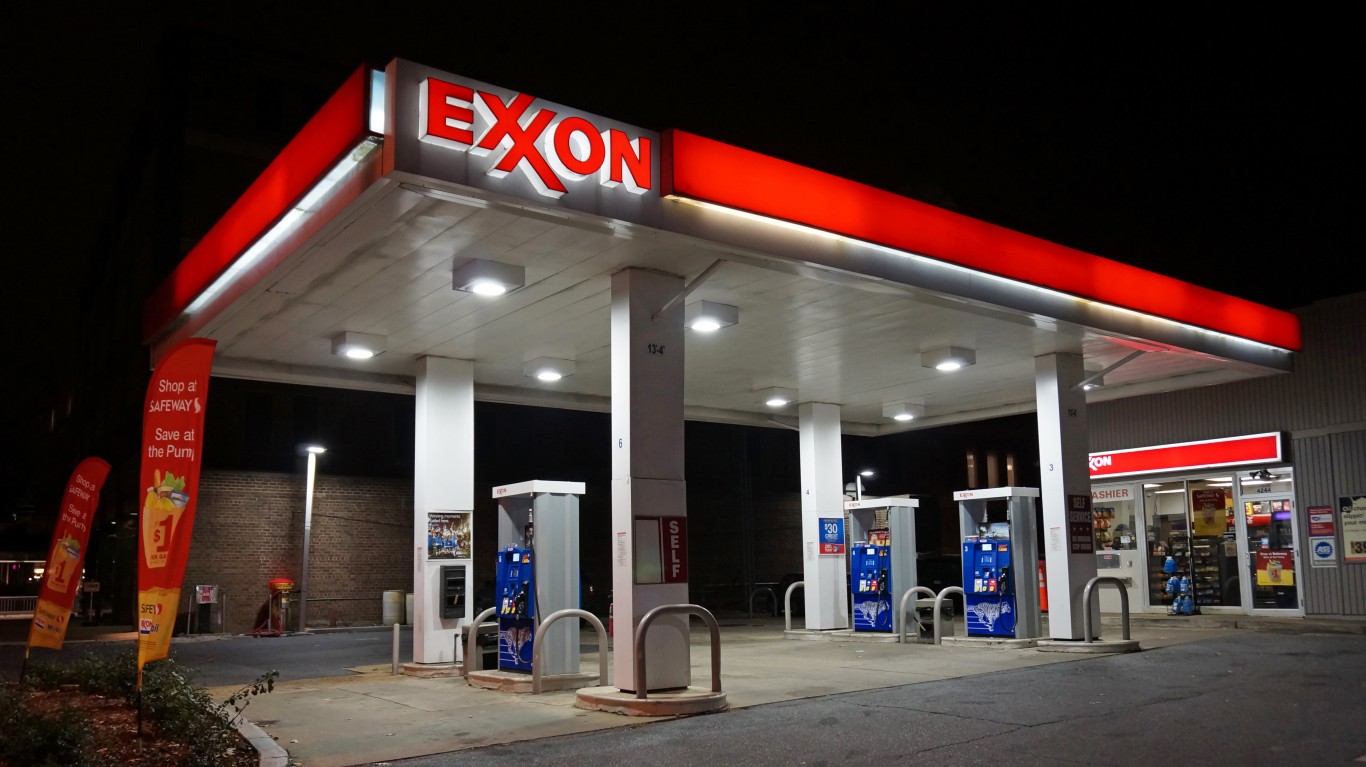
Shares of Chevron (NYSE:CVX | CVX Price Prediction) and Exxon Mobil (NYSE:XOM) are climbing in Monday morning trading after the United States and Iran resumed military strikes over the weekend, with shipping through the Strait of Hormuz still constrained. Chevron stock is up 3% to $207.80; Exxon Mobil stock is rising 3% to $161.31.
The energy complex is repricing supply risk in real time. WTI crude oil is at $86.06 per barrel, up 3% over the past 24 hours, while Brent has topped $90. Crude trades nearly around the clock, so that 24-hour figure captures weekend headlines across venues open beyond U.S. equity hours.
Energy is the standout group this morning. The Energy Select Sector SPDR ETF (NYSEARCA:XLE) is up 2% to $64.18. Broad benchmarks are moving the other way, with the SPDR S&P 500 ETF Trust (NYSEARCA:SPY) down 0.4% to $766.13, while Exxon Mobil and Chevron together sit at the top of the XLE weighting, so the fund is tracking crude prices almost tick for tick today.
Hormuz Risk Repricing Fuels the Bid
The driver here is geopolitical. Both Chevron and Exxon Mobil have stayed quiet on the newswires today, leaving the weekend escalation between Washington and Tehran as the sole catalyst. Traders are pricing supply optionality across the crude curve as headline sentiment shifts.
Hormuz matters for the pair because a large share of seaborne crude and LNG passes through the strait. A supply-risk premium builds quickly when tanker transit is uncertain, and it fades just as quickly once flows resume. That two-way sensitivity marks today’s move as a repricing of headline risk, with limited implications for the majors’ long-term earnings power.
WTI crude oil’s recent path adds context to today’s bid in Chevron and Exxon Mobil. The daily FRED spot series had crude near $83.90 on August 25, after touching $89.75 on August 20, so today’s bounce retraces part of last week’s slide before the weekend headlines hit. That level sits above the $60 to $80 range the EIA classifies as moderate, and beneath the year’s high of $114.58 on April 7.
Commentary from both CEOs foreshadowed this backdrop. Chevron CEO Mike Wirth cited “geopolitical uncertainty and market volatility” on the company’s most recent call. Exxon Mobil CEO Darren Woods struck a similar note, saying “Events in the Middle East tested that strength… those events also underscored the importance of reliable, affordable energy products.”
One Move, Two Different Businesses
Chevron and Exxon Mobil are both up roughly 3%, and that’s an observation worth flagging. The market is treating the pair as a single crude-beta position, glossing over how differently their segments respond to a crude spike.
Both are integrated majors, each spanning upstream production, where a higher crude price lifts realizations on every barrel produced, and downstream refining and chemicals, where crude functions as an input cost. A jump in oil therefore lands unevenly across an integrated major’s segments. Pure exploration and production companies feel that lift more uniformly across revenue and margin lines.
Scale reinforces the herd trade in Chevron and Exxon Mobil. Chevron’s Hess integration has broadened its reserve base, while Exxon Mobil’s Guyana ramp and Permian footprint anchor its upstream mix. Both names also carry sizable refining capacity, which cushions the earnings mix when crude runs and can absorb some of the upside if the risk premium sticks.
Both stocks have run hard heading into today, with Chevron stock up 36% year to date (YTD) through Friday’s close. Exxon Mobil stock was up 33% year to date through that same tag. That momentum leaves less valuation cushion in Chevron and Exxon Mobil if the geopolitical premium unwinds and crude retraces toward the summer trend.
What to Watch
The next share-price move in Chevron and Exxon Mobil depends on Hormuz traffic and OPEC’s posture. Investors can watch for whether tanker transit normalizes and for whether the cartel signals any production response as WTI crude oil holds above $85. Peer strength across the energy patch, including refiners and services names inside the XLE ETF, will provide a read on how broadly the risk premium is being priced across the value chain.
Position sizing deserves emphasis for investors of Chevron and Exxon Mobil today. A geopolitical risk premium is among the most reversible moves in energy, and it can unwind as quickly as it appeared if the conflict de-escalates or Hormuz transit normalizes. Traders sizing their exposure here can stage entries and avoid chasing the current level, since headline risk cuts in both directions and today’s bid in these two names could reverse on a single wire story.
Contact [email protected] for any questions or corrections.
David Moadel is financial writer specializing in stocks, ETFs, options, precious metals, and Bitcoin. David has written well over 1,000 articles for leading online publications, helping investors understand markets, income strategies, and risk.His work has appeared in The Motley Fool, InvestorPlace, U.S. News & World Report, TipRanks, ValueWalk, Benzinga, Market Realist, TalkMarkets, Finmasters, 24/7 Wall St., and others.With a master’s degree in education, David has taught at the elementary, high school, and college levels. That teaching background shapes his writing style: clear, educational, and practical. David has also built a loyal social-media audience by providing trustworthy financial content on YouTube, X/Twitter, and StockTwits.