AeroVironment CEO: “$10-Per-Shot Laser Beats $150,000 Drones” — But Stock Keeps Falling
AeroVironment just landed the first-ever production contract for directed-energy weapons in U.S. military history, yet the stock has collapsed nearly 41% over the past year. Something about this story does not add up, and the answer involves a CEO selling…


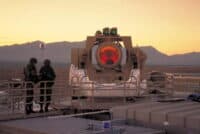
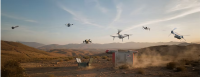
AeroVironment (NASDAQ:AVAV | AVAV Price Prediction) chairman and chief executive Wahid Nawabi went on CNBC this week with an arithmetic problem for defense investors. Drones being thrown at Western militaries and border installations cost roughly $150,000 apiece, according to Nawabi, while the interceptors historically used to knock them down cost millions of dollars per shot. His pitch is that AeroVironment’s LOCUST directed-energy laser, per Nawabi, brings that engagement cost down to less than $10 per shot.
That is a serious claim, and the U.S. Army evidently took it seriously enough to hand AeroVironment a $464 million Enduring High Energy Laser production award, described on the earnings call as “the first ever production contract for direct energy systems in U.S. military history.” And yet shares are down 40.47% over the past year. The disconnect is what this story is about.
Why $10-a-Shot Lasers Break the Drone Math
Ukraine made the cost asymmetry of modern air defense impossible to ignore. When an attacker can send waves of cheap drones and each defensive round costs orders of magnitude more, the defender runs out of money before the attacker runs out of drones.
A directed-energy weapon runs on electricity, so once the platform’s capital cost is amortized, the marginal engagement price collapses. Nawabi frames LOCUST as giving the warfighter “an essentially unlimited magazine.”
The demand backdrop supports him. The Pentagon’s FY2027 budget request earmarks $53.6 billion for drone dominance and counter-drone technologies, including $14.4 billion specifically for counter-unmanned systems development and deployment.
Nawabi told CNBC this is “a prolonged sustained demand profile” that will last at least a decade, and the top-line budget lines up with that view.
Fielded Hardware With an Operational Track Record
Directed energy has lived in the research budget for years. What changed in this cycle is that AeroVironment moved from prototype to fielded product.
Management said LOCUST systems are already operating at the southern border, where roughly 300 cartel drones have been shot down year to date, and the FAA has cleared the weapon to operate in national airspace. That track record unlocked the first international commercial order, a $52 million deal signed in the quarter.
The financials caught up too. First-quarter revenue was $480.49 million, adjusted EPS of $0.59 beat the $0.2479 consensus, and funded backlog hit a record $1.50 billion, up 37% year over year, per the company’s 8-K exhibit.

Nawabi even said on the call that LOCUST could become a “half a billion dollar plus a year franchise” within about a year.
Great Bookings, Broken Chart
The stock disagrees. AVAV trades at $147.07, down 24.97% in the last month alone and well below the analyst average target of $225.77.

Some of the pain is self-inflicted. The prior fiscal year included a $240.7 million goodwill impairment and a GAAP net loss of $265.122 million, driven by BlueHalo integration charges and the BADGER SCAR stop-work that vaporized roughly $1,493.2 million of unfunded backlog.
Estimate revisions tell the same story. The consensus EPS for the fiscal year ending April 2028 has been cut from $5.3838 90 days ago to $4.3910 today, with 9 down revisions in the past thirty days.

Meanwhile, insiders have been selling into the weakness. Nawabi himself sold 28,265 shares at $139.00 on June 29, 2026. That’s $3.9 million worth of AVAV stock.
What Investors Should Watch Next on AVAV
The thesis will be falsified or confirmed by three things: whether the half-billion-dollar LOCUST program that Nawabi cited converts into follow-on international orders, whether the Albuquerque expansion delivers the throughput management has promised, and whether Congress passes the FY2027 defense budget on time rather than dragging out a continuing resolution.
The unspoken risk Nawabi did not raise is program concentration. A single stop-work order already cost the company a $151.3 million impairment on SCAR, and nothing structurally prevents a similar surprise elsewhere in the portfolio.
At a forward P/E of 47x on 3.62x sales, the multiple still assumes execution. But with 86% revenue visibility to the guidance midpoint and a genuinely differentiated laser franchise, the risk-reward has improved as the price has come in.
The setup argues for patience: one more clean quarter of execution and confirmation that LOCUST orders are compounding internationally would go a long way toward validating the growth story Nawabi is telling before the current multiple looks defensible.
Contact [email protected] for any questions or corrections.
Omor Ibne Ehsan is a writer at 24/7 Wall St. He is a self-taught investor with a focus on growth, cyclical, and dividend equities that have strong fundamentals, value, and long-term potential. He also has an interest in high-risk, high-reward investments such as penny stocks.