Spotify vs. Netflix: I’d Bet on This Streaming Stock for the Next 5 Years
Spotify and Netflix just reported quarters that point in completely different directions, and the gap between their strategies raises a question worth sitting with: which business actually has more room to run from here?


Spotify (NYSE:SPOT | SPOT Price Prediction) and Netflix (NASDAQ:NFLX) just delivered Q2 2026 reports that frame streaming’s next chapter.
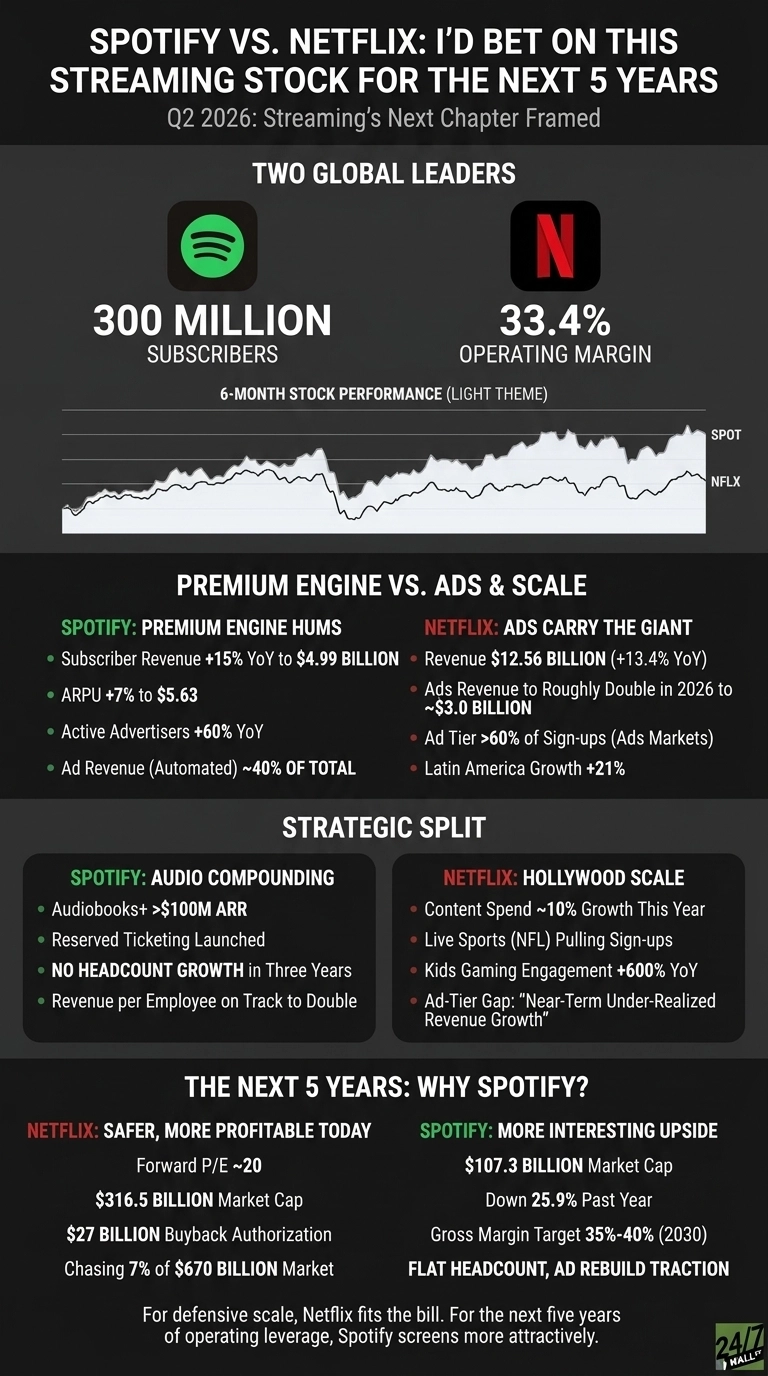
Spotify crossed 300 million subscribers and pushed gross margin to a record. Netflix hit 33.4% operating margin and doubled down on ads. Audio pure-play versus video giant, priced very differently by the market today.
Premium Engine Hums for Spotify, Ads Carry Netflix
Spotify’s quarter was built on Premium. Subscriber revenue rose 15% year over year to $4.99 billion, while ARPU climbed 7% to $5.63 on price hikes.
Ad-supported revenue only ticked up 1%, but management said automated channels now make up nearly 40% of ad-supported revenue, and active advertisers grew 60% year over year. CEO Daniel Ek’s team put it plainly: “Our margin is a managed outcome, not a byproduct.”

Netflix landed differently. Revenue of $12.56 billion came in a hair light versus estimates, but every region grew double digits, led by Latin America at +21%.
The real story is advertising, expected to roughly double in 2026 to about $3 billion, with the ad tier now over 60% of sign-ups in ads markets.

| Business Driver | Spotify | Netflix |
| Main Growth Engine | Premium subs and ARPU | Ads plus pricing |
| Q2 Revenue Growth | +13.9% | +13.4% |
| Operating Margin | 12.8% | 33.4% |
Audio Compounding vs. Hollywood Scale
The strategic split is sharp. Spotify is stacking “subscriptions on top of subscriptions,” with Audiobooks+ passing $100 million in annual recurring revenue and a Reserved ticketing feature launched with Live Nation.
The company has not added headcount in three years while revenue per employee is on track to double. That is operating leverage most media companies would envy.

Netflix is playing the opposite hand: spend big, monetize scale.
Content spend is guided up about 10% this year, live sports like the expanded NFL slate are pulling in sign-ups, and gaming engagement for kids jumped 600% year over year. Co-CEO Greg Peters called the ad-tier gap versus standard pricing “essentially near-term under-realized revenue growth.”

Next Test Is Monetization Quality
Spotify guided Q3 to 788 million MAUs and revenue near 5 billion euro, 14% growth, while flagging emerging-market friction that could dent user counts. Netflix guided Q3 revenue of $12.86 billion and reaffirmed FY2026 free cash flow around $12.5 billion.
I will be watching whether Spotify’s ad platform truly inflects to double-digit growth in the second half, and whether Netflix can keep ARPU rising without hurting retention after price hikes in the U.S., Mexico, and Spain.
Why I’d Bet on Spotify for the Next Five Years
Here is my read. Netflix is the safer, more profitable business today, trading at a forward P/E near 20 with a fortress $27 billion buyback authorization. But it is already a $316.5 billion company chasing 7% of a $670 billion addressable market. The upside is real, just not asymmetric.

Spotify, at a $107.3 billion market cap and down 25.9% over the past year, looks more interesting to me. Gross margin expanding toward a 35% to 40% 2030 target, flat headcount, an ad rebuild finally showing traction, and audiobooks stacking new revenue all point to compounding.
For defensive scale, Netflix fits the bill. For the next five years of operating leverage, Spotify screens more attractively.

Contact [email protected] for any questions or corrections.
Vandita Jadeja is a financial publisher with over a decade of experience writing about financial topics, including investment, savings, retirement, insurance and banking. Vandita is a Chartered Accountant who loves to debunk financial concepts for readers.
Her work has appeared on sites that include The Motley Fool, InvestorPlace, and Benzinga. She covers investing and focuses on stock picks and price prediction for 24/7 Wall St.
When not looking for the next stock investment opportunity, she can be found traveling, reading, chasing sunsets and enjoying her iced latte.