AMD Is Sitting at $515. Here Is What Most U.S. Investors Should Actually Do About It.
AMD has surged over 200% in a year, locked in multi-gigawatt AI deals with OpenAI and Meta, and still has its entire senior leadership selling shares into the rally. One of those facts should give you serious pause before you…

This post may contain links from our sponsors and affiliates, and Flywheel Publishing may receive compensation for actions taken through them.

At $515, AMD (NASDAQ:AMD | AMD Price Prediction) sits in a wait-and-see zone for most U.S. investors. The stock has more than doubled year to date on the back of hyperscaler AI wins and blowout Data Center growth, but it now trades at a valuation that leaves little room for execution error on a Helios ramp that has barely started.
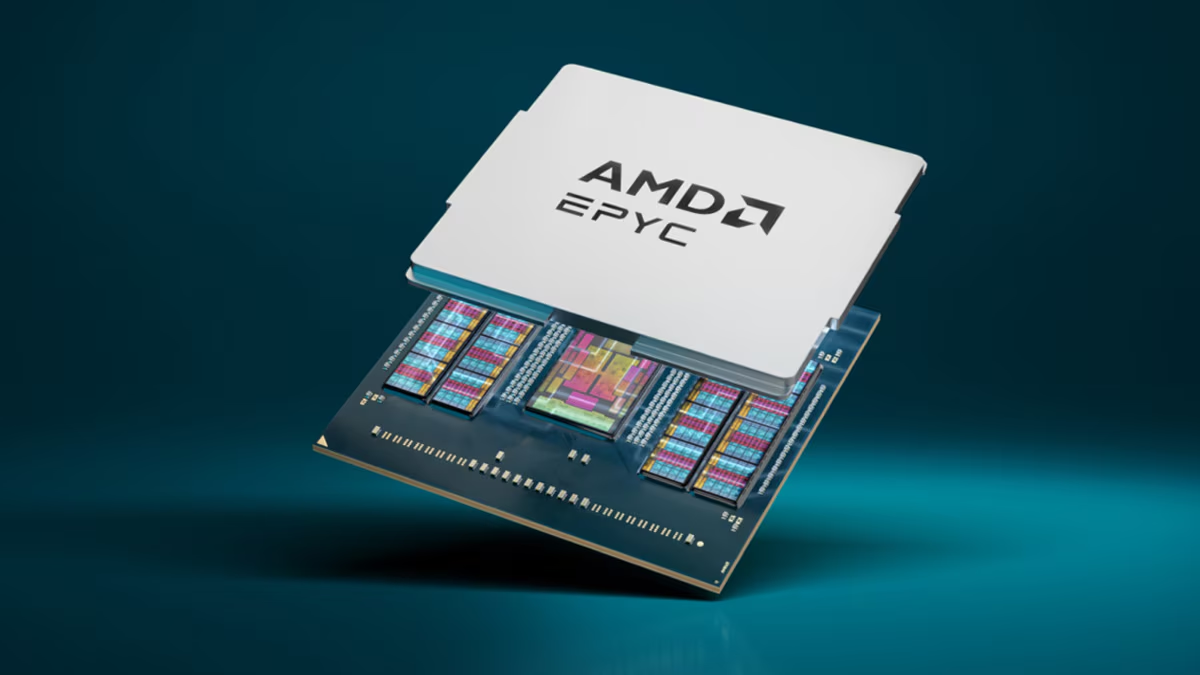
AMD designs high-performance CPUs, GPUs and adaptive chips, and it sits as the clear number two behind Nvidia in AI accelerators while gaining share against Intel in x86 servers. The current price reflects a market that has already priced in aggressive success across the Instinct MI450 series, Helios rack-scale platform, and 6th Gen EPYC Venice product cycles.
The setup is genuine, and so is the risk. Both deserve a full hearing before choosing a side.
Why the AI Bull Case Is Real at This Price
AMD just posted Q2 FY2026 revenue of $11.536 billion, up 50.11% year over year, with Data Center revenue of $6.718 billion, up 107% and now 58% of the total. Non-GAAP EPS of $1.66 beat the $1.6107 consensus, and non-GAAP gross margin expanded to 56% from 43% a year ago.
The forward book is where the bull case sharpens. AMD signed multi-gigawatt Instinct deployments with OpenAI (6 GW), Meta (6 GW), and Anthropic (up to 2 GW), with Microsoft adding Helios racks on Azure. Management now models the data-center AI accelerator TAM at roughly $1.4 trillion by 2030 and expects Data Center revenue to more than double year over year in 2027. Consensus already reflects this: FY2027 EPS estimates average $15.6118 across 48 analysts, with 33 upward revisions in the trailing 30 days versus only 3 downward.
Why the Bear Case Cannot Be Dismissed
The valuation is the problem. AMD trades at a trailing P/E near 194 and roughly a high multiple of the FY2026 EPS consensus. Nvidia still dominates AI training, and the FY2027 EPS range spans $10.77 to $20.25, telling you analysts genuinely disagree on how the Helios ramp lands.
Insider behavior amplifies the concern. Over a compressed August window, CEO Lisa Su, CFO Jean Hu, CTO Mark Papermaster, and multiple EVPs sold common stock at prices ranging from roughly $453 to $556. Gaming revenue fell 31% year over year, and export controls on MI308 shipments to China remain a live overhang, with Reddit chatter picking up on a possible new round of chip tariffs.
Why Patience Beats Conviction Here
Both sides remain unproven. Helios is only beginning initial shipments in the third quarter of 2026, with the meaningful ramp stepping into Q4 and Q1 2027. That means the next two reports will settle whether the multi-gigawatt customer commitments translate into recognized revenue on the timeline bulls assume.
The business itself is running well. Server CPU revenue grew more than 70% year over year in cloud and enterprise, EPYC Venice is in production, and Embedded posted 19% growth to $977 million. That argues against bearish positioning. But paying 68x forward earnings for a chipmaker whose largest AI customers have not yet shipped in volume argues against fresh accumulation at this level.
Numbers Behind the Stalemate
AMD currently trades at $516.13, up 141% year to date and 231.55% over the past year. Over the same one-year window, the S&P 500 tracked by SPDR S&P 500 ETF Trust (NYSEARCA:SPY) returned 16.22%, with a 12.08% year-to-date gain. AMD has beaten the benchmark by a factor most stocks never see in a decade.
Coverage is deep: 48 analysts contribute to the FY2026 EPS consensus of $7.5701, with a range of $7.00 to $8.20. Estimate revisions skew positive, with 28 upward and 9 downward revisions for FY2026 in the last 30 days. Formal price targets are one input, not a guarantee, and dispersion around FY2027 numbers signals the market is unsettled on the shape of the ramp.
Valuation stays the sticking point. A trailing P/E near 194 and free-cash-flow yield of roughly 0.79% against a $842 billion market cap assume years of clean execution.
Verdict: Let the Helios Ramp Do the Talking
At $515, AMD sits in a wait-and-see zone. Here is why.
The specific conditions that would strengthen the bullish thesis are visible: two consecutive quarters showing Helios revenue tracking with the server-revenue guide of more than 80% year-over-year growth in the second half of 2026, MI450 shipments confirmed against the OpenAI and Anthropic commitments, and gross margin holding at 56% as data-center AI mix rises. Hit those marks and the FY2027 EPS path toward $15.61 pulls the forward multiple down to roughly 33x, which is defensible for this growth rate.
The conditions that would strengthen the bearish thesis are equally clear: a Helios yield or timing slip disclosed on the next earnings call, a widening of China export restrictions beyond MI308, or any sign that hyperscaler capex is being pulled forward rather than expanded. Any of those would compress the forward multiple sharply from a base that already discounts near-perfect execution.
The cost of patience is opportunity cost if the ramp goes exactly to plan. The cost of acting prematurely, after a 231.55% one-year run and with the entire senior leadership team selling into August strength, is buying the top of an AI expectations cycle rather than the middle (riding a mania is fine as long as you plan the exit, which is the whole point of our free bubble survivor’s handbook). Watch the Q3 report for Helios revenue disclosure, Data Center segment margin, and any update on China policy.
Waiting is the right call because AMD has already earned a premium, but has not yet earned this one.
Contact [email protected] for any questions or corrections.
Alex Sirois is a financial writer with experience spanning both retail and institutional investing. He has written for InvestorPlace and held roles at BNY Mellon and Bernstein, giving him a perspective that bridges Main Street portfolios and Wall Street analysis.
Alex holds an MBA from George Washington University and has built his career across multiple industries, including e-commerce, education, and translation — a breadth of experience that informs how he breaks down complex financial topics for everyday investors. His writing is conversational, actionable, and grounded in long-term, buy-and-hold investing principles.
At 247 Wall St., Alex focuses on delivering analysis that is both accessible and useful, with a clear emphasis on helping readers make more informed decisions with their money.