Forget the Magnificent 7. This Duo Says Broadcom, Not Nvidia, Wins the Next Leg of AI.
Two finance podcast hosts just aired a live disagreement over where AI money flows next, and the stock they split on has already posted triple-digit revenue growth that most investors are pricing as if it will never repeat.


On a recent Earn Your Leisure episode, hosts Troy Millings and Rashaad Bilal split openly on where the next dollar of AI value accrues. Millings argued for names outside the Magnificent 7 and made Broadcom’s custom accelerator business the centerpiece of the case. Bilal countered that “you have to go with the people who are on the leaderboard,” naming Taiwan Semiconductor (NYSE:TSM | TSM Price Prediction), Nvidia (NASDAQ:NVDA), Micron (NASDAQ:MU), Apple (NASDAQ:AAPL), Alphabet (NASDAQ:GOOG, NASDAQ:GOOGL), Microsoft (NASDAQ:MSFT), and the Nasdaq 100.
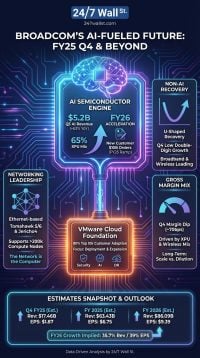
I find Millings the more persuasive of the two. Broadcom (NASDAQ:AVGO) posted AI semiconductor revenue of $16.7 billion in the third quarter of fiscal 2026, up 221% year over year, and guided the fourth quarter to $21.7 billion, up 236%. On the earnings call, Hock Tan sketched a trajectory to roughly $115 billion in fiscal 2027 and $230 billion in fiscal 2028.
Those are company figures. They reframe what the phrase “alternative to Nvidia” means in practice.
Where the Earn Your Leisure Hosts Split
Millings framed the moment by saying, “The leaderboard is growing. You’re looking at more trillion-dollar companies than we’ve ever seen before.” His practical claim was that investors misread Broadcom’s custom silicon and reflexively equate AI with Nvidia.
He also said OpenAI’s latest release required 100 Vera Rubin chips to power it, a podcast assertion rather than a company disclosure, and worth marking as such, according to Earn Your Leisure. The number matters less than the direction: frontier models are hungry, and silicon co-designed for one workload can be cheaper per token than a general GPU.
Bilal’s counter was cleaner and, on the surface, harder to argue against. If the biggest names have already won, why bet on the next tier at all?
My answer is that the question assumes only one winner. Broadcom’s Q3 alongside NVIDIA’s $96.22 billion quarter and 105.85% year-over-year growth together suggest the pie itself is enlarging.
What Custom Silicon Actually Buys You
An application-specific integrated circuit is a chip designed for a single workload rather than a general problem. Broadcom builds them for hyperscalers like Google and Meta (NASDAQ:META) and, increasingly, for OpenAI and Anthropic, while Nvidia sells one platform to everyone.
The tradeoff is straightforward. Custom silicon wins on cost and power at scale when the workload is stable and known, and it struggles when the target keeps moving underneath it.
Frontier training probably still favors NVIDIA because architectures shift quarter to quarter. Inference of a shipped model at hyperscale looks much closer to the stable workload where ASICs earn their keep, and XPU shipments were 73% of Broadcom’s AI revenue last quarter.
Tan told analysts that “when you co-develop a chip that is optimized for your particular LLM workloads, you will outperform any GPU,” citing OpenAI’s Jalapeno running at half the cost of a GPU. Take the exact figure with skepticism, though the direction is real.
Testing the Supporting Names Around the Trade
Taiwan Semiconductor is Millings’ favorite for years, and it fabricates both Broadcom’s XPUs and AMD’s Instinct GPUs. August 2026 revenue rose 53.3% year over year, and the stock trades at a forward P/E of 20. The bull case’s weak point is geopolitical concentration, which no multiple prices cleanly.
Dell Technologies (NYSE:DELL) booked a record $60.9 billion in AI orders last quarter with a $95 billion backlog and raised its full-year FY27 guide by $25 billion to $192 billion. Server hardware carries thin margins, though: ISG’s operating margin was 15%, respectable and nowhere near a chip designer’s economics.
AMD (NASDAQ:AMD) grew Data Center revenue 107% year over year to $6.72 billion and lined up gigawatt commitments with Anthropic, Meta and Microsoft. Yet the stock trades at a trailing P/E of 132, and its GPU share still has to travel a long way against NVIDIA’s installed CUDA base before that multiple looks earned.
Each of these benefits if Millings is right that the leaderboard is widening. The steadiest of them for a patient owner is the one Broadcom itself depends on: TSM.
Where AVGO Stock Sits
Broadcom trades at a trailing P/E of 46x and a forward P/E of 19x, with an analyst target of $531.85 against a recent price of $361.99. Shares are down 12.99% over the past month, even after a Q3 that logged nine consecutive EPS beats and free cash flow of $13.66 billion.

Against NVIDIA’s roughly $5.27 trillion market cap and 44x P/E, Broadcom looks like a cheaper way to own the same AI capex cycle from a different angle. The real risks are customer concentration among a handful of frontier labs and the financing exposure baked into the Anthropic and OpenAI XPV vehicles.

The risk/reward here looks constructive, with eyes open. Bilal is right that owning NVIDIA outright remains the simplest expression of the trade, although Millings is more right that Broadcom’s custom-accelerator franchise is priced as though the $115 billion fiscal 2027 outlook might not arrive, and the setup rewards the patient reader willing to sit through the noise (we reverse-engineered what the earliest signals of the biggest tech winners looked like in a free playbook you can grab here).

Contact [email protected] for any questions or corrections.
Omor Ibne Ehsan is a writer at 24/7 Wall St. He is a self-taught investor with a focus on growth, cyclical, and dividend equities that have strong fundamentals, value, and long-term potential. He also has an interest in high-risk, high-reward investments such as penny stocks.