Up 129% Year-to-Date: 1 Flashing Red Light That Makes AMD Stock a Dangerous Buy Above $475
At $475.51, Advanced Micro Devices (NASDAQ:AMD | AMD Price Prediction) is a Hold. The stock has roughly doubled in five months on accelerating AI demand, and the gap between the operating story and the multiple has rarely been wider. AMD…


At $475.51, Advanced Micro Devices (NASDAQ:AMD | AMD Price Prediction) is a Hold. The stock has roughly doubled in five months on accelerating AI demand, and the gap between the operating story and the multiple has rarely been wider.
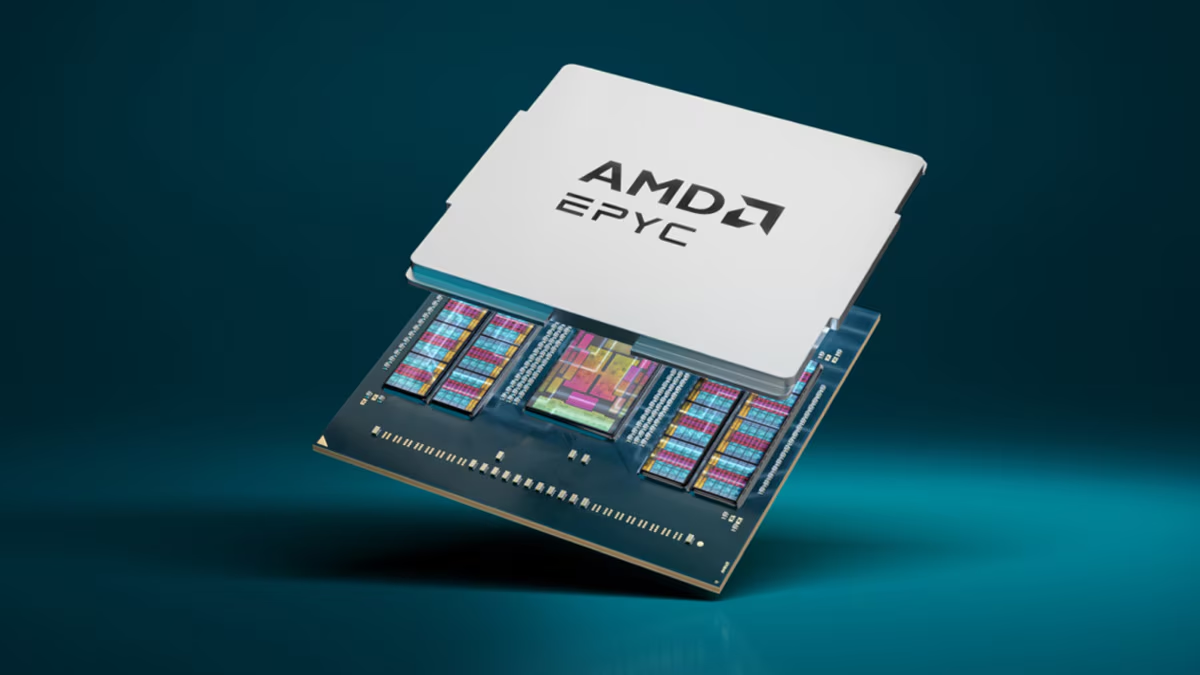
AMD designs the CPUs and GPUs powering hyperscale AI factories, with EPYC server chips and Instinct accelerators now the company’s growth engine. Data Center revenue hit $5.78 billion in Q1 2026, up 57% year over year, and Lisa Su told analysts the business has reached “a clear inflection in our growth trajectory and a structural shift.” The rally has carried the stock from $222.50 at the February earnings report to a recent 52-week high of $546.44.
The Bull Case: An AI Franchise Just Hitting Escape Velocity
Bulls argue AMD has finally cracked the accelerator market that NVIDIA (NASDAQ:NVDA) built. Meta (NASDAQ:META) committed to up to 6 gigawatts of Instinct GPUs, OpenAI signed for another 6 gigawatts, and Oracle (NYSE:ORCL) is deploying a 27,000-node MI355X cluster. Su raised the server CPU TAM to “over $120 billion by 2030” at greater than 35% annual growth, double the figure given six months earlier.
Fundamentals back the narrative. Q1 revenue rose 37.85% to $10.25 billion, free cash flow tripled to $2.57 billion, and Q2 guidance calls for $11.2 billion at roughly 46% YoY growth. On a forward basis, AMD trades at 67 times earnings with a PEG ratio of 1.12, which is reasonable for a hyperscaler-anchored AI franchise.
The Bear Case: A Multiple Untethered From Earnings
Bears point to the trailing P/E of 164, an EV/EBITDA of 93, and an earnings yield of roughly 0.6% against rising real rates. A widely upvoted r/stockmarket post titled “AMD’s price has massively detached from forward earnings expectations” drew 665 upvotes in early June, capturing the mood.
Concentration risk is real. Data Center is over half of revenue and leans on a handful of hyperscalers whose capex cycles turn. Management flagged tight supply, memory inflation, a gaming revenue decline of more than 20% in H2, and an MI450 ramp that will run below corporate average gross margin. Export controls already cost $800 million in Q2 2025 charges, and MI308 China licenses remain in limbo.
The Hold Case: Right Story, Wrong Entry
The business is executing, but the price is doing the heavy lifting. AMD has rallied 122.03% year to date versus 8.08% for the S&P 500, and the stock already gave back 8.83% in the past week. Overweight holders may consider rebalancing, though fully exiting clean exposure to the AI infrastructure cycle carries its own opportunity cost.
The Numbers Behind the Verdict
AMD trades at $475.51 against an analyst consensus target of $482.69, implying virtually no upside from the average price target. Of 51 analysts covering the name, 5 rate it Strong Buy, 36 Buy, 10 Hold, and none Sell. The cluster of price targets near spot price tells you the Street sees the easy money as made.
Valuation sits at 164 times trailing earnings, 21 times sales, and a beta of 2.49. The 200-day moving average of $247.60 sits nearly 50% below spot.
Verdict: Hold and Wait for Mean Reversion
At $475.51, AMD is a Hold.
The AI accelerator thesis is intact and arguably strengthening, with Meta, OpenAI, and Oracle providing multi-year visibility that did not exist a year ago. The problem is mathematical. Buying here requires AMD to compound earnings into a 164 times multiple while liquidity tightens and forward PE still screens at 67. A 9% week proved how quickly sentiment can flip.
The trigger for fresh capital is a multiple reset toward $360, roughly where Q1 earnings were filed and where forward PE drops into the 50s. The trigger to reduce further is a Data Center growth figure under 40%, a slip in MI450 ship timing, or a hyperscaler capex cut. Watch the Q3 report for MI450 volumes and Helios margins quarter by quarter.
The cost of patience is missing more upside in a momentum tape; the cost of chasing is paying a 164 PE for a cyclical semiconductor at the top of a hyperscaler capex cycle. Patient investors may prefer to see the multiple compress before adding exposure.
Contact [email protected] for any questions or corrections.
Alex Sirois is a financial writer with experience spanning both retail and institutional investing. He has written for InvestorPlace and held roles at BNY Mellon and Bernstein, giving him a perspective that bridges Main Street portfolios and Wall Street analysis.
Alex holds an MBA from George Washington University and has built his career across multiple industries, including e-commerce, education, and translation — a breadth of experience that informs how he breaks down complex financial topics for everyday investors. His writing is conversational, actionable, and grounded in long-term, buy-and-hold investing principles.
At 247 Wall St., Alex focuses on delivering analysis that is both accessible and useful, with a clear emphasis on helping readers make more informed decisions with their money.