CoreWeave Imploded Over The Last Few Months: One High-Conviction Wall Street Pro Says 200% Gains Start Now
CoreWeave has shed nearly half its value from recent highs while simultaneously reporting record revenue growth, and one Wall Street analyst sees a setup so lopsided it warrants a price target that would require the stock to triple from here.


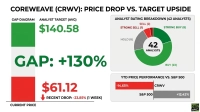
CoreWeave (NASDAQ:CRWV) currently trades at $82.98, while the Wall Street consensus price target sits at $144.46, an implied upside of roughly 74%.
CoreWeave is a purpose-built GPU cloud provider whose customer roster reads like an AI honor roll: OpenAI, Meta, Anthropic, Databricks, Cohere, and Mistral. The company was added to the Nasdaq-100 this year and closed Q2 with a revenue backlog of approximately $104 billion, plus over $25 billion of net new customer commitments added in early Q3 that were not yet in that figure.
Wall Street has been watching because CoreWeave is one of the purest listed vehicles for the AI infrastructure buildout. The dislocation matters because the company is simultaneously reporting record revenue growth and burning cash at a pace that requires constant capital markets access.
A Textbook AI Growth Story Meets a Balance Sheet Panic
The catalyst was a slow re-rating on cost of capital. Shares fell 21.17% over the past month and 25.88% over the past year, leaving the stock roughly 46% below its $153.20 52-week high.
Q2 headline numbers were strong. Revenue rose 112% year over year to $2.575 billion, and adjusted EBITDA margin hit 59%. The problem sat below the operating line. GAAP net loss widened to $626 million from $290 million, interest expense jumped to $640 million from $267 million, and free cash flow ran to negative $5.74 billion in a single quarter.
Full-year 2026 capex guidance of $35 to $39 billion and Q3 interest expense guidance of $860 to $940 million gave the bears exactly what they wanted. Add in worries about hyperscalers reselling excess GPU capacity, and the multiple compressed hard.
Rosenblatt Sees 200% Upside Hiding Inside the Backlog
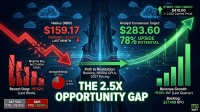
Rosenblatt Securities analyst John McPeake carries the highest active target at $250, implying roughly 201% upside from current levels. His thesis has four legs. Meta’s multi-year leases through 2032 contractually prohibit resale of leased capacity, insulating CoreWeave from the hyperscaler dumping fear. The $100 billion-plus backlog offers unusual long-dated revenue visibility. Structural GPU shortages let specialized neoclouds command premium pricing. And CoreWeave’s liquid-cooled, bare-metal architecture is more efficient per TFLOPS than retrofitted hyperscaler stacks.
The broader analyst tape is more measured but still constructive. Coverage sits at 38 firms, with the following ratings breakdown from Alpha Vantage:
- 5 Strong Buy
- 21 Buy
- 10 Hold
- 1 Sell
- 1 Strong Sell
Trailing 30-day EPS revisions for fiscal 2026 show 7 up and 9 down, a slight bearish tilt that has coincided with the sell-off rather than reversing it. What analysts still want to see: Q3 revenue of $3.45 to $3.6 billion, adjusted operating margin expanding into low teens by Q4, and a year-end annualized run-rate of $18.5 to $19.5 billion. Hit those, and the multiple debate looks very different.
Where CoreWeave Sits Versus Nebius and IREN
The neocloud group sold off together over the past month, but the peer set is far from uniform on price target upside.
Nebius Group (NASDAQ:NBIS | NBIS Price Prediction) fell 23.58% in the past month yet remains up 153.5% year to date. It trades at $212.19 against an average target of $290.71, roughly 37% upside. Coverage is thinner, with 1 Strong Buy, 2 Buy, and 2 Hold. Analyst upside here is smaller than CoreWeave’s.
IREN (NASDAQ:IREN) has held up better, down only 2.02% over the past month and up 14.3% year to date. Shares at $43.17 versus a $77.84 target imply roughly 80% upside, with a rating split of 1 Strong Buy, 12 Buy, 3 Hold, and 1 Strong Sell. IREN screens with more analyst-implied upside than the CoreWeave average, though less than Rosenblatt’s high target.
The single largest analyst-implied upside in the group sits on CoreWeave via Rosenblatt. On consensus averages, IREN has the widest gap, which frames CoreWeave as the higher-conviction, higher-controversy call.
What the Numbers Actually Say About the Setup
CoreWeave trades at $82.98 against a consensus target of $144.46, an implied gap of about 74% across 38 covering analysts. The stock is up 15.88% year to date, compared with 11.57% for the S&P 500, but the recent picture is uglier: down 21.17% over the past month while the S&P 500 slipped 2%.
Fiscal 2026 consensus points to revenue of roughly $12.9 billion and an EPS loss near -$5.18, with 2027 revenue expected to more than double to about $26.5 billion. Targets are only one data point, and the growth curve underneath them is the bull case in a nutshell.
My Take on Whether the 200% Call Is Real
The bull case holds if the operating margin ramp management guided to actually shows up. Q4 adjusted operating margin reaching low teens, continued backlog conversion, and the reported 300 basis point reduction in weighted average cost of debt would all point toward the Rosenblatt path. If capital markets keep funding the buildout at improving rates, the $250 print becomes plausible.
The bear case strengthens if capex keeps overshooting guidance, interest expense keeps compounding faster than revenue, and dilution accelerates through more equity-linked issuance. A single missed deployment or a customer renegotiation could unwind the thesis quickly given 8.9x debt-to-equity leverage.
The setup skews cautiously constructive. The 74% average-target gap looks defensible given the backlog and margin trajectory, but Rosenblatt’s 200% call requires everything to break right on financing costs. This is a high-conviction, high-volatility setup suited to investors who can stomach the leverage.
Contact [email protected] for any questions or corrections.
Alex Sirois is a financial writer with experience spanning both retail and institutional investing. He has written for InvestorPlace and held roles at BNY Mellon and Bernstein, giving him a perspective that bridges Main Street portfolios and Wall Street analysis.
Alex holds an MBA from George Washington University and has built his career across multiple industries, including e-commerce, education, and translation — a breadth of experience that informs how he breaks down complex financial topics for everyday investors. His writing is conversational, actionable, and grounded in long-term, buy-and-hold investing principles.
At 247 Wall St., Alex focuses on delivering analysis that is both accessible and useful, with a clear emphasis on helping readers make more informed decisions with their money.