Microsoft Stock Could Be One of the AI Era’s Biggest Winners
Azure just crossed a threshold that almost no software business ever reaches, and Microsoft's AI backlog is growing faster than its ability to build the infrastructure to support it. Whether that tension becomes a windfall or a warning sign depends…


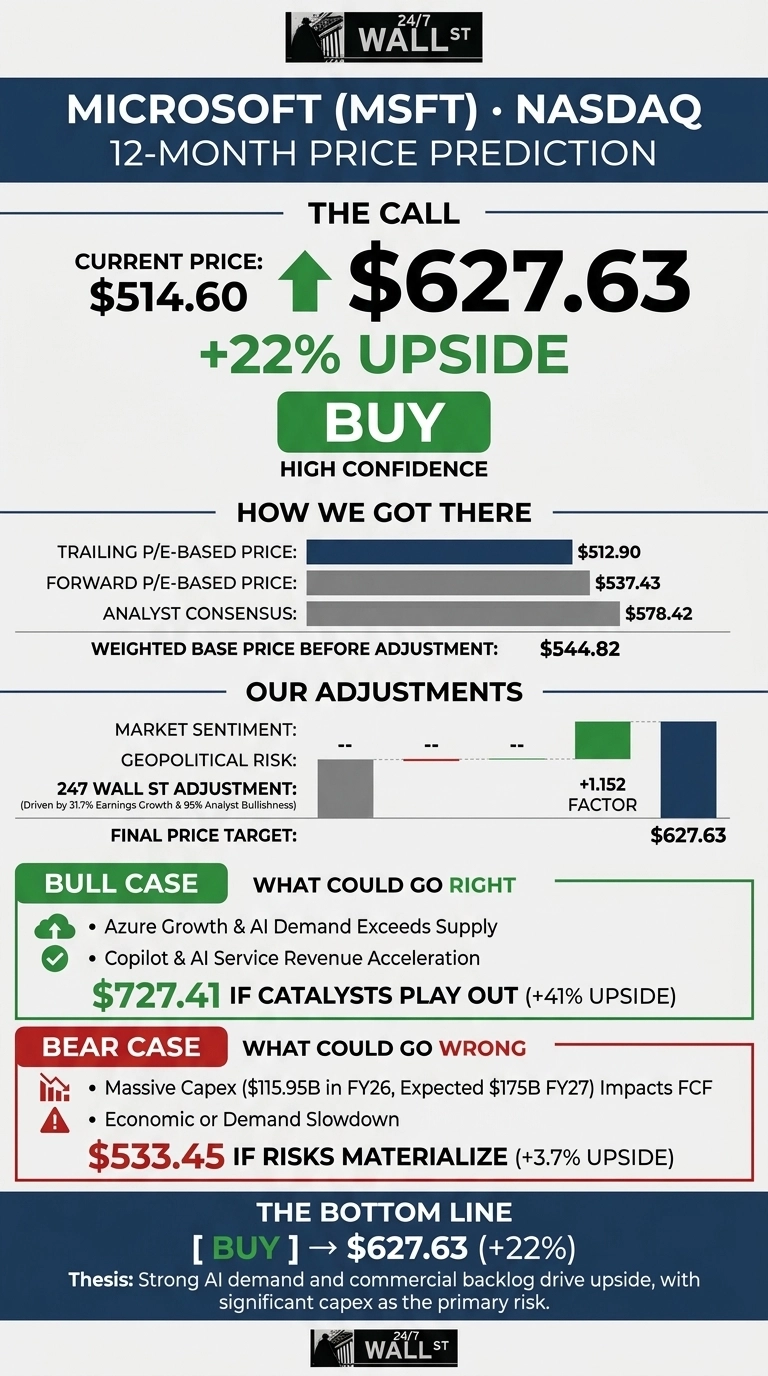
Microsoft (NASDAQ:MSFT | MSFT Price Prediction) trades at $514.60. The 24/7 Wall St. price target stands at $627.63 over the next 12 months, which implies 22% upside. The stock earns a buy rating with high confidence.
| Metric | Value |
|---|---|
| Current Price | $514.60 |
| Price Target from 24/7 Wall St. | $627.63 |
| Upside/Downside | 22% |
| Recommendation | BUY |
| Confidence Level | 90% |

Three numbers ground my view: Azure passed $100 billion in annual revenue, commercial remaining performance obligations (RPO, meaning signed revenue not yet recorded) reached $678 billion, and Microsoft 365 Copilot topped 30 million paid seats. Few companies are turning AI demand into signed revenue this quickly.
A 30% Rally Since July Puts Microsoft Near Its Highs
Shares rose 2.8% over the past week and 7.08% year to date. The stock has gained 30% since mid-July and stands 6.3% below its 52-week high of $549.20.
Fiscal Q4 revenue of $90.01 billion beat estimates by 2.71%, and EPS of $4.74 topped the $4.24 consensus. A $3.2 billion Anthropic gain helped. Management guided next-quarter Azure growth to roughly 45% in constant currency.
Why Bulls See $727 Within Reach
Our bull scenario reaches $727.41, or 41% upside. Azure grew 40%, 39%, 40% and 43% across fiscal 2026, and roughly 30% of RPO should convert to revenue within 12 months. The CFO said “demand continues to exceed available supply.“
Copilot is switching to seat-plus-usage pricing, and GitHub Copilot reached 50 million users. Wall Street agrees: 14 analysts rate the stock a strong buy, 38 rate it a buy and 3 rate it a hold.

Capex Is the Number That Could Derail the Story
Our bear case lands at $533.45, a gain of only 3.7%. Fiscal 2026 capex rose 79.62% to $115.95 billion, and free cash flow slid 6.46%. Management expects fiscal 2027 capex of roughly $175 billion. Excluding OpenAI, RPO grew 25%, and Windows OEM revenue is expected to fall in the high teens.

Bulls counter that operating cash flow rose 34.35%, management expects free cash flow to stay positive in fiscal 2027, and much of the spending goes to GPUs that the company can “just slow down” if demand cools.
Microsoft Looks Fairly Priced Next to Alphabet and Amazon
Alphabet (NASDAQ:GOOGL) competes directly with Azure through Google Cloud, which grew 82% last quarter. Its 15 P/E looks cheap, but $99.03 billion in unrealized equity gains inflated earnings, and free cash flow turned negative.
Amazon (NASDAQ:AMZN) owns AWS, which grew 37%, yet it trades at 35 times earnings with trailing free cash flow of -$7.6 billion.
| Company | Trailing P/E | Latest Cloud Growth |
|---|---|---|
| Microsoft (Azure) | 28 | 43% |
| Alphabet (Google Cloud) | 15 | 82% |
| Amazon (AWS) | 35 | 37% |
Of the three, Microsoft is the only one still producing solidly positive free cash flow, at $66.99 billion. A 26x forward multiple makes our target look reasonable compared with this group.
Microsoft Price Prediction 2026-2030
The 24/7 Wall St. price target of $627.63 carries a buy rating and 90% confidence. The signed backlog is a key factor, and the case strengthens if Azure hits its 45% guide and Copilot usage revenue compounds.
I would turn cautious if fiscal 2027 capex outpaces revenue growth or free cash flow turns negative. At current levels, the model’s scenarios lean toward the upside.
Looking further ahead, here is where our model projects Microsoft could trade at each year-end, assuming current growth trends hold.
| Year | Price Target from 24/7 Wall St. |
|---|---|
| 2026 | $538.42 |
| 2027 | $647.99 |
| 2028 | $729.19 |
| 2029 | $832.41 |
| 2030 | $908.45 |
The projections rest on Microsoft executing its AI strategy. Results could swing widely based on returns from AI infrastructure spending and backlog dependency on OpenAI.
Contact [email protected] for any questions or corrections.
Vandita Jadeja is a financial publisher with over a decade of experience writing about financial topics, including investment, savings, retirement, insurance and banking. Vandita is a Chartered Accountant who loves to debunk financial concepts for readers.
Her work has appeared on sites that include The Motley Fool, InvestorPlace, and Benzinga. She covers investing and focuses on stock picks and price prediction for 24/7 Wall St.
When not looking for the next stock investment opportunity, she can be found traveling, reading, chasing sunsets and enjoying her iced latte.