Norwegian Falls 3% as Wells Fargo Trims Carnival Target on Caribbean Pricing Pressure; Carnival Slips, Royal Caribbean Dips
A Wells Fargo note about Carnival is hitting Norwegian Cruise Line the hardest, and the reason why reveals exactly which operator the market sees as most exposed to the Caribbean pricing storm now moving through the sector.

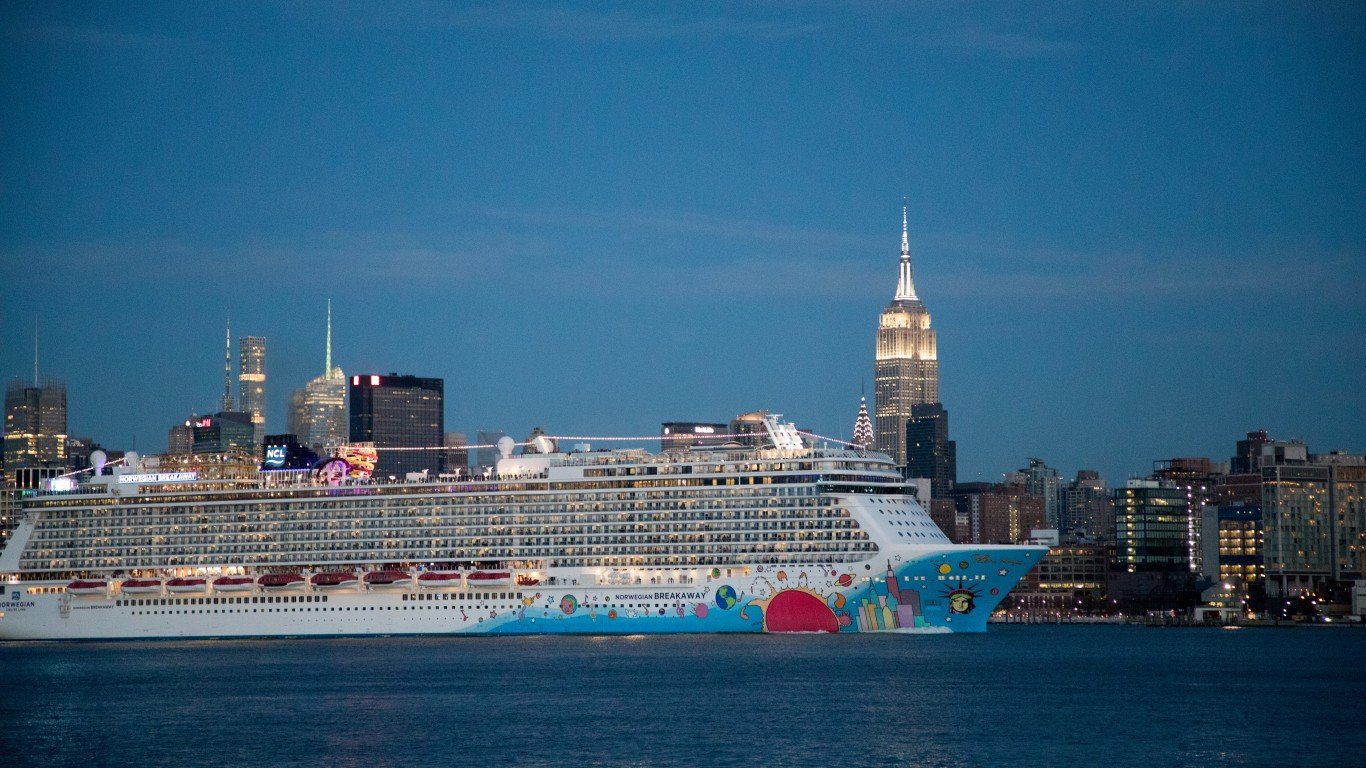
Norwegian Cruise Line Holdings (NYSE:NCLH | NCLH Price Prediction) is leading a cruise-sector pullback midday Tuesday after Wells Fargo trimmed its price target on a rival operator and cited Caribbean pricing pressure. Norwegian stock is down 3% to $14.28, extending a stretch that has left it the group’s weakest name and the biggest decliner among the three cruise majors today.

Carnival Corporation (NYSE:CCL) is the actual subject of the Wells Fargo note, yet Carnival stock is holding up better than Norwegian, down 2% to $22.03. Royal Caribbean (NYSE:RCL) stock is faring best of the three, off 2% to $250.98, thanks to a broader itinerary map and premium-brand positioning.
The SPDR S&P 500 ETF Trust (NYSEARCA:SPY) is down 0.5% to $757.17, so the broader market isn’t offering much cover. Energy is moving the other way: the Energy Select Sector SPDR ETF (NYSEARCA:XLE) is up 2% to $65.69. That energy strength matters here because fuel is one of the largest variable costs for Norwegian, Carnival and Royal Caribbean.
Wells Fargo Trims Carnival Target on Caribbean Pricing
Wells Fargo lowered its price target on Carnival to $36 while keeping its Overweight rating, saying the reduction doesn’t reflect a change in its constructive view of the company or its longer-term prospects. The firm cited cheaper alternatives in the Caribbean that are making it harder for operators to push pricing and hold previously expected yield levels through Carnival’s current fiscal fourth quarter and the first half of next year.
The note was written about Carnival, yet Norwegian stock is falling harder than Carnival’s. That’s the familiar pattern when a sell-side concern about pricing gets read across to whichever operator carries the most risk, and Norwegian enters today’s session with the softest setup in the sector.
Norwegian Carries the Sector’s Weakest Setup
Norwegian stock has fallen 25% over the past month, so the company didn’t need a fresh sell-side warning to look vulnerable. In its most recent update, Norwegian cut full-year 2026 adjusted EPS guidance to $1.50 with net yield expected to decline 5% in constant currency, and Q3 2026 net yield is guided to decline 8.9%. CEO John Chidsey has framed the year as an early-stage turnaround with an additional $100 million of annualized cost savings identified.
Royal Caribbean’s relative resilience owes to scale and itinerary mix. A broader deployment map dilutes the Caribbean pricing problem Wells Fargo flagged, with the Caribbean representing 57% of Royal Caribbean’s full-year 2026 capacity and its most recent quarter delivering adjusted EPS of $4.21 on revenue of $4.83 billion. Management has since raised full-year 2026 adjusted EPS guidance for Royal Caribbean to a range of $17.73 to $17.87.
Carnival’s fundamentals have held up as well, with a 12th consecutive quarter of record net yields and customer deposits at a record $9 billion. The company has continued to lean on private destinations such as Celebration Key and Relaxaway Half Moon Cay to defend pricing, with Carnival 93% booked for 2026 at historically high prices in constant currency.
The macro backdrop cuts both ways for cruise operators. University of Michigan consumer sentiment came in at 55.2 in its latest reading, a recovery from 44.8 in May but still in territory the survey classifies as pessimistic. On the cost side, Norwegian has flagged fuel per metric ton net of hedges rising to $888 from $659 year over year, and that fuel drag is why today’s energy rally matters even as the Wells Fargo note steals the headline.
What to Watch
Carnival has scheduled a fiscal Q3 2026 earnings conference call, which could be the next official venue for management commentary on Caribbean bookings and pricing. Investors can watch for whether Carnival’s read on the region gives Norwegian’s turnaround narrative any incremental support or instead reinforces the Wells Fargo concern.
The bull case for Norwegian is that the stock already reflects a great deal of bad news after a drop of this size, with Wells Fargo’s $36 price target on Carnival still implying constructive framing across the space. The bear case is that soft Caribbean pricing and rising fuel costs squeeze Norwegian’s margins from both ends at once, especially with WTI crude oil recently topping $105 per barrel. Anyone sizing new exposure to Norwegian may want to keep their positions modest into that call.
Contact [email protected] for any questions or corrections.
David Moadel is financial writer specializing in stocks, ETFs, options, precious metals, and Bitcoin. David has written well over 1,000 articles for leading online publications, helping investors understand markets, income strategies, and risk.His work has appeared in The Motley Fool, InvestorPlace, U.S. News & World Report, TipRanks, ValueWalk, Benzinga, Market Realist, TalkMarkets, Finmasters, 24/7 Wall St., and others.With a master’s degree in education, David has taught at the elementary, high school, and college levels. That teaching background shapes his writing style: clear, educational, and practical. David has also built a loyal social-media audience by providing trustworthy financial content on YouTube, X/Twitter, and StockTwits.