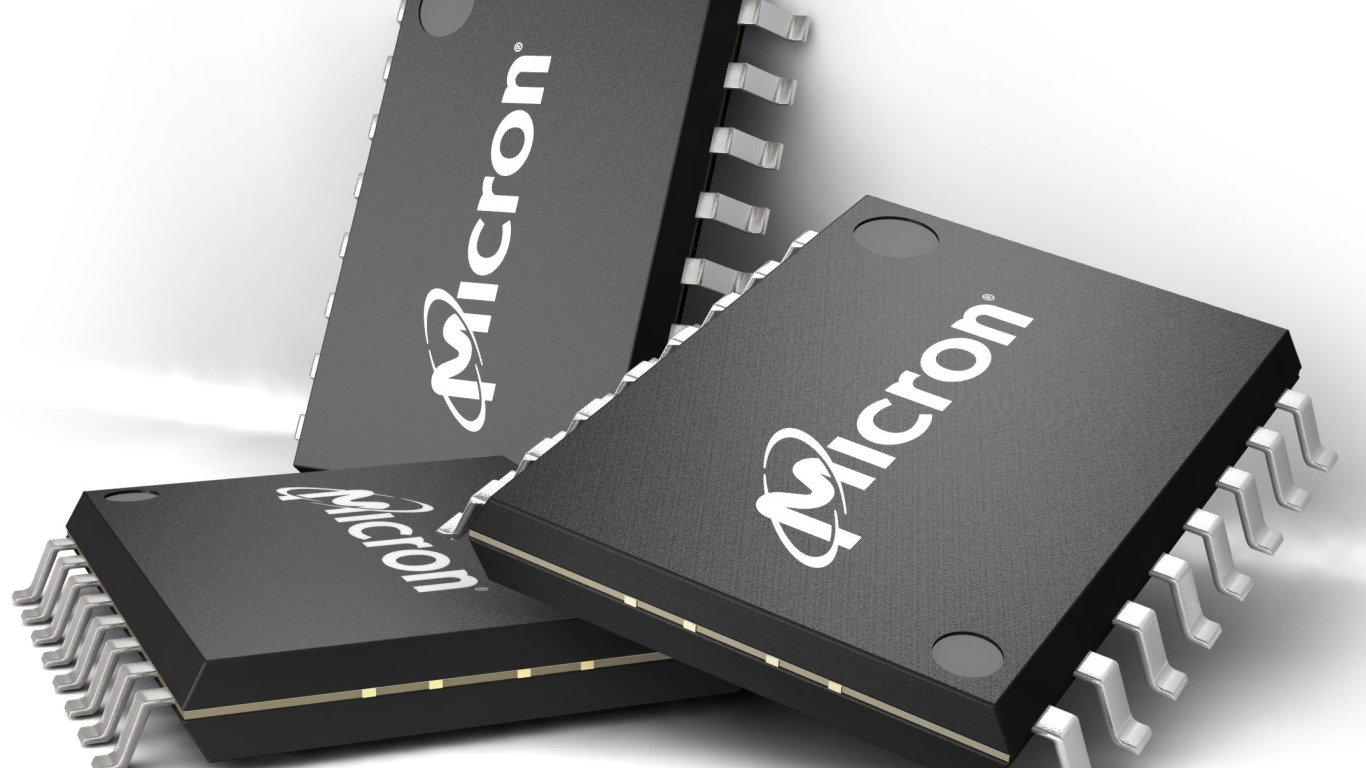
Micron Trades Hands at $927: Here’s What You Should Do
Micron posted a blowout quarter, locked in $100 billion in committed revenue contracts, and then watched its stock slide anyway. Before you buy into a company sitting at the center of the AI memory boom, there is a specific earnings…

This post may contain links from our sponsors and affiliates, and Flywheel Publishing may receive compensation for actions taken through them.

At $927.60, Micron Technology (NASDAQ:MU | MU Price Prediction) is a Hold. The memory maker just posted $41.46 billion in fiscal Q3 revenue, guided fiscal Q4 to $50 billion, and then watched its stock drop 7.26% in a week as tech leaders publicly called for an AI slowdown.
Micron is the only U.S.-based DRAM and NAND manufacturer, and it now sits at the center of the AI capital-expenditure cycle through high-bandwidth memory (HBM) sold into accelerator platforms. A year ago the stock traded near $157.51. Today its market cap is roughly $1.05 trillion, and the debate now centers on whether the pricing and volume assumptions embedded in $927 can survive any wobble in hyperscaler spending.
Why the Bulls Think $927 Is Still Cheap
The bull case starts with forward earnings. Analysts model fiscal 2027 EPS averaging $156.07 on revenue of roughly $244 billion. Against that, Micron trades at a forward P/E of 6, an unusual multiple for a company guiding 86% GAAP gross margins.
Then there are the Strategic Customer Agreements. Management disclosed 16 SCAs covering roughly 20% of DRAM volume and one-third of NAND volume, with $100 billion in minimum committed revenue and take-or-pay floor pricing. Fourteen Wall Street firms rate MU Strong Buy or Buy against just 4 Holds and zero Sells. The consensus target of $1,513.11 implies substantial upside, though targets are not guarantees.
Why the Bears See a Cyclical Peak
Memory has always been cyclical, and Micron just printed a GAAP gross margin of 84.6% versus 37.7% a year earlier. Peak margins rarely mark good entry points. Management already flagged “a meaningful moderation in the rate of price increases” for fiscal Q4, and the shares fell after tech executives publicly called for an AI capacity slowdown.
Concentration risk is real: HBM4 high-volume shipments hinge on a single lead customer, and fiscal 2026 capex is running near $27 billion. A beta of 2.22 means any AI-spending scare hits MU harder than the broader market. Layer in a Taiwan union pressing a profit-sharing demand with strike preparations, and the near-term risk profile is not clean.
The wider tell is where the money is going: hyperscaler capex is funding power, cooling, and networking as aggressively as it is funding silicon, and we mapped seven suppliers riding that buildout in a free report you can grab here.
Why Patience Beats Conviction Right Now
The picture is genuinely unclear. Fundamentals are extraordinary, but so is the setup. A quantitative model pegs fair value at $963.59, only 3.88% above spot, with a bull case of $1,345.57 and a bear case of $716.20. That is a fair-value zone with wide tails, not a screaming buy.
Investors should watch the fiscal Q4 earnings report against the $50 billion revenue and $31.00 EPS guide, hyperscaler capex commentary, and whether HBM4 pricing holds as supply catches up in calendar 2028.
What the Numbers Say About $927
MU currently trades at $927.60, against an analyst target of $1,513.11 from 48 covering analysts, implying meaningful upside if targets are met. Ratings skew heavily bullish:
- Strong Buy: 9
- Buy: 35
- Hold: 4
- Sell: 0
Valuation looks split: a trailing P/E of 21 versus a forward P/E of 6, with EBITDA of $68.2 billion and TTM revenue of $90.3 billion. Performance is where the divergence really shows. MU is up 488.9% over the past year and 225.21% year to date, while the S&P 500 gained 14.6% and 11.07% over the same periods. Over one month, MU is down 4.53% versus SPY down 2.44%.
Verdict: Hold Until the Cycle Confirms
At $927, Micron is a Hold. Here is why.
Two conditions would flip this to a Buy. First, fiscal Q4 delivering on the $50 billion revenue and $31.00 EPS guide with commentary that HBM4 pricing is holding into calendar 2027. Second, a pullback into the $716 to $800 zone, which would offer a genuine margin of safety against a cyclical correction.
Two conditions would flip it to a Sell. Any concrete sign that hyperscaler AI capex is decelerating, or a downward revision to the SCA framework that undermines the take-or-pay economics that justify a mid-single-digit forward multiple.
The cost of patience here is small. Base-case modeling puts one-year upside at just 3.88%, while the bear case implies 22.79% downside. That is not the payoff profile of a stock to chase after a 489% run. Wait for the fiscal Q4 report and the AI-spending narrative to settle before adding.
Contact [email protected] for any questions or corrections.
Alex Sirois is a financial writer with experience spanning both retail and institutional investing. He has written for InvestorPlace and held roles at BNY Mellon and Bernstein, giving him a perspective that bridges Main Street portfolios and Wall Street analysis.
Alex holds an MBA from George Washington University and has built his career across multiple industries, including e-commerce, education, and translation — a breadth of experience that informs how he breaks down complex financial topics for everyday investors. His writing is conversational, actionable, and grounded in long-term, buy-and-hold investing principles.
At 247 Wall St., Alex focuses on delivering analysis that is both accessible and useful, with a clear emphasis on helping readers make more informed decisions with their money.