Despite Hype, Broadcom Keeps Edging Sideways and Down: This Wall Street Analyst Says It Will Provide 75% Returns Soon
Broadcom just posted its ninth consecutive earnings beat and guided AI revenue up 236% year-on-year, yet the stock keeps sliding while the rest of the sector holds firm. One top analyst thinks the selloff created a rare window that closes…

This post may contain links from our sponsors and affiliates, and Flywheel Publishing may receive compensation for actions taken through them.
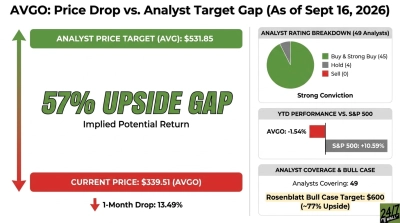
Broadcom (NASDAQ:AVGO | AVGO Price Prediction) currently trades at $339.51, well below the average Wall Street 12-month price target of $531.85, a gap that implies roughly 57% upside from here.
Broadcom is now the second-largest US semiconductor company by market capitalization at roughly $1.62 trillion, sitting behind only NVIDIA. Its role in the AI buildout has shifted from “one of many” to the custom silicon partner of choice for hyperscalers like Google, Meta, OpenAI, and Anthropic. That is why the disconnect between the fundamentals and the share price has drawn analyst attention.
The setup is unusual. Broadcom just posted its ninth consecutive EPS beat and guided Q4 AI semiconductor revenue to $21.7 billion, up 236% year-on-year. And the stock keeps drifting the wrong way.
Why AVGO Keeps Grinding Lower Despite Blowout Numbers
The headline damage is the one-month move, with the stock down 13.49% against a Q4 revenue guide of roughly $34.8 billion, up 93% year-on-year. The pullback accelerated after CNBC reported Anthropic had pushed Broadcom to slow the pace of AI capacity deployment. Broadcom’s chief executive publicly said the underlying AI revenue targets have not changed.
The bigger issue is positioning. AVGO ran to roughly $495 at its Q2 filing before sliding to $371.27 at the Q3 release, and it has given back more ground since. Investors are questioning whether the fiscal 2028 AI outlook of $230 billion reflects secured supply more than secured demand, and whether concentration among a handful of hyperscaler customers is a strength or a single point of failure.
The selloff has been AVGO-specific rather than a group event. The S&P 500 is up 10.59% YTD, while AVGO is down 1.54% YTD and off 5% over the past year, an outlier among big-cap AI names.
Rosenblatt’s $600 Call Frames the Bull Case
Rosenblatt Securities analyst Sajal Dogra raised the firm’s price target to $600 from $500 with a Buy rating. Against the current $339.51 quote, that works out to roughly 77% upside, well above the 40% threshold that makes this the analytical centerpiece here.
The math behind $600 is straightforward: an 18x P/E applied to a fiscal 2028 non-GAAP EPS estimate. Management said on the last call it is “very much on target to exceed $30 in earnings per share in fiscal 2028”. Rosenblatt argues the multiple is defensible because AI revenue is guided to roughly $115 billion in FY2027 and $230 billion in FY2028, and because actual end-market demand outstrips those figures, with real-world revenue bottlenecked by physical data center power, shell readiness, and deployment pace. All of that buildout has to be powered, cooled, and networked by somebody, and we profiled seven of those suppliers in a free report on the non-chip winners of the AI boom.
Socket quality matters just as much. Broadcom is shipping Ironwood TPU v7 in high volume to Google and has begun production shipments of TPU v8i, which CEO Hock Tan said is “comparable if not surpasses the Vera Rubin GPU”. Anthropic is on track to become Broadcom’s largest XPU customer in fiscal 2027, with OpenAI’s Jalapeno accelerator scaling to a planned 1.3-gigawatt deployment the same year. Rosenblatt concedes Broadcom’s incremental TPU market share may taper from roughly 80% to 85% today toward 60% to 65% by FY2027, but higher dollar content per socket should offset the unit dilution.
The Street is aligned on direction. Of 49 covering analysts, 8 have it Strong Buy, 37 Buy, 4 Hold, and zero Sells. Fiscal 2027 EPS estimates have been revised up 6 times in the past 30 days against 1 downward revision.
How the AI Chip Peer Group Stacks Up
Broadcom fell alone while the group held up.
NVIDIA (NASDAQ:NVDA) trades at $213.90 against a $328.66 average target, roughly 54% implied upside. It is up 14.96% YTD, with 57 of 60 covering analysts at Buy or Strong Buy, and Data Center revenue up 117% year-on-year last quarter.
Advanced Micro Devices (NASDAQ:AMD) sits at $512.50 with a $616.51 target, only about 20% upside. AMD is up 139.31% YTD after Data Center revenue grew 107% year-on-year. Posture is mostly Buy with 11 Holds mixed in. The Street has largely caught up here.
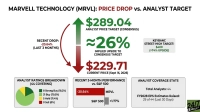
Marvell Technology (NASDAQ:MRVL) trades at $229.71 against a $289.04 target, roughly 26% upside. Its custom silicon story has re-rated the shares 170.7% YTD, leaving less room to run despite a supportive analyst posture.
The largest analyst-implied upside in the group sits with AVGO, and it is not close. Broadcom is the only name here where the target has widened against a falling share price. Targets are one data point among many, but the direction is telling.
Numbers Behind the Dislocation
Broadcom trades at $339.51 with a 12-month consensus target of $531.85 across 49 analysts, implying roughly 57% upside. Shares are down 6.83% over the past week and 13.49% over the past month. Year-to-date, AVGO is off 1.54% while the S&P 500 is up 10.59%, a roughly 12-point gap against the benchmark.
Analyst ratings breakdown:
- Strong Buy: 8
- Buy: 37
- Hold: 4
- Sell: 0
- Strong Sell: 0
Forward valuation is where the tension lives. On fiscal 2027 consensus EPS of $19.3839 across 47 analysts, AVGO trades at roughly 18x forward earnings, essentially in line with the multiple Rosenblatt applied to its 2028 estimate. The trailing P/E of 43 looks steep, while the forward multiple looks reasonable.
Bull and Bear Cases for AVGO From Here
The bull case works if fiscal 2028 AI semiconductor revenue lands anywhere near the $230 billion Hock Tan is guiding to, and if Anthropic, OpenAI, and Google keep validating custom silicon at the current pace. In that world, the Rosenblatt $600 target is not aggressive, and today’s $339.51 quote is a gift. Analyst targets are not guarantees, but the path back involves execution on already-secured supply.
The bear case builds if the Anthropic pace-slowing story is a leading indicator rather than a one-off, or if the residual value exposure sitting inside Broadcom’s XPU financing platform with Apollo and Blackstone quietly grows. Customer concentration cuts both ways: three or four hyperscalers changing their capex cadence would reprice this stock overnight.
The setup skews bullish. Too many blowout data points, too much analyst conviction, and too clean a fiscal 2028 EPS bridge to ignore just because the recent price action has been ugly.
Contact [email protected] for any questions or corrections.
Alex Sirois is a financial writer with experience spanning both retail and institutional investing. He has written for InvestorPlace and held roles at BNY Mellon and Bernstein, giving him a perspective that bridges Main Street portfolios and Wall Street analysis.
Alex holds an MBA from George Washington University and has built his career across multiple industries, including e-commerce, education, and translation — a breadth of experience that informs how he breaks down complex financial topics for everyday investors. His writing is conversational, actionable, and grounded in long-term, buy-and-hold investing principles.
At 247 Wall St., Alex focuses on delivering analysis that is both accessible and useful, with a clear emphasis on helping readers make more informed decisions with their money.