XRP Was the No. 2 Crypto in 2018. What Would It Take to Get Back There?
XRP once commanded second place among all cryptocurrencies, and some holders believe it can return there. But the math reveals a target far beyond any price the token has ever reached, and the catalysts meant to get it there are…

This post may contain links from our sponsors and affiliates, and Flywheel Publishing may receive compensation for actions taken through them.

XRP (CRYPTO:XRP) held the title of the No. 2 cryptocurrency by market value in 2018, but now ranks fifth. The token currently trades at $1.25, down 32% in 2026 and 66% from its peak of $3.65 on July 17, 2025.
In recent weeks, XRP has struggled, reaching a high of $1.52 on October 4 before dropping to $1.24 on October 29, and it has lost 17% over the past month. Nonetheless, holders still look to XRP’s previous ranking as a benchmark for its potential future rise.
Market value, or market cap, is determined by multiplying a token’s price by the total number of tokens in circulation. So, what will it take for XRP to reclaim its second-place status, and is it feasible by the end of 2027?
XRP Needs a $277 Billion Market Cap to Pass Ethereum
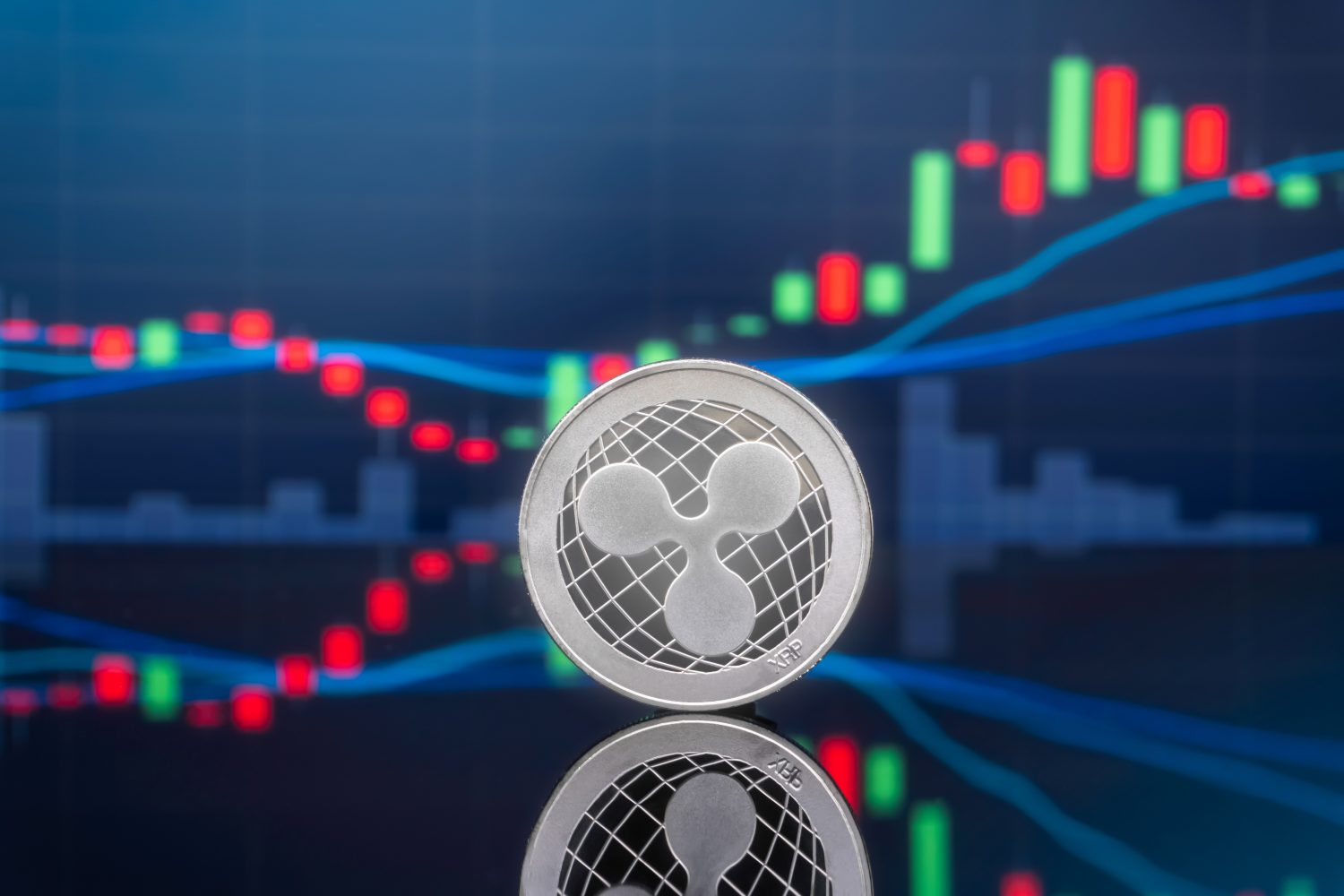
Currently, Ethereum (CRYPTO:ETH) holds the second position with a market cap of $277 billion. Tether (CRYPTO:USDT) is third at $180 billion, BNB (CRYPTO:BNB) is fourth at $94 billion, and XRP trails at $79 billion.
To match Ethereum’s market cap, XRP would need to reach approximately $4.37 per token, which is 3.5 times its current market value. This price point is nearly 20% above XRP’s all-time high. Additionally, XRP would need to surpass Tether, requiring a price of about $2.84. Climbing to fourth place is more within reach, as XRP would need to increase by 18% to around $1.48, a level it has previously exceeded.
Why XRP’s Record Price Still Falls Short of Second Place
XRP last held second place in early 2018, when it closed at $3.40 on January 6, representing a market value of $132 billion, before plunging to $0.51 by March 31. The situation worsened when the SEC sued Ripple, the company behind XRP, in December 2020. In July 2023, a judge ruled that XRP’s retail sales did not violate securities law, and by August 2025, both parties withdrew their appeals.
However, one of the main issues facing XRP is supply dilution. Dilution occurs when more tokens enter circulation, causing the market value to rise even if the price stays the same. In January 2018, about 38.7 billion XRP tokens were in circulation. Now, that number has increased to 63.4 billion, up to a maximum supply of 100 billion.
With the current supply, XRP’s 2018 high of $3.40 would translate to a market cap of about $215 billion, and the $3.65 peak would result in a market cap of around $231 billion. Both figures fall short of Ethereum’s $277 billion, indicating that even at its best, XRP wouldn’t reclaim second place.
XRP ETFs and Ripple’s Bank Charter Haven’t Lifted the Price Yet
A spot ETF is a fund that holds the cryptocurrency directly and is traded on a stock exchange. As of October 30, U.S. spot XRP ETFs had $1.4 billion in net assets, compared to $13.2 billion in Ethereum ETFs. Since their launch, the cumulative net inflows for XRP ETFs reached $1.8 billion.
That said, recent inflow trends have been modest. Between October 2 and October 30, cumulative inflows increased by only about $18 million, and on October 30, the funds experienced about $500,000 in net outflows following a peak inflow of $8.4 million earlier that month. XRP’s price fell by 50% after closing at $2.50 on November 1, 2025, just days before the first U.S. spot XRP ETF launched on November 13, suggesting that these new funds alone weren’t sufficient to maintain the price.
On October 26, the OCC, the federal regulator for national banks, granted Ripple final authorization to establish Ripple National Trust Bank. This trust bank will hold and manage assets for clients, with federal oversight for certain reserves linked to RLUSD, Ripple’s dollar-pegged stablecoin that operates on the XRP Ledger.
Despite this development, XRP traders showed little enthusiasm. On October 25, the day before the approval, XRP traded at $1.29 and has since dropped by about 3%. While the trust bank could benefit Ripple as a company, XRP’s price will only rise if the bank’s clients buy and hold the token.
Can XRP’s Market Cap Climb Back to No. 2 by 2027?
XRP has a fair chance of surpassing BNB to reclaim fourth place, though the chance of reaching second place by the end of 2027 is low. To move into fourth, XRP may need just a solid rally. However, regaining the second spot would require a new all-time high.
XRP likely must first regain its 200-day moving average of $1.28 and its 50-day moving average of $1.39. If it fails to reach $1.39 by the end of December, expectations that it will return to second place may be premature.
If BNB stays stable, a daily close above $1.48 could help XRP climb into fourth, especially if ETF assets rise above the $1.7 billion mark from October 6. To climb to second place, XRP would need to clear $2.84, its $3.65 record, and $4.37, likely requiring ETF assets closer to Ethereum’s $13.2 billion. However, if inflows remain stagnant and the trust bank doesn’t drive demand, XRP could drift back toward its recent low of $0.99 from August 16.
Contact [email protected] for any questions or corrections.
Sam Daodu is a crypto analyst and the editor of 24/7 Wall St.'s Crypto Desk, where he covers Bitcoin, XRP, Ethereum, Solana and the altcoins investors search for most. His work focuses on price levels, spot ETF flows, on-chain data and the regulatory decisions that move crypto markets, written so a first-time buyer and a seasoned trader can both use it.
Sam has written about crypto professionally since 2019 and has published more than 2,000 articles. Before joining 24/7 Wall St., he wrote for crypto media outlets and Web3 companies and ghostwrote for crypto founders and token launches. His analysis is syndicated on Yahoo Finance, MSN and AOL and has been cited by other crypto news sites. He also founded MacLabs Marketing, a content and personal branding agency for crypto founders and executives.
When he isn't reading charts, Sam is usually at the gym or watching One Piece, a series he maintains has better tokenomics than most altcoins.