McDonald’s CEO Admits Execution Failure as K-Shape Economy Splits Consumer Base
McDonald's is supposed to be the stock that holds up when consumers fall apart, so why is it trading like the crisis is already here while retail spending hits record highs? The answer exposes a fracture in the American consumer…

This post may contain links from our sponsors and affiliates, and Flywheel Publishing may receive compensation for actions taken through them.
McDonald’s (NYSE:MCD | MCD Price Prediction) exists in most portfolios for one reason: it is supposed to work when the consumer does not. That thesis is what broke on Wednesday. Shares closed at $248.51, down 1.69% on the session and 17.1% lower year to date, sinking McDonald’s to its lowest level in two years.
The awkward part is what is happening around the stock. Headline retail sales rose 1.2% in August to $773.9 billion, the highest reading in the supplied series. Aggregate spending is fine. The stock, designed to be a shelter when it is not fine, is trading as the storm has already arrived.
On CNBC’s Fast Money, trader Guy Adami framed the move without hedge: “When you go from an all-time high earlier this year to a multiyear low today, that’s got to be telling you something. And again, it’s not in a vacuum. It’s what we heard.” He noted McDonald’s is down 27% from its highs of the year. The relevant question is what that price action signals, and whether it has created a level worth acting on.

A Read on the Customer
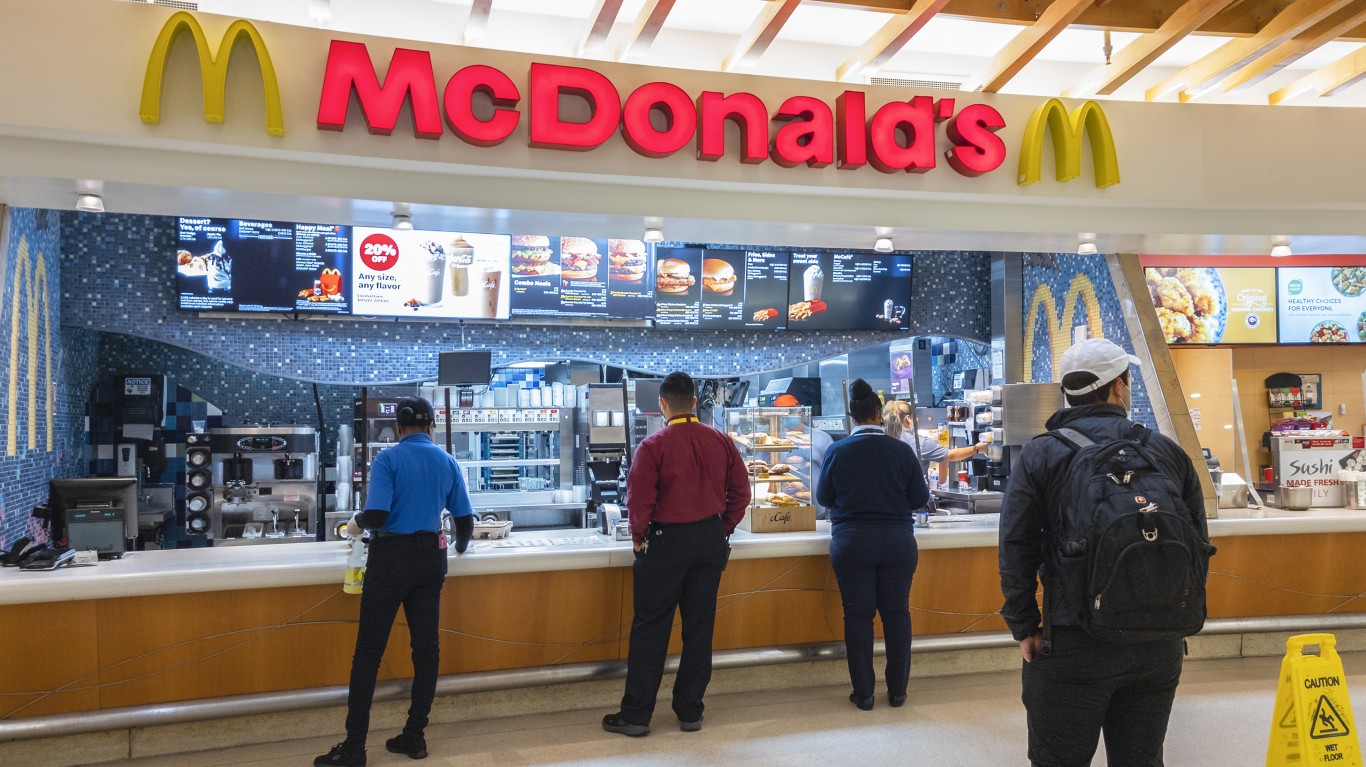
McDonald’s problem this quarter was traffic, with visits falling even as it held competitive share. U.S. comparable sales grew just 0.8% in the second quarter, and U.S. guest counts turned negative, while global comps decelerated to 1.3% from 3.8% a year earlier.
That happened as CEO Chris Kempczinski told investors, “We don’t have a strategy problem. We simply didn’t execute at the level we needed to in the second quarter.” Even accepting that, execution issues explain only about two-thirds of the traffic miss.

The rest lives in the customer. University of Michigan consumer sentiment sits at 55.2, still well inside the pessimism zone even after a bounce. Both a strong retail sales reading and a weak McDonald’s stock can be true because they measure different households.
K-Shape Economy Explains the Dispersion
Adami’s mechanism was the split economy: “There’s two different types of consumers, and it goes back to the K-shape economy. Some are struggling and some are doing really, really well. You’re going to see a lot more dispersion within stocks and within retailers.”
McDonald’s marginal customer is the lower-income visitor who trades down from casual dining or up from home. When that household pulls back, a value chain loses traffic first, because there is no cheaper option to trade down to.
Value promotions defend share but compress unit economics. McDonald’s launched an under-$3 everyday affordable price menu and a $4 breakfast meal deal, and still watched SG&A jump 17%. Winning a discounting war costs money even when you win.
That is why the K-shape produces dispersion rather than a uniform selloff. High-end names catch a bid from the top half, while chains anchored on the bottom half re-rate lower even as the aggregate spending index holds.
Higher Rates Make the Wound Deeper
The 10-year Treasury yield hit 5.00% on September 15, its high in the supplied series. That does two things to this stock at once.
It raises the competing yield on a defensive holding whose dividend sits at 2.91%, and it tightens the budget of the exact household McDonald’s needs back in the drive-thru. Credit card delinquencies at 2.85% sit in the “normalizing” band, not yet stress, but the direction of rates argues against fast relief.
Analyst estimates are only starting to reflect this. Fiscal 2027 EPS has seen 26 downward revisions against 3 upward in the trailing 30 days, moving the average from $14.22 to $13.98. Numbers are catching down to traffic, with more likely to come.
Bull and Bear Case for MCD Stock
The bull case is real. McDonald’s earns a 46.1% operating margin and a 31.9% net margin on a franchised base, opened 1,915 net restaurants over the past year, and is buying back stock at a 4.09% free cash flow yield. At roughly 19x the 2026 estimate of $12.93, you are paying a below-average multiple for the world’s dominant quick-service franchise, as detailed in the Q2 2026 8-K.
The bear case is that a defensive stock bought during a consumer downturn is only defensive if the downturn ends. Estimates are still moving the wrong way, the 10-year is at a series high, and management’s own plan does not have marketing “fully back to where we need to be” until 2027. Owning MCD here means underwriting both a customer recovery and a rate reprieve.

The variable that settles it is same-store traffic, not same-store sales. Price and mix can carry a quarter’s comp. Guest counts cannot be faked, and until that line turns positive in the U.S., every rally in this stock is a trade rather than a thesis.

Contact [email protected] for any questions or corrections.
Omor Ibne Ehsan is a writer at 24/7 Wall St. He is a self-taught investor with a focus on growth, cyclical, and dividend equities that have strong fundamentals, value, and long-term potential. He also has an interest in high-risk, high-reward investments such as penny stocks.