The AI Boom Has a Power Problem. These 3 Utilities Are Getting Paid to Solve It.
PJM capacity prices just hit the ceiling for the third straight auction, and the utilities scrambling to meet hyperscaler demand are not all playing the same game. Three names are getting paid to solve the grid crisis in very different…


US data center demand has outrun the grid’s ability to add generation, and the power buyers know it. PJM’s most recent Base Residual Auction for the 2028/2029 delivery year cleared at $325.00/MWd, the third straight auction to settle at the price cap, with uncapped prices that would have settled in excess of $500 a megawatt day. Interconnection queues, transmission bottlenecks, and generation adequacy shortfalls are the binding constraints, and the three names below are the ones getting paid to solve them. One is a rate-regulated utility that earns an allowed return on capital it invests to serve load. The other two are merchant generators whose cash flows swing with power and capacity prices. Same tailwind. Very different engines.
NextEra Energy: Regulated Rate Base Meets a 21 GW Pipeline
NextEra Energy (NYSE:NEE | NEE Price Prediction) is the parent of Florida Power & Light, a rate-regulated utility, plus NextEra Energy Resources, a contracted renewables and storage developer. Market cap sits at ~$169.1B, with shares up 16.63% over the past year. The regulated model matters here: FPL cannot simply charge a hyperscaler the market-clearing price. It invests capital, and the Florida commission allows it to earn a return on that investment through base rates. That is why the large-load tariff is the story.
On the Q2 call, management said FPL has roughly 21 gigawatts of large load interest, with 12 gigawatts in advanced discussions, and expects to announce at least one large load transaction under FPL’s tariff by the end of the year. Each gigawatt is initially expected to represent roughly $2 billion of capex earning the same ROE as other FPL investments. Q2 adjusted EPS came in at $1.15 vs $1.10 consensus, and FPL’s regulatory capital employed grew approximately 9.3%. The NEER backlog is now ~35.1 GW, and the Duane Arnold nuclear restart remains on track for no later than Q1, 2029.
Bull case: a regulated cash flow foundation growing at a target of 8%+ adjusted EPS CAGR through 2032, with a visible large-load pipeline that converts directly into rate base. Risk: the pending Dominion combination carries regulatory approval risk across Virginia, North Carolina, South Carolina, FERC and NRC, and clean-energy policy remains a live variable.

Vistra: Merchant Fleet Selling Into a Bid It Has Never Seen
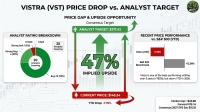
Vistra (NYSE:VST) is a merchant IPP with a dispatchable Texas and PJM fleet spanning gas, nuclear, coal, solar, and storage, plus integrated retail. Market cap is ~$47.5B. Unlike FPL, Vistra sells power into competitive markets. When PJM capacity clears at the cap and hyperscalers pay premiums for existing nuclear baseload, the upside flows to shareholders rather than being credited back to ratepayers. The downside works the same way.
Q2 Ongoing Operations Adjusted EBITDA was $1.77B, up more than 30% YoY, though GAAP results absorbed $472M of unrealized mark-to-market losses on hedges. Vistra signed long-term power purchase agreements with Meta at PJM nuclear sites, expected to contribute to Adjusted EBITDA in 2027, and formed Helix Digital Infrastructure with NVIDIA, KKR, and the Kuwait Investment Authority, with Vistra committing up to $1 billion to be invested over time, $100 million subject to the achievement of certain milestones. CFO Chris Moldovan told analysts that Cogentrix and the Meta PPA together “could reasonably conclude that they’d add roughly $700 million to our midpoint opportunity” in 2027. CEO Jim Burke framed the customer economics bluntly: “The large load customers, they are interested in contracting with existing, and they are interested in contracting at a premium with existing because it’s still a discount to what new build costs.”
Bull case: dispatchable baseload directly exposed to soaring PJM and ERCOT capacity prices, hyperscaler contracts in hand, and ~$6.5B of buybacks executed since Nov 2021, reducing shares outstanding ~30%. Risk: this is a merchant business. Cash flows move with power prices, GAAP earnings will keep getting distorted by hedge marks, and only ~72% of 2028 volumes are hedged. Shares are down 33.36% over the past year despite the operational tailwind.

Talen Energy: Nuclear Baseload in PJM at the Right Moment
Talen Energy (NASDAQ:TLN) is a nuclear-heavy merchant producer in PJM, anchored by Susquehanna. Market cap is ~$13.5B. Talen is the purest expression of the merchant nuclear thesis: 24/7 baseload capacity selling into a capacity market that just cleared at the cap and an energy market where PJM demand is forecasted to grow over 17% through the end of the decade.
Q2 Adjusted EBITDA was $374M vs $90M YoY, capacity revenue jumped to $237M from $88M, and Talen cleared over 10 GW in the 2028/2029 PJM Base Residual Auction at $325.00/MWd. Management raised 2026 Adjusted EBITDA guidance to $2.025-$2.225B from $1.75-$2.05B. The Cornerstone acquisition closed June 15, 2026, adding ~2.6 GW of gas capacity at Waterford, Darby, and Lawrenceburg. The powered-land flywheel now covers a pipeline of approximately 4 GW of land development and data center contracting options. CEO Mac McFarland put the customer thesis this way: “We believe blending new capacity with existing energy on a front-of-the-meter grid-connected site is more reliable and durable, and, in fact, less expensive than any behind-the-meter solution.”
Bull case: nuclear baseload in the market where hyperscalers most need firm 24/7 power, with raised guidance across 2026, 2027 and 2028 and an existing AWS ramp at Susquehanna that management expects to reach full build-out sometime between 2028 and 2030. Risk: merchant exposure with heavy new debt from the Cornerstone financing ($4B new senior unsecured notes, total debt ~$9.5B), only ~30% of 2028 hedged, and Q2 GAAP results absorbed $211M unrealized commodity derivative losses. Shares are down 30.41% over the past year and 13.39% in the past week alone, a reminder of what merchant volatility looks like.

Reading the Three Together
Do not treat these as one trade. NEE turns data center load into rate base at an allowed return; its earnings compound whether power prices rise or fall, provided the commission signs off. VST and TLN monetize the same demand through capacity auctions, hyperscaler PPAs, and merchant energy sales, which is why their EBITDA has roughly doubled and their share prices have still been punished on power-curve moves. The AI power bid is real and the contracts are getting signed. What differs is who bears the volatility and who gets the upside. The utilities are one slice of this trade; the power, cooling, and networking suppliers feeding the same buildout are another, and we pulled seven of them into a free report here: 7 Stocks Powering the AI Boom (That Aren’t Chipmakers).
Contact [email protected] for any questions or corrections.
Joel South covers large-cap stocks, dividend investing, and major market trends, with a focus on earnings analysis, valuation, and turning complex data into actionable insights for investors.
He brings more than 15 years of experience as an investor and financial journalist, including 12 years at The Motley Fool, where he served as an investment analyst, Bureau Chief, and later led the Fool.com investing news desk. He has also co-hosted an investing podcast and appeared across TV and radio discussing market trends.