Nike Is No Longer a Growth Story. Is It a Dividend Story Yet?
Nike's stock has shed nearly half its value in a year, and suddenly the swoosh is flashing a yield income investors cannot ignore. But a fat dividend built on a collapsing share price is a very different animal from one…

This post may contain links from our sponsors and affiliates, and Flywheel Publishing may receive compensation for actions taken through them.
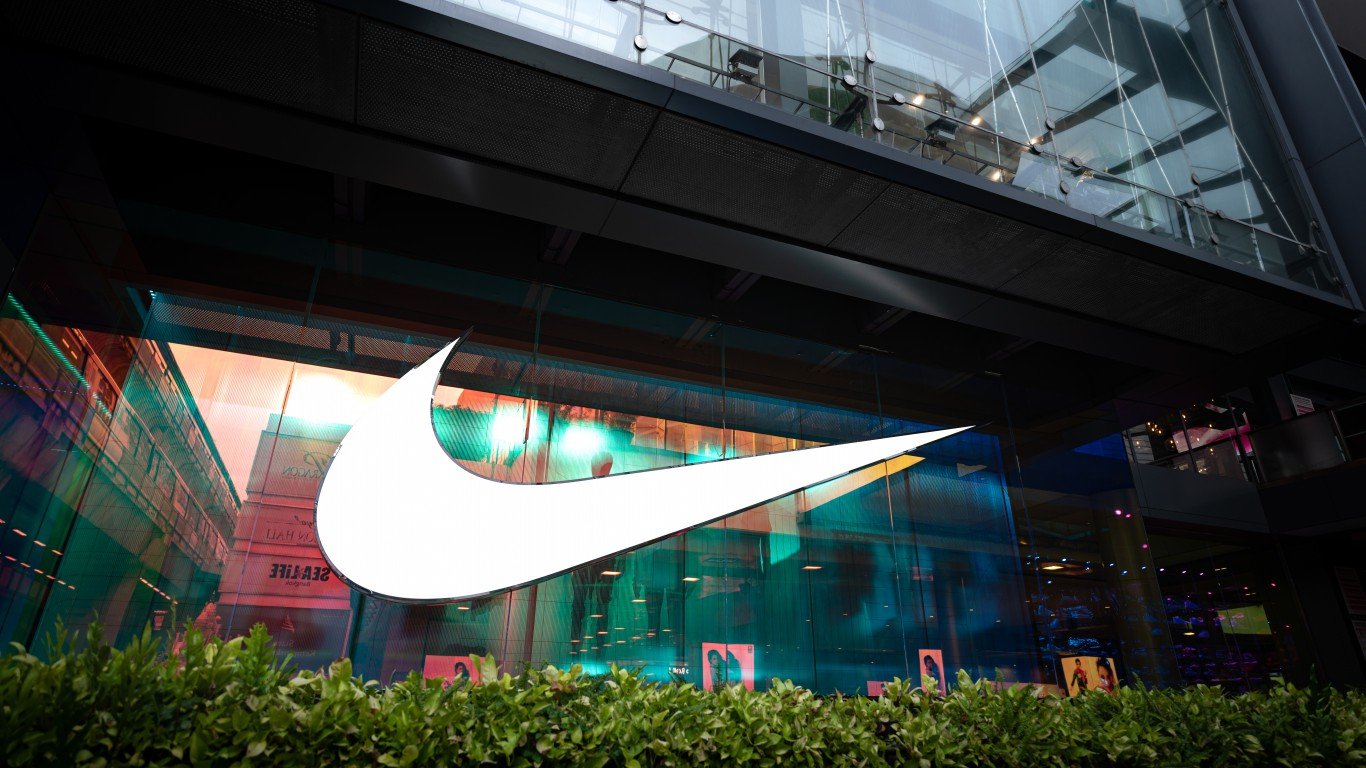
For most of the past three decades, owning Nike (NYSE:NKE | NKE Price Prediction) meant owning a compounder. That thesis has cracked. Shares are down 41.53% year to date and 48.16% over the past year, trading at $36.28 against a 52-week high of $74.51. Reuters reported this week that the slide has put Nike’s Dow seat in jeopardy. Barron’s echoed that Nike’s days in the Dow may be numbered. So the question owners now have to answer is uncomfortable: is this still a growth stock, or is it a dividend stock wearing a growth stock’s old jersey?

A Yield That Grew Both Ways
The trailing yield sits at 4.56%, well above Nike’s historical band. Two forces got it there. The payout genuinely grew: the quarterly dividend rose from $0.16 in 2016 to $0.41 today, and management flagged the 24th consecutive year of increasing dividend payouts in fiscal Q3 2026. But the share price also collapsed. A yield that looks generous because the payer is shrinking is not the same as one earned through compounding.
Contrast that with peers riding the opposite trade. Lululemon Athletica (NASDAQ:LULU) has historically returned cash through buybacks rather than a regular dividend, the profile Nike itself carried a decade ago. On Holding (NYSE:ONON) pays nothing and is the pure growth narrative eating Nike’s running share, even as Nike claims to have added “roughly a billion dollars to our running business” and gained five points of statement-footwear share in FY26.
Is the Check Actually Covered?
Here the picture gets thinner. Fiscal 2026 dividend payments totaled $2.407 billion against operating cash flow of just $2.868 billion and capex of $684 million. Operating cash flow has fallen from $7.429 billion in fiscal 2024. Buybacks were throttled to $123 million in fiscal 2026, a fraction of prior years. Net income of $3.108 billion still covers the dividend, but reported FY26 EPS of $2.10 included a one-time $986 million IEEPA tariff-recovery benefit. Strip that out and EPS was $1.58, uncomfortably close to the $1.64 annualized payout.

The balance sheet still offers cover: $7.563 billion in cash and short-term investments against $11.033 billion in total debt. CFO Matthew Friend told analysts, “Our balance sheet is strong with substantial liquidity and flexibility to operate as we go forward.”
Verdict
CEO Elliott Hill’s framing is candid. “The results aren’t there yet,” he said, adding, “I’m confident we’re building Nike the right way, not for the next quarter, but for the next decade.” FY27 guidance calls for revenue down low to mid-single digits. That is not a growth story.

Nike has become a dividend story, but a fragile one. The streak is real, the yield is real, and coverage holds. Owners are now being paid to wait, with the risk that if margins do not stabilize, the payout growth slows to a crawl long before Hill’s decade-long comeback pays off. A yield stretched by a falling share price is exactly the setup that trips income investors, which is why we cataloged the seven warning signs of a dividend on borrowed time in a free report.
Contact [email protected] for any questions or corrections.
Chris Lange is a financial and geopolitical writer with more than a decade of experience covering a myriad of topics. He has published thousands of articles for 24/7 Wall St., with past coverage focused heavily on stocks, IPOs, healthcare, defense, global affairs, and technology.
His work has been quoted, or referenced by a number of outlets including Business Insider, USA Today, Yahoo Finance, MSN, The Motley Fool, and many other publications. A graduate of Southwestern University, he studied business with a focus on investments and has previous experience in banking and startups.
When not reading or writing the news, he is following his passion for Lacrosse, playing chess, or building solar projects with his dad.