4 Battle-Tested Consumer Staples Stocks That Keep Raising Their Dividends
Some dividend stocks fold the moment a recession hits, but four consumer staples names kept raising their payouts straight through a housing collapse and a global lockdown without missing a beat. The question now is whether their current yields and…


Consumer staples earn their keep in the ugly years, and four names built their reputations by writing bigger dividend checks straight through the two nastiest downturns of the modern era. Kimberly-Clark, Hormel, McCormick, and Church & Dwight all raised their annual payouts across both the 2008 financial crisis and the 2020 pandemic shock, and their dividend histories back that up on the tape. As a benchmark for the group, Kimberly-Clark’s quarterly dividend has climbed from $0.58 in 2008 to $1.28 in 2026, a slow-motion doubling that survived a housing collapse and a global lockdown without a single cut.
Kimberly-Clark: 54 Years of Raises and a 4.6% Yield
Kimberly-Clark (NYSE:KMB | KMB Price Prediction) trades at $108.68 with a dividend yield of 4.62% and an annualized forward dividend of $5.12. The maker of Kleenex, Huggies, and Cottonelle just extended its dividend increase streak to 54 consecutive years, which qualifies it as a Dividend King and covers every recession this century.
Trailing twelve-month EPS of $5.04 against the $5.08 trailing dividend puts the payout ratio near the ceiling on an accounting basis, but cash generation is healthier: management reported Q1 FY26 operating cash flow of $745M and Q2 adjusted operating profit of $757M, up 6.2%. Cash on the balance sheet stands at $956M, up 50.79% year over year. Adjusted gross margin expanded 190 basis points to 38.8% in the latest quarter, and the low beta of 0.276 tells you what income investors already suspected: this stock does not move like the market.
The bull case is a reset year finishing with high-single-digit adjusted EPS growth from continuing operations on a constant-currency basis and a yield well above the S&P 500. However, there is a caveat. A China social media disinformation campaign is dragging diaper sales by roughly 50 basis points, and the pending Kenvue combination adds integration risk to a company already exiting US private-label diapers.
Hormel Foods: A 5.5% Yield From the SPAM Empire
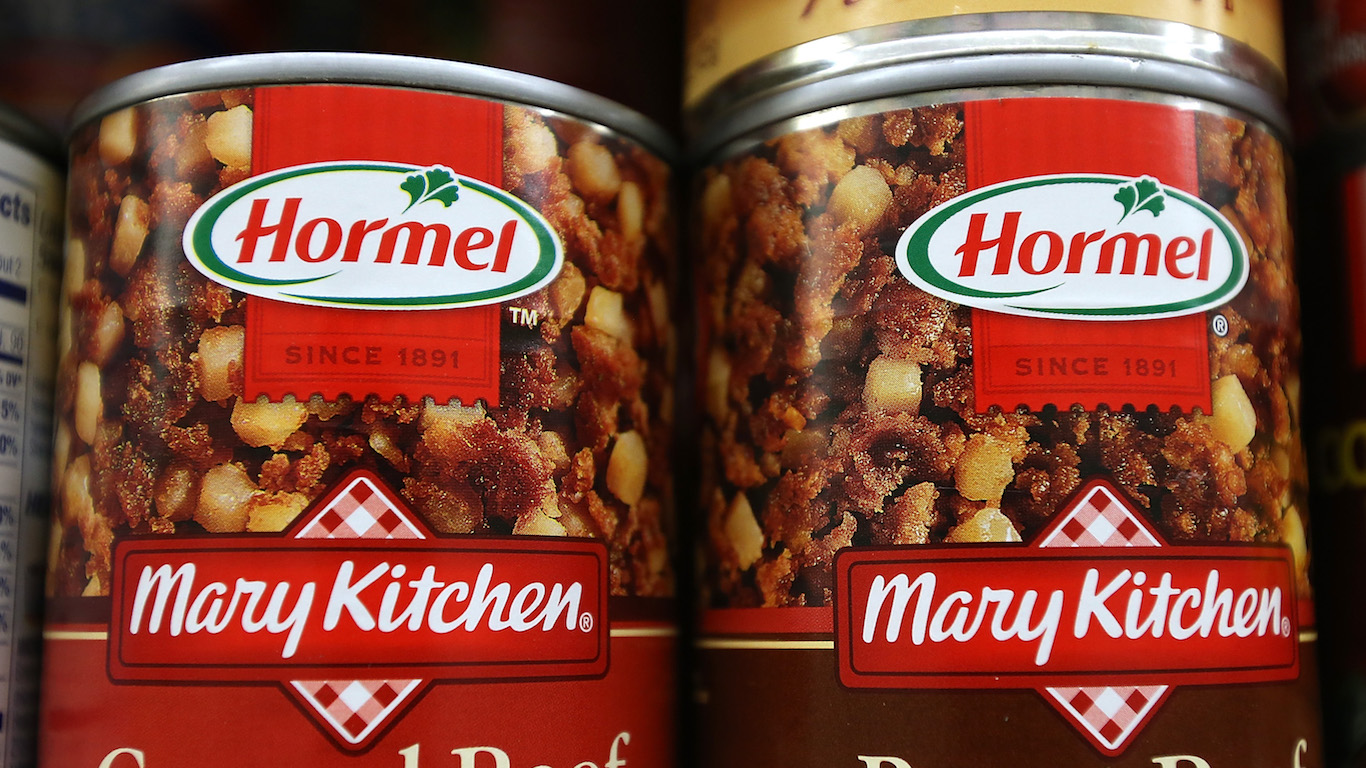
Hormel Foods (NYSE:HRL) has been repriced hard. The stock trades at $21.60 after a 16.4% one-month drop, and the sell-off has pushed the dividend yield to 5.49%, its highest in years. Dividend history verifies the theme: quarterly payments rose from $0.185 through 2008 to $0.2325 in 2020 and now sit at $0.2925, or $1.17 annualized.
The pressure shows up in reported EPS, while cash generation remains healthy. TTM diluted EPS of $0.63 reflects a battered Q3 GAAP EPS of $0.11 hit by a $56M Brazil divestiture loss, a $48.2M Indonesia impairment, and a $37.5M litigation settlement. Strip those out and adjusted EPS beat estimates. On cash, fiscal 2025 operating cash flow was $845.3M against $633.2M in dividends, and the most recent quarter produced $240.6M in operating cash flow versus $161M in dividend payouts. Balance sheet cash of $839.6M is up 40.1% year over year.
The bull case is a beaten-down income staple guiding to 6% to 10% adjusted EPS growth in FY26 with a forward P/E of 14. The risk is that the pressured consumer keeps squeezing retail volumes and the portfolio-reshaping charges keep depressing reported earnings.
McCormick: A Spice Aristocrat in a Rough Year
McCormick (NYSE:MKC) trades at $54.10, down 17.27% year to date, which has pushed the dividend yield to 3.41%. Dividend history confirms the resilience story: the quarterly payout was raised from $0.22 to $0.24 at the end of 2008 and from $0.62 to $0.68 at the end of 2020. The current quarterly dividend of $0.48 annualizes to $1.92.
Fiscal 2025 operating cash flow was $962.2M against $483M in dividend payouts. In the latest quarter alone, operating cash flow was $379.8M and dividends paid were $129M. Balance sheet cash of $331.2M is up 166.88% year over year, and Q2 adjusted gross margin expanded 270 basis points to 40.2%. The reported trailing P/E of 9 looks eye-catchingly cheap, though it is inflated by a large one-time gain from the McCormick de Mexico consolidation, so the forward P/E of 16 is the cleaner read.
The bull case is a global flavor leader raising FY26 guidance to adjusted EPS of $3.05 to $3.13 while pursuing a proposed Unilever Foods combination with roughly $600M in annual run-rate cost synergies. The risk is the execution: the Consumer segment posted organic volume/mix of negative 1.9%, and higher interest expense from acquisitions and a FY26 tax rate near 24% will pressure reported earnings.
Church & Dwight: Low Yield, Fortress Coverage
Church & Dwight (NYSE:CHD) is the growth entry in this bundle. The stock trades at $100.20, up 21.89% year to date, and the dividend yield is 1.18%. The Arm & Hammer parent raised the quarterly payout from $0.08 to $0.09 during 2008, held $0.24 through 2020 after stepping up from $0.2275 in 2019, and now pays $0.3075 per quarter, or $1.23 annualized.
The low yield masks unusually strong safety for this stock. Fiscal 2025 operating cash flow was $1.215B against just $287.2M in dividends, and management guides FY26 operating cash flow to approximately $1.175B. Organic sales grew 5.8% in Q2 FY26, gross margin expanded 240 basis points to 45.4%, and global e-commerce jumped 22.7% to 25.5% of consumer sales. Management raised the FY26 outlook to adjusted EPS of $3.74 to $3.81, representing 6% to 8% growth.
The bull case is a portfolio of power brands (THERABREATH, HERO, ZICAM, BATISTE) throwing off enough cash to fund tuck-in deals and steady raises. However, valuation could raise some concerns with a trailing P/E of 33 and a forward P/E of 27, buyers are paying a premium for the growth, and the recent TOUCHLAND acquisition has taken cash on hand down 72.4% year over year.
How These Four Fit Together
These four consumer staples cover the full income spectrum: Hormel at 5.49% for pure yield, Kimberly-Clark at 4.62% for a Dividend King with visible margin expansion, McCormick at 3.41% for a beaten-down aristocrat with an acquisition catalyst, and Church & Dwight at 1.18% for the growth compounder with cash flow to spare. Each one raised its dividend through the 2008 crisis and again through 2020, and each one is doing it again in 2026 (we ranked ten Dividend Kings like these by valuation right now in a free report you can grab here). That is the shared hook: household products people buy in every economic climate, funding raises that keep showing up on schedule.
Contact [email protected] for any questions or corrections.
Chris Lange is a financial and geopolitical writer with more than a decade of experience covering a myriad of topics. He has published thousands of articles for 24/7 Wall St., with past coverage focused heavily on stocks, IPOs, healthcare, defense, global affairs, and technology.
His work has been quoted, or referenced by a number of outlets including Business Insider, USA Today, Yahoo Finance, MSN, The Motley Fool, and many other publications. A graduate of Southwestern University, he studied business with a focus on investments and has previous experience in banking and startups.
When not reading or writing the news, he is following his passion for Lacrosse, playing chess, or building solar projects with his dad.