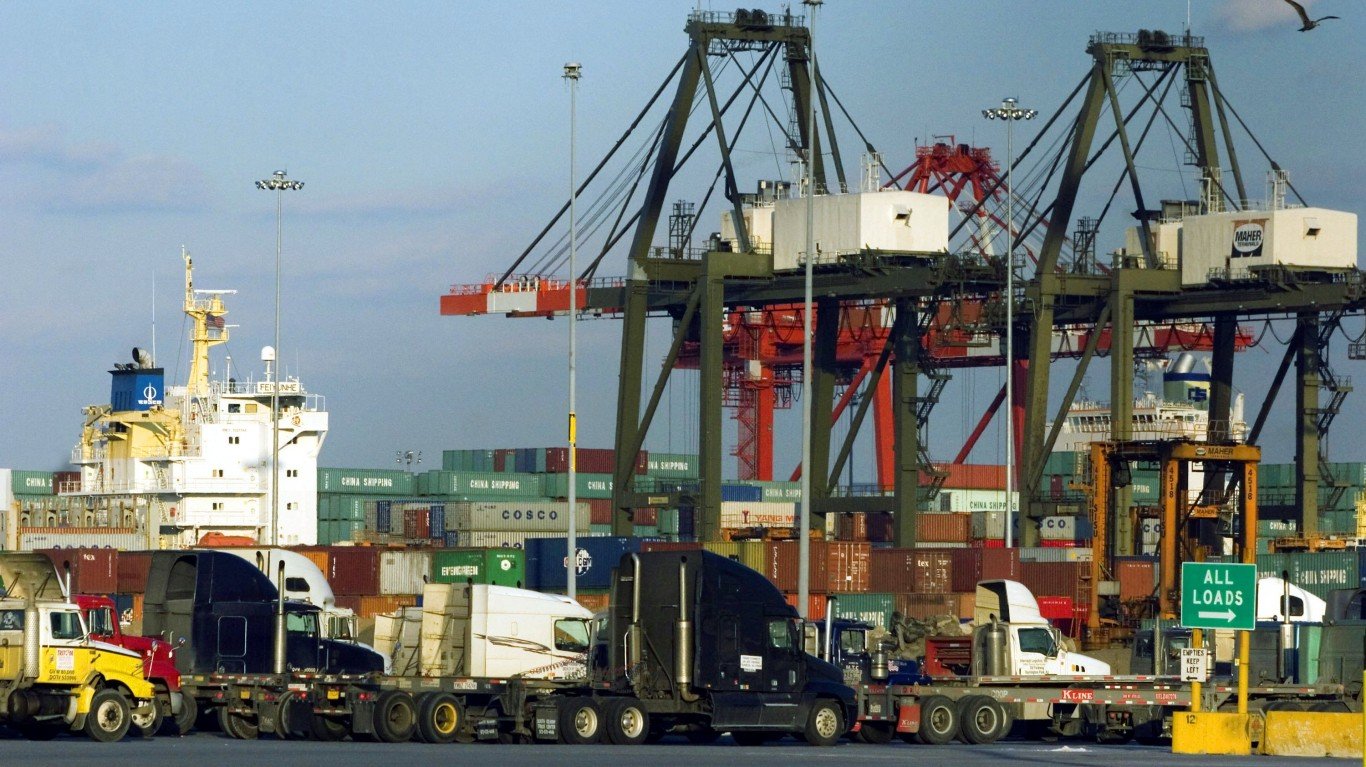
These Shipping Stocks Yield Up to 9%. The Dividends Come With a Catch
Four US-listed shipping stocks are flashing yields as high as 9%, but the contracts, balance sheets, and payout histories behind those numbers tell very different stories about which ones can actually sustain them.


Shipping dividends can look like income candy. FLEX LNG (NYSE:FLNG) trades with a trailing dividend yield of 9.31%, and dry bulk operator Star Bulk Carriers (NASDAQ:SBLK) is printing a 6.09% trailing yield after a quarterly hike. The trap: several of these operators pay variable distributions tied directly to spot charter rates, so the trailing yield is a rear-view mirror. This roster covers four US-listed shipping names across LNG carriers, dry bulk, containerships, and product tankers, with dividend safety framed first and cyclicality flagged loudly.
Star Bulk Carriers
Star Bulk, a Greece-domiciled dry bulk operator, sits at a trailing yield of 6.09% on a share price of $32.27. The dividend is explicitly variable. Under the current policy, management distributes 100% of operating cash flow, subject to maintaining a minimum cash balance of $2.1 million per vessel. The Q2 2026 declaration was $0.90 per share, up from $0.50 the prior quarter, and up from a floor of just $0.05 in mid-2025.
Operating cash flow was $149.0 million in Q2 2026 against a dividend payout of $55.9 million and capex of $79.0 million. The balance sheet carries $498.2 million in cash against $1.34 billion in liabilities and $2.51 billion of equity. Trailing PE is 12, forward PE 7.
Bull case: SBLK is compounding capital through a full-payout model plus a $100M share repurchase program, with the CEO targeting >$3/share in total shareholder returns for 2026 under the current freight forward curve. Risk: the 2025 payment sequence dropped as low as $0.05 per share, a real-time reminder that the distribution collapses with charter rates.
Danaos
Danaos (NYSE:DAC) is the containership name in this bundle, with growing dry bulk exposure. At $162.40, the trailing yield is a modest 2.26%, but that headline understates what income investors are actually receiving. The payout has stepped up in stages rather than swinging wildly: $0.5 in 2021, $0.75 during 2022 and 2023, $0.8 during 2024, $0.85 during 2025, and $0.9 in the latest available 2026 records. The yield is low today because the stock is up 76.27% year to date.
Q2 2026 diluted EPS came in at $8.32 against a $0.90 quarterly dividend, so coverage is enormous. Danaos also has a $4.31 billion contracted revenue backlog as of June 30, 2026, with $506.5M rest of 2026, $967.8M in 2027, $2.83B thereafter. The balance sheet is fortress-grade: $1.01B cash, $1.39B total liabilities, $4.06B shareholders’ equity. Trailing PE is 6 and price-to-book is 0.714.
Bull case: a multi-year charter backlog and low leverage give DAC the strongest dividend coverage on this list. Risk: newbuilding commitments total $1.81B through 2029, and U.S.-China tariff friction plus Red Sea and Strait of Hormuz disruption could compress container demand faster than the backlog can smooth it.
FLEX LNG
Bermuda-domiciled FLEX LNG runs a 13-vessel fleet of LNG carriers and carries the highest headline yield in this group at 9.31%, on a share price of $32.03. The distribution is effectively a fixed quarterly for now: the Q2 2026 declaration of $0.75 per share marked the 20th consecutive quarter at that level, and payment history confirms an unbroken 0.75 across the last eight recorded quarters.
Contract coverage sits at ~89% for remainder of 2026, firm backlog runs 51 years fleet-wide, up to 78 with options, and minimum contractual undiscounted future charter payments are $1.59B. FY2026 guidance calls for adjusted EBITDA of $255–280M. That backlog is what keeps this payout upright. The balance sheet is more levered than the group: cash $397.4M, total liabilities $1.86B, shareholders’ equity $702.5M. Trailing PE is 17.
Bull case: long-dated contracts with major energy counterparties make the $0.75 quarterly the most schedule-like payout in shipping. Risk: Flex Artemis and Flex Volunteer face charter expiry in Q3 2026 without long-term employment secured, higher leverage compared with peers, and the dividend has been paid from Contributed Surplus rather than retained earnings, which some analysts have flagged as a sustainability question.
Scorpio Tankers
Monaco-domiciled Scorpio Tankers (NYSE:STNG | STNG Price Prediction) runs a product tanker fleet across LR2, MR, and Handymax classes. At $88.35, the trailing yield is 2.01%. The dividend is a fixed quarterly with stepwise increases: $0.4 for each recorded ex-dividend date from 2024-03-07 through 2025-05-30, up to $0.42 on 2025-11-14, and $0.45 on 2026-03-06 and again since. The low headline yield reflects a 76.87% year-to-date share move.
Q2 2026 adjusted net income was $243.7 million against a quarterly dividend payout of $22.5 million. The company sits on $2.2 billion in cash as of July 28th, with $483 million in availability under revolving credit facilities. Management said cash break-even is below $11,000 per day and the CFO described the net cash position as worth approximately $26 per share. Trailing PE is 5.
Bull case: a deleveraged balance sheet and low break-even give the dividend deep cushion even if rates soften. Management said the priorities include “Return to shareholders” and combined dividend plus buyback returned more than $175 million to shareholders during Q2. Risk: Q3 2026 spot rates are cooling from Middle East-conflict highs (LR2 spot $65K/day (34% booked), MR $29K (46% booked), Handymax $20.8K (38% booked)), and $978M in remaining newbuild installments through 2030 will consume cash. The CEO said it plainly: “Records, by definition, aren’t meant to last.”
Read Across the Roster
These four names split cleanly into two camps. FLNG and DAC ride contracted backlogs that support scheduled payouts, and their dividend histories reflect that stability. SBLK and STNG are more spot-exposed: SBLK is transparently variable, while STNG holds a conservative fixed dividend precisely because management is saving cash for the next down cycle. This roster fits opportunistic income investors who track charter rates the way a REIT investor tracks occupancy. Treat the trailing yields as a snapshot of last quarter’s rate deck (a double-digit shipping yield usually means the market suspects a cut is coming, and we cataloged the seven warning signs that confirm it in a free dividend trap guide).
Contact [email protected] for any questions or corrections.
Chris Lange is a financial and geopolitical writer with more than a decade of experience covering a myriad of topics. He has published thousands of articles for 24/7 Wall St., with past coverage focused heavily on stocks, IPOs, healthcare, defense, global affairs, and technology.
His work has been quoted, or referenced by a number of outlets including Business Insider, USA Today, Yahoo Finance, MSN, The Motley Fool, and many other publications. A graduate of Southwestern University, he studied business with a focus on investments and has previous experience in banking and startups.
When not reading or writing the news, he is following his passion for Lacrosse, playing chess, or building solar projects with his dad.