UPS vs FedEx: Which Dividend Is Actually Stronger for Income Investors
UPS and FedEx both pay dividends, but the case for owning each one points in completely opposite directions depending on what a retiree actually needs from a portfolio.

This post may contain links from our sponsors and affiliates, and Flywheel Publishing may receive compensation for actions taken through them.
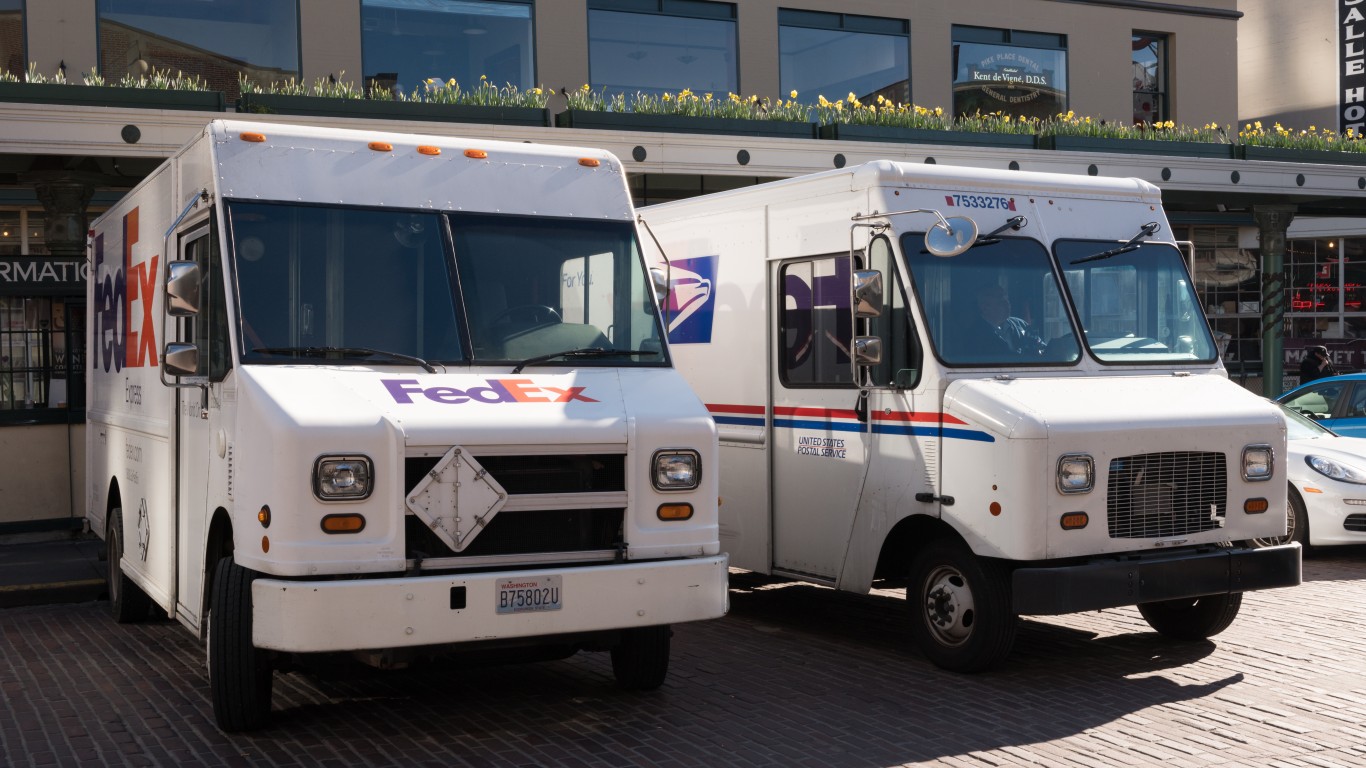
For the retiree writing a check to themselves out of dividend income each quarter, the choice between United Parcel Service (NYSE:UPS | UPS Price Prediction) and FedEx (NYSE:FDX) comes down to a real tradeoff: one pays materially more cash today, the other pays less but funds it from a healthier free cash flow stream. Which one should a retirement-focused investor actually own right now?
Dimension 1: Current Yield and Cash Income
UPS wins this one decisively. At a current price of $100.17, UPS carries an annualized forward dividend of $6.56, backed by a quarterly payout of $1.64 that has held steady across the four most recent ex-dividend dates from November 2025 through August 2026. FedEx’s latest declared quarterly dividend is $1.22, with an annualized forward of $4.88 on a $305.88 share price.


The gap in yield per dollar invested is not subtle, and for a retiree living on quarterly distributions UPS produces meaningfully more spendable cash.
Important nuance on FedEx: the drop from $1.45 to $1.22 per quarter that appears starting with the June 22, 2026 ex-date reflects a structural adjustment, not operating stress. FedEx completed the spin-off of FedEx Freight on June 1, 2026, and holders received equity in the separated entity. Management raised the dividend by 5% after adjusting for the FedEx Freight spinoff, marking the sixth consecutive annual dividend increase. The per-share number is smaller, but total shareholder income was preserved through the spin-off equity. Winner: UPS.
Dimension 2: Payout Coverage and Durability
FedEx wins this one by a wide margin. In FY26, FedEx generated $4.7 billion in adjusted free cash flow against common-stock dividend payments of $1.374 billion. Management called it “nearly 100% conversion from adjusted net income” and reiterated a target of $6 billion in adjusted free cash flow in CY29.
UPS is running the tighter ship. Management guided full-year 2026 free cash flow to approximately $5.5 billion against planned dividend payments of around $5.4 billion. Through the first half, UPS generated $1.6 billion in free cash flow while paying $2.7 billion in dividends. The math works for the full year, but the buffer is thin. The dividend history confirms it: the quarterly payout inched from $1.63 to $1.64 and has stayed flat since. After the 49% dividend boost in 2022, management is telling income holders something with this pause. Winner: FDX.
Dimension 3: Growth Trajectory of the Underlying Business
FedEx again. FY26 consolidated revenue grew 8% and adjusted operating income grew 8%. Q4 FY26 adjusted EPS came in at $6.31 and FY26 adjusted EPS reached $20.24. DRIVE and Network 2.0 delivered more than $1B in cost savings, and capital intensity dropped to 4% of revenue, the lowest in company history. CY26 adjusted EPS guidance is $16.90 to $18.10. FedEx is also transitioning to a calendar fiscal year ending December 31, effective June 1, 2026, which will make near-term period comparisons messy.
UPS is guiding to approximately $7.22 in FY26 adjusted EPS following completion of the Amazon glide-down. Q2 revenue grew 7.6%, but GAAP results absorbed $1.17B in transformation costs and consolidated volumes still fell 3.6% year over year. The market has voted: FDX is up 70.12% over one year and 64.87% over five, while UPS is up 25.18% over one year and down 33.36% over five. Winner: FDX.


Verdict for the Income-Focused Retiree
FedEx wins two of three dimensions on the fundamentals. UPS still owns the one that matters most to a retiree spending distributions: current cash yield. For a retirement-focused income investor whose defining need is current cash yield hitting the account each quarter, UPS is the right answer (we sketched a full plan for turning a mid six-figure balance into $1,500 a month of income in a free report you can grab here). The yield gap is too wide to argue away, coverage still works even if the buffer has narrowed, and the streak of raises, however slowed, remains intact.
FedEx is the better business and the better total-return story. It belongs in a growth-and-income sleeve. If the goal is maximum sustainable dividend dollars deposited today, own UPS.
Contact [email protected] for any questions or corrections.
Chris Lange is a financial and geopolitical writer with more than a decade of experience covering a myriad of topics. He has published thousands of articles for 24/7 Wall St., with past coverage focused heavily on stocks, IPOs, healthcare, defense, global affairs, and technology.
His work has been quoted, or referenced by a number of outlets including Business Insider, USA Today, Yahoo Finance, MSN, The Motley Fool, and many other publications. A graduate of Southwestern University, he studied business with a focus on investments and has previous experience in banking and startups.
When not reading or writing the news, he is following his passion for Lacrosse, playing chess, or building solar projects with his dad.