Price Prediction: One Bank Sees Netflix at $57. We See Triple That.
One major bank just slapped a brutally low price target on Netflix even as the company reports double-digit revenue growth and a $25 billion buyback. The gap between the most bearish Wall Street call and our proprietary model is too…


Netflix has become one of the most polarizing large-cap stocks. One bearish sell-side target sits near $57. Our proprietary model points to roughly triple that.
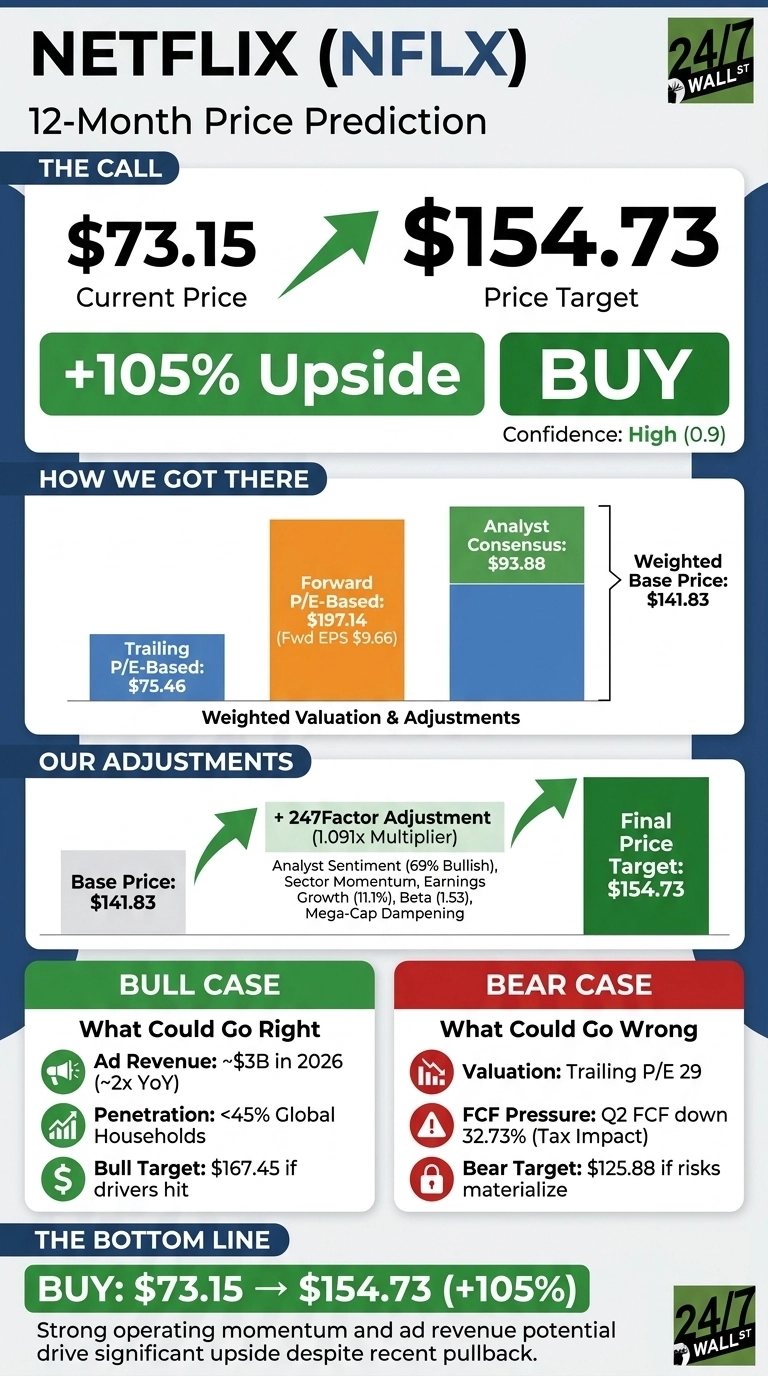
Netflix (NASDAQ:NFLX | NFLX Price Prediction) trades at $73.15 as of the September 18 premarket session. Our 24/7 Wall St. price target for Netflix is $154.73, implying upside of roughly 105% over the next 12 months. Our recommendation is buy with high confidence (0.9).
24/7 Wall St. Price Target Summary
| Metric | Value |
|---|---|
| Current Price | $73.15 |
| 24/7 Wall St. Price Target | $154.73 |
| Upside | 105% |
| Recommendation | BUY |
| Confidence Level | 90% |

A Brutal Year for a Business Still Growing Double Digits
Netflix shares are down 21.98% year to date and 40.46% over the past 12 months, trading well off the 52-week high of $124.86. Yet the operating story keeps improving.
Q2 2026 revenue rose 13.37% year over year to $12.56 billion with an operating margin of 33.4%. Management guided full-year revenue to $51 to $51.4 billion and authorized an additional $25 billion buyback, executing $4.7 billion of repurchases in Q2. Netflix pocketed a $2.80 billion termination fee from Warner Bros. earlier this year.

Why Bulls See a Breakout Ahead
The bull case rests on advertising and pricing power. Netflix expects roughly $3 billion in 2026 ad revenue, about double year over year, with the ad-supported tier accounting for over 60% of sign-ups in ads markets.
On the Q2 call, CFO Spence Neumann said Netflix is “under 45% penetrated into addressable households” and captures only 7% of the addressable revenue market. Our bull-case scenario projects $167.45 within 12 months if live sports, gaming (Netflix Playground daily players up 3x), and the ad-tech rollout hit stride.

What Could Go Wrong
The bear thesis starts with valuation and price action. Netflix trades at a trailing P/E of 29 even after the drawdown, and Polymarket contracts assign only a 9.5% probability to a close above $80 by month-end September.
Q2 free cash flow fell 32.73% on higher cash taxes, and $1 billion of debt matures later in 2026. Bulls would counter that the FCF decline is a one-time tax timing issue tied to the Warner Bros. termination fee. Our bear-case scenario still lands at $125.88, well above today.
How Netflix Compares to Disney and Warner Bros. Discovery
Walt Disney (NYSE:DIS) trades at a P/E of 15 with a diversified parks and sports base. Disney+ and Hulu combined SVOD operating income more than doubled to $712 million in fiscal Q3 2026, but Netflix’s 29.49% operating margin dwarfs Disney’s 14.6%. The valuation gap is earned.
Warner Bros. Discovery (NASDAQ:WBD) is the direct streaming counterpoint. Q2 2026 revenue fell 11.16% year over year to $8.72 billion, with net leverage at 3.4x and a pending Paramount Skydance deal on hold. Netflix’s 0.18 net debt/EBITDA and growing revenue base make our target look reasonable against a peer set that is either lower-margin or restructuring.
Netflix Price Prediction 2026-2030
Our 24/7 Wall St. price target of $154.73 reflects a buy call at high confidence. The tipping factor is forward earnings power: at $9.66 in forward EPS, NFLX trades at an implied forward multiple below 9x, which is out of line with a business growing revenue 13% and returning capital aggressively.
Key variables to monitor include whether ad revenue clears $3 billion, whether margins hold above 31%, and whether content amortization outpaces revenue for a second straight half.
| Year | 24/7 Wall St. Price Target |
|---|---|
| 2026 | $95 |
| 2027 | $154.73 |
| 2028 | $262.71 |
| 2029 | $369.84 |
| 2030 | $461.18 |
These projections assume Netflix continues scaling advertising toward double-digit share of revenue and holds operating margins above 30%. Meaningful upside or downside could result from live-sports rights inflation, FX volatility, or a step-change in generative AI production economics.
Contact [email protected] for any questions or corrections.
Vandita Jadeja is a financial publisher with over a decade of experience writing about financial topics, including investment, savings, retirement, insurance and banking. Vandita is a Chartered Accountant who loves to debunk financial concepts for readers.
Her work has appeared on sites that include The Motley Fool, InvestorPlace, and Benzinga. She covers investing and focuses on stock picks and price prediction for 24/7 Wall St.
When not looking for the next stock investment opportunity, she can be found traveling, reading, chasing sunsets and enjoying her iced latte.