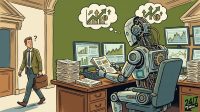
Shopify’s CEO Made Staff Prove AI Couldn’t Do Their Jobs. Now He Says They’re Tossing AI “Slop Grenades” at Each Other.
Shopify's CEO mandated that staff prove AI couldn't replace them before new hires were approved. Now he has a name for what that policy produced inside the company, and it is not a compliment.

On April 7, 2025, Business Insider reported that the company’s Shopify’s CEO, Tobias Lutke said before hiring anyone new, employees must prove AI can’t do the job better. CNBC reported that staffers needed to prove jobs can’t be done by AI before asking for more headcount. The Verge framed it the same way: no new hires without proof AI can’t do the job.
Now the executive who set that policy is describing what came out of it. Speaking on the Knowledge Project podcast, Tobias Lütke, the chief executive of Shopify (NASDAQ:SHOP | SHOP Price Prediction), said “We call those ‘slop grenades’ that people toss at each other. That’s definitely a bad thing.” Fortune first reported the remarks, and Futurism followed.

A Mandate, Then a Description of the Output
The mechanism Lütke described is the part worth sitting with. “You don’t really read it, and now it has to be reviewed by your colleagues, and they are like, ‘this doesn’t look right.’ You’re just letting AI do the work for you,” he said, according to Shopify. The cost of unreviewed AI output transfers to the colleague who has to open, read, and check it.
The original directive was delivered at high volume. Futurism reported that Lütke had told workers that using AI tools was a “baseline expectation” in the workplace, and that the initiative pushed staff to go nuts on AI. A policy delivered at that pitch produces output. Output is what Lütke is now describing on the receiving end.
Shopify has not announced a change to the policy, and Lütke did not describe one. What he described is a management observation about the shape of the work the mandate produced. The person generating AI text and the person who has to verify it are often different people, and when text is cheap to produce and expensive to check, the verification bill lands on whoever opens the message.
Where the Company Is on AI Externally
That internal observation sits alongside how Shopify is talking about the same technology to investors. In its most recent 8-K, filed August 5, 2026, the company described “AI integration to expand what is possible for merchants on the platform” as a core growth initiative. The filing exhibit is posted on the SEC’s site: Shopify’s Q2 2026 press release.
On the accompanying earnings call, president Harley Finkelstein called Shopify “probably the most AI-pilled company in the world” and said AI is “now baked into how Shopify operates.” Chief financial officer Jeff Hoffmeister said the company had “moved from a place of just reflexive use of AI to a place of AI leverage” and described the current philosophy as “maximum leverage paired with thoughtful cost management.”

Read against Lütke’s slop grenades remark, the leverage framing takes on a specific meaning inside the building, according to Shopify. The reflexive stage produced a lot of AI output. The stage management is describing now involves being more selective about what actually gets sent, published, or handed to a colleague. How widespread the slop grenade problem is inside Shopify, and whether it has affected any business result, is not something the reporting establishes. Neither Fortune nor Futurism has said the mandate has been changed.
What the Quotes Actually Support
What Lütke’s remarks support, cleanly, is a narrower point any manager or investor can use. When output is cheap to produce and expensive to verify, the work moves to someone else. The person who generates the draft is rarely the person who pays the review cost.
Contact [email protected] for any questions or corrections.
AJ spent 10 years writing about financial markets at The Motley Fool. His coverage centers on technology stocks and the broader macroeconomic trends, from interest rates to geopolitics, that shape where markets are headed next. AJ is drawn to the stories where big-picture economics and individual companies collide.