JPMorgan Chase Falls 3% Despite New $20B QIA Partnership; Goldman Sachs Eases, Bank of America Slips
JPMorgan Chase just landed a $20 billion sovereign wealth partnership, yet its stock is leading the big banks lower today. Something bigger than a press release is moving the tape, and it starts with where Treasury yields are sitting right…

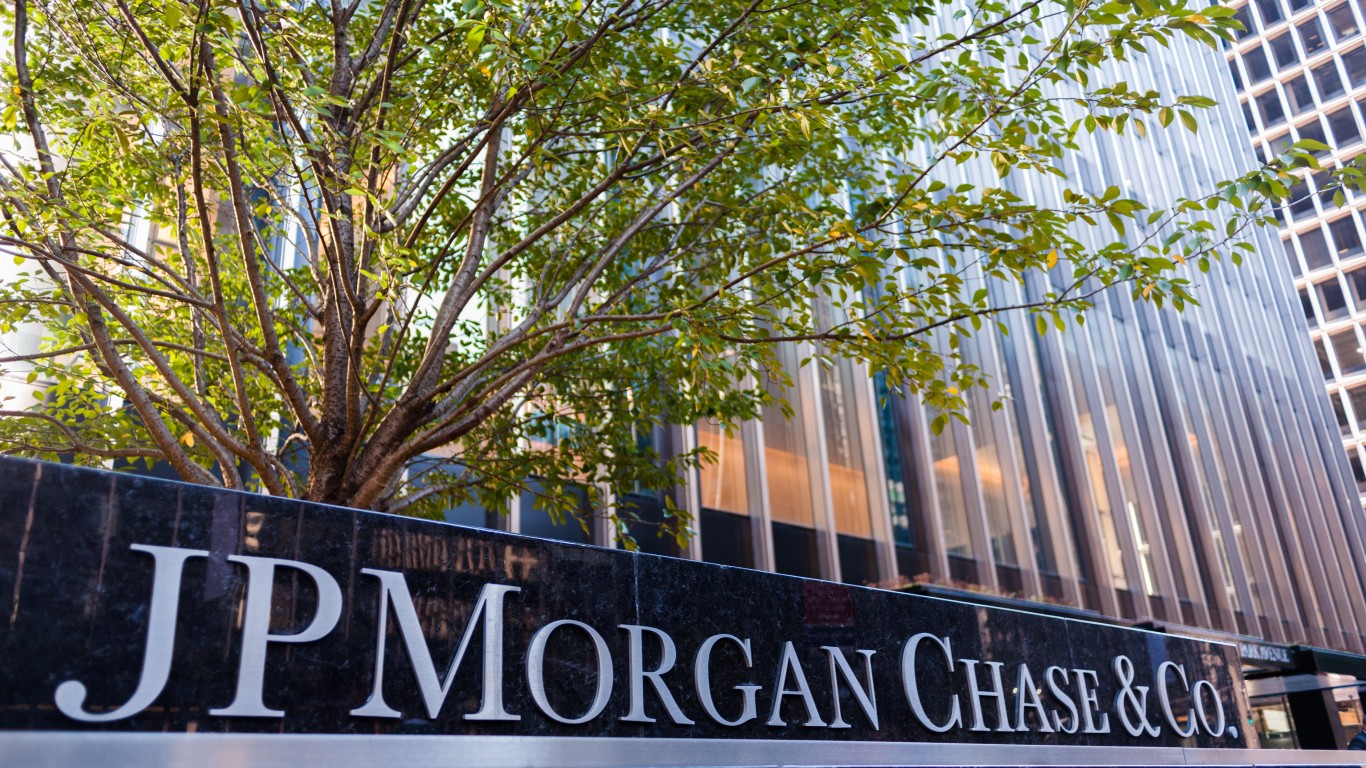
Shares of JPMorgan Chase (NYSE:JPM | JPM Price Prediction) are sliding in Tuesday midday trading, even after the bank unveiled a headline-grabbing tie-up with the Qatar Investment Authority (QIA). JPMorgan Chase stock is down 3% to $340.23, the steepest decline among the three large banks moving lower today.
Fellow money-center bank Goldman Sachs (NYSE:GS) stock is down 1% to $948.60, while Bank of America (NYSE:BAC) shares are off 2% to $56.63. Goldman Sachs stock is dragging the tape harder than the percentage suggests, and Bank of America’s slide echoes the pressure without adding an index dimension.
The broader group is taking the hit as well. Financial Select Sector SPDR ETF (NYSEARCA:XLF) is down 2% to $54.84, while SPDR Dow Jones Industrial Average ETF Trust (NYSEARCA:DIA) is off 0.5% to $517.42 as the bank weakness weighs on the price-weighted index.
QIA Partnership Fails to Lift JPMorgan Chase Stock
JPMorgan Chase announced that JPMorgan Asset Management and the Qatar Investment Authority (QIA) agreed to form a $20 billion investment partnership spanning public and private market strategies across equities and credit. The arrangement begins with a public equities mandate, under which JPMorgan Asset Management will run tailored global equity portfolios for QIA. It also opens a private markets program providing senior financing to established U.S. middle-market companies in industrials, services, healthcare and technology.
Mary Callahan Erdoes, Chief Executive Officer of JPMorgan Asset and Wealth Management, stated the firm will leverage its global investment capabilities across public and private markets to support QIA’s role as a leader in global institutional investing. For JPMorgan Chase, the mandate is exactly the kind of fee-based, capital-light business a large bank wants to add, and it lands regardless of where the shares trade in a single session.
Yet, the market response makes clear JPMorgan Chase stock is being pushed around by something larger than its own press release. The bank rolled out a marquee sovereign-wealth win and its shares still led the decliners in the group.
Bank Stocks Drag the Dow
Barron’s reported that Goldman Sachs and JPMorgan Chase were the two largest drags on the Dow Jones Industrial Average this session, contributing 105 and 75 points respectively. The Dow is price-weighted rather than weighted by market value, so a higher-priced share exerts more influence per percentage point it moves. That is why Goldman Sachs can drag the benchmark harder than JPMorgan Chase while falling by a smaller percent.
Bank of America adds to the picture without moving the Dow in the same way, because Bank of America isn’t a Dow component. The three declines together, however, are pulling the XLF ETF lower and pointing to broad selling across large-cap banks rather than a name-specific problem at any one lender.
The macro backdrop isn’t helping. The 10-year Treasury yield has climbed to 4.98%, and the 10Y-2Y curve has flattened to 0.2%, a combination that can pressure expectations for bank net interest margins even as loan rates rise.
Putting JPMorgan Chase Stock’s Move in Perspective
No confirmed company-specific catalyst is driving the selling in Goldman Sachs or Bank of America, and no sector-wide news release has been tied to the session move. The mechanism supported by the numbers is broad de-risking across the biggest U.S. banks, with the financials fund’s own decline confirming the pressure isn’t isolated to any single ticker.
The complication for JPMorgan Chase is that its drop is the steepest of the three banks in percentage terms, so JPMorgan Chase isn’t simply being carried down by the group. Its QIA announcement is a genuine positive for the franchise’s asset-management business, but the impact is being drowned out by whatever is turning traders away from bank exposure today. JPMorgan Chase stock still sits above where it started the year, so the session is a give-back within an uptrend rather than a break of one.
What to Watch Next
Investors can watch for whether the XLF ETF stabilizes into the afternoon and whether the Dow’s bank drag eases as the session progresses. A firmer bid under Goldman Sachs and Bank of America would take some of the group pressure off JPMorgan Chase stock and let the QIA news reassert itself in the price.
Traders may want to keep an eye on whether JPMorgan Chase shares recover intraday ground or close near session lows, since a weak finish would signal the sector reset has more room to run. Shareholders should size their bank-sector exposure to withstand days like this one, where a positive company headline can be overwhelmed by group flows and macro rate moves.
Contact [email protected] for any questions or corrections.
David Moadel is financial writer specializing in stocks, ETFs, options, precious metals, and Bitcoin. David has written well over 1,000 articles for leading online publications, helping investors understand markets, income strategies, and risk.His work has appeared in The Motley Fool, InvestorPlace, U.S. News & World Report, TipRanks, ValueWalk, Benzinga, Market Realist, TalkMarkets, Finmasters, 24/7 Wall St., and others.With a master’s degree in education, David has taught at the elementary, high school, and college levels. That teaching background shapes his writing style: clear, educational, and practical. David has also built a loyal social-media audience by providing trustworthy financial content on YouTube, X/Twitter, and StockTwits.