Let’s Be Real. Retirees Who Price Every Hawaiian Island Keep Ending Up on the Same One
Most mainlanders dream of five different Hawaiian islands, but retirees who actually run the numbers end up somewhere far more specific, driven by a calculation that has nothing to do with beaches.

This post may contain links from our sponsors and affiliates, and Flywheel Publishing may receive compensation for actions taken through them.
If you were to ask ten mainlanders where they would retire in Hawaii, you get five different islands. Ask another ten retirees who priced it out and stayed, and the answers cluster tightly. The math and medical map do most of the sorting.
Start With The Cost, Because Hawaii Does Not Flatter You
Unsurprisingly, Hawaii is the most expensive state in the country. The Bureau of Economic Analysis puts Hawaii’s regional price parity at 109.951 against a national index of 100, tied with the District of Columbia and behind California at 110.72. Nearly everything consumed arrived by container ship, with surcharges baked into groceries, gasoline, building materials, and electric bills. Hawaii’s residential electricity rates are the highest in the nation.
BLS pegs average annual household expenditures at $78,535 in 2024. A two-person household aiming for a comfortable life on Oahu should budget roughly $110,000 to $130,000 a year before healthcare and mainland travel.
Tax Picture Is The Best Argument For Staying
Hawaii’s income tax brackets are progressive, but Social Security benefits are fully exempt from Hawaii state income tax, and employer-funded pension income is also exempt. For a retiree whose income is heavily weighted toward Social Security and a defined-benefit pension, the effective state tax rate can be surprisingly light.
Property tax is the other pleasant surprise. Hawaii’s county property tax rates are among the lowest in the country, and each county offers a home exemption that grows meaningfully at age 60 and again at 70 for owner-occupants. On a $1.1 million Oahu home, the annual property tax bill for a qualifying older owner-occupant frequently lands under $3,500.
The Wall Street Journal recently profiled a couple who tracked the property-tax delta after leaving Illinois for Arizona and reinvested the approximately $10,000 difference in stocks, a balance that now exceeds $100,000. Against California, New Jersey, or Illinois, the Hawaii version of that arithmetic holds up.
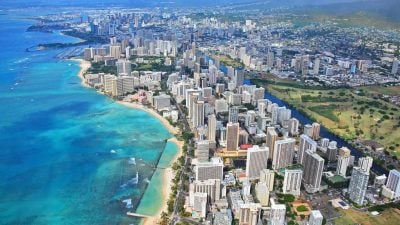
Oahu Is The Answer For Most Retirees
Oahu has the state’s only tertiary care infrastructure, its only Level I trauma center, and the deepest bench of specialists. On other islands, a serious cardiac event, complex cancer, or stroke frequently means inter-island medevac to Honolulu. Air-ambulance transport runs into five figures and is not always fully covered. For a retiree in their late seventies, that can be the reason they leave.
Oahu also carries the lowest shipping premium on groceries, the only international airport with frequent mainland nonstops, and the deepest labor market for trades. Housing is not cheap. The national Case-Shiller index sits at 336.7 as of June 2026, up 0.4% from the prior month, and Honolulu single-family medians run well above the national picture.
Choose differently only if circumstances are specific. Maui works for a retiree healthy enough to fly to Honolulu for serious care. The Big Island’s Kohala and Waimea corridor suits someone who wants land and can accept the drive to Hilo or flight to Oahu for advanced care. Kauai suits those who want a quieter life and understand the specialist gap. Do not move to Molokai or Lanai in retirement unless you have deep local ties. If your medical picture is complicated, grandchildren are on the East Coast, or your portfolio cannot absorb a 30% to 40% lift on daily living costs, Hawaii is the wrong answer.
What Sends People Back, And The Test Before You Buy
Vanguard research found that about 60% of retirees who moved after retiring went to a more affordable area and pocketed capital gains from their houses, typically unlocking around $100,000 in home equity. Hawaii inverts that pattern. You move to a more expensive area, and if you later want to return, the door closes behind you.
Rent on the specific island for a full year before buying. Price a medical emergency, including inter-island transport. Then price family visits at the frequency you expect and put that line in the budget in ink.
Number That Actually Makes This Work
For a couple targeting a comfortable Oahu retirement, plan on roughly $120,000 a year in current dollars, net of a paid-off or largely paid-off home. Subtract Social Security checks and pension income, and divide the remaining gap by a 3.75% withdrawal rate. That typically points to an investable portfolio of about $1.5 to $2 million alongside the house, funded by index funds, a bond ladder for the first decade of withdrawals, and enough cash to ride out a bad year.
The cost most retirees fail to price is the flights. Beyond the ones in the brochure, count the ones on the calendar for the next twenty-five years for every wedding, birth, illness, and funeral while you are 2,500 miles away. Price those, and Oahu still works for most people who can afford Hawaii at all (turning a nest egg into a monthly Hawaii budget is the whole exercise in our free Paycheck Portfolio Method guide).
Contact [email protected] for any questions or corrections.
David Beren has been a Flywheel Publishing contributor since 2022. Writing for 24/7 Wall St. since 2023, David loves to write about topics of all shapes and sizes. As a technology expert, David focuses heavily on consumer electronics brands, automobiles, and general technology. He has previously written for LifeWire, formerly About.com. As a part-time freelance writer, David’s “day job” has been working on and leading social media for multiple Fortune 100 brands. David loves the flexibility of this field and its ability to reach customers exactly where they like to spend their time. Additionally, David previously published his own blog, TmoNews.com, which reached 3 million readers in its first year. In addition to freelance and social media work, David loves to spend time with his family and children and relive the glory days of video game consoles by playing any retro game console he can get his hands on.