Micron Fell For 3 Months: Now One Wall Street Pro Says 110% Are About to Materialize
Micron slid for three months while the S&P 500 climbed, reopening a price-to-target gap that one prominent analyst now believes is far larger than the Street consensus suggests. Whether that gap represents a generational opportunity or a familiar cycle trap…

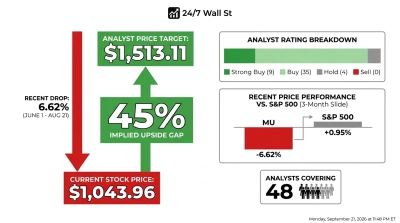
Micron Technology (NASDAQ:MU | MU Price Prediction) trades at $1,043.96, while the Wall Street consensus price target sits at $1,513.11. That leaves roughly 45% of implied upside on the table.
Micron is the largest US-based memory maker. Its high-bandwidth memory (HBM) chips are critical to AI hardware. Wall Street focuses on how quickly Micron converts that scarcity into durable, contracted revenue.
When the stock slid through the summer, the price-to-target gap reopened. One bulge-bracket call now points to more than 110% upside from current levels.
Summer Slide That Broke a Winning Streak
Micron dropped 6.62% between June 1 and August 21, a three-month slide that ended a winning streak. The S&P 500 edged up 0.95% over the same window, so this was MU-specific weakness.
Fiscal Q3 delivered blowout numbers: revenue of $41.46B (up 345.7% year over year) and non-GAAP EPS of $25.11. Q4 guidance flagged “a meaningful moderation in the rate of price increases,” and a $325M loss on debt prepayments hit the release. Investors read peak-cycle and locked in profits.
MU has since rebounded 14.67% over the last month, and 12.98% in the last week alone. The target gap has not fully closed.
Melius Sees a Path to $2,200
Ben Reitzes at Melius Research carries the Street-high $2,200 price target on Micron, roughly 110.7% above current levels. His bull case rests on Micron’s HBM capacity being effectively sold out over multi-year horizons, backed by long-term supply agreements with major AI and cloud customers.
Reitzes frames Micron as a secular AI compounder. Multi-year contracts for HBM, DRAM, and NAND deliver revenue visibility the business has never had. Management confirmed 16 Strategic Customer Agreements covering roughly 20% of DRAM volume and about 30% of NAND volume, with $100 billion in minimum contracted revenue and $22 billion in customer deposits. CEO Sanjay Mehrotra said supply-demand tightness would persist “beyond calendar 2027.” Even at SCA floor prices, gross margins would sit above prior peak-cycle margins.
Broader coverage is bullish. 48 analysts cover MU with 9 Strong Buy, 35 Buy, 4 Hold, and no Sell ratings. Fiscal 2027 consensus EPS has climbed from $117.8618 ninety days ago to $156.5298 today. Revisions have skewed materially higher, supporting the bull thesis even before Melius’s Street-high number.
The memory and storage complex sold off together this summer, then rallied together. Price-to-target gaps now differ across the group.
Western Digital (NASDAQ:WDC), the pure-play HDD company after the SanDisk spin, trades at $448.17 versus a $664.92 consensus target, or roughly 48% implied upside. Coverage tilts heavily Buy: 4 Strong Buy, 17 Buy, 5 Hold. Fiscal Q4 revenue rose 43.84% year over year.
Seagate Technology (NASDAQ:STX) trades at $877.33 against a $1,125 target for about 28% implied upside. Analyst posture: 4 Strong Buy, 18 Buy, 2 Hold, 1 Strong Sell. STX just delivered $5.71 non-GAAP EPS on 48.49% revenue growth. Wall Street sees less runway here than at MU.
SanDisk (NASDAQ:SNDK), the NAND pure-play post-Western Digital separation, has ripped to $1,766.64 versus a $2,125.09 target, or about 20% upside. Ratings: 4 Strong Buy, 16 Buy, 3 Hold, 1 Strong Sell. Fiscal Q4 revenue jumped 371.59% year over year, but the price has largely caught up to consensus.
The widest implied upside in the group sits at Micron on the consensus number, and MU is the only name in the peer set with a mainstream Street call pointing above 100%.
Numbers Behind the 110% Call
Micron trades at $1,043.96 with a 12-month consensus target of $1,513.11 (44.9% implied upside) and a Street-high $2,200 target from Melius (110.7% upside). 48 analysts cover the stock.
MU is up 266% year to date and 542.57% over the past year. Over the last three months, MU has meaningfully outpaced the S&P 500’s 5.49% gain. Shares change hands at roughly 7 times consensus fiscal 2027 EPS of $156.5298, versus a trailing multiple of 23. That valuation gap is where the bull argument lives. Analyst targets are one data point.
Cautiously Constructive on the Contracts Thesis
The bull case works if you believe the Strategic Customer Agreements truly change the business shape. If HBM stays sold out through 2027 and floor pricing delivers margins above prior peaks, $2,200 becomes defensible. The path requires the HBM4 ramp holding, more SCAs signed, and revisions moving toward the high-end estimate of $221.27.
The bear case works if you think memory is still just memory. Prior cycles have ended in supply overshoot. A $27 billion capex plan, HBM concentration with a single lead customer, and management’s own flag on price moderation are fingerprints of prior tops. If AI capex slips in 2027, SCA floor prices help but will not shield the multiple from compression. The AI buildout has a bigger cast than the chipmakers, of course, and we profiled seven of the power, cooling, and networking suppliers behind it in a free report here.
Cautiously constructive. The SCA framework is real visibility, and 45% consensus upside looks earned. Getting to Melius’s 110% requires believing the memory cycle has structurally broken. That is a call requiring more evidence.
Contact [email protected] for any questions or corrections.
Alex Sirois is a financial writer with experience spanning both retail and institutional investing. He has written for InvestorPlace and held roles at BNY Mellon and Bernstein, giving him a perspective that bridges Main Street portfolios and Wall Street analysis.
Alex holds an MBA from George Washington University and has built his career across multiple industries, including e-commerce, education, and translation — a breadth of experience that informs how he breaks down complex financial topics for everyday investors. His writing is conversational, actionable, and grounded in long-term, buy-and-hold investing principles.
At 247 Wall St., Alex focuses on delivering analysis that is both accessible and useful, with a clear emphasis on helping readers make more informed decisions with their money.