Hormel Foods vs General Mills: One Dividend Rests on Solid Cash, the Other on Fumes
Both Hormel and General Mills paid out more in dividends than they earned last year, but that shared screener flag tells a completely different story at each company. One dividend sits on solid footing while the other is quietly running…

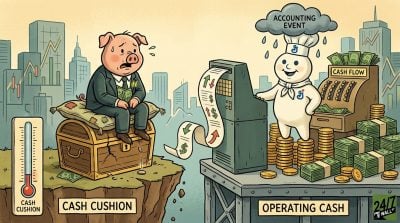
Hormel Foods (NYSE:HRL | HRL Price Prediction) and General Mills (NYSE:GIS) are both long-tenured packaged-food dividend payers, and in each company’s most recently completed fiscal year, dividends paid to shareholders exceeded reported net income. That shared headline looks alarming on a screener, but it means something very different at each company.
Hormel’s Cash Cushion Is Getting Thin
For fiscal 2025, ended October 31, 2025, Hormel generated $845.3 million of operating cash flow, spent $310.9 million on capex, and paid $633.2 million in dividends against net income of $478.2 million. After capex and dividends, almost nothing remains. The fiscal fourth quarter posted a net loss of $56.2 million. In the quarter ended July 31, 2026, dividends of $161 million far exceeded the quarter’s $59.5 million net income. The latest raise moved the quarterly payout from $0.29 to $0.2925, a token bump defending a 60-year streak rather than sharing growth. Shares trade near $20.13, down 17.6% over the past year.

General Mills Took an Earnings Hit, Not a Cash Hit
General Mills reported a fiscal 2026 loss that looks worse in headline terms. For the year ended May 31, 2026, net income was −$85.3 million, but operating cash flow was $2.166 billion against capex of $539.9 million and dividends of $1.315 billion. The payout was comfortably funded out of cash. The loss, concentrated in the fiscal fourth quarter (net loss of −$2.007 billion), reflected $2.8 billion in non-cash charges, including $1.75 billion of goodwill and intangible impairments largely tied to the North America Pet segment and a $1.032 billion non-cash valuation loss on the planned Brazil divestiture. Non-cash means no dollars left the building. The 127th consecutive year of uninterrupted payments continues, with shares recently at $35.70.

When a Payout Ratio Above 100% Still Passes the Cash Test
Reported net income includes impairments and valuation losses that never touch the checking account. Cash funds the dividend from operating cash flow after capex, and coverage is what matters. A payout ratio above 100% is a prompt to open the cash flow statement.
Coverage at a Glance
| Metric (most recent fiscal year) | HRL (FY ended Oct 31, 2025) | GIS (FY ended May 31, 2026) |
|---|---|---|
| Operating cash flow | $845.3M | $2,166M |
| Capital expenditures | $310.9M | $539.9M |
| Dividends paid | $633.2M | $1,315.3M |
| Net income | $478.2M | −$85.3M |
For Hormel, watch whether operating cash flow recovers enough to clear capex plus the dividend with room to spare. For General Mills, monitor whether strong cash generation holds and whether the fourth-quarter loss proves to be a one-off tied to non-cash marks rather than a trend.
Which Dividend Actually Has a Cash Problem
Hormel has a cash-level problem. General Mills’ loss was an accounting event; operating cash comfortably funded the payout. Hormel’s earnings dropped, its cushion narrowed to almost nothing, and the raise shrank to a fraction of a cent. That is where improvement is needed before confidence returns. (A shrinking cushion behind a token raise is one of the seven warning signs we cataloged in a free dividend trap guide.)


Contact [email protected] for any questions or corrections.
Trey has been an editor and author at 24/7 Wall St. for more than a decade, where he has published thousands of articles analyzing corporate earnings, dividend stocks, short interest, insider buying, private equity, and market trends. His comprehensive coverage spans the full spectrum of financial markets, from blue-chip stalwarts to emerging growth companies.
Beyond 24/7 Wall St., Trey has created and edited financial content for Benzinga and AOL's BloggingStocks, contributing additional hundreds of articles to the investment community.
Trey's editorial expertise extends across multiple publishing environments. He served as production editor at Dearborn Financial Publishing and development editor at Kaplan, where he helped shape financial education materials. Earlier in his career, he worked as a writer-producer at SVE. His freelance editing portfolio includes work for prestigious clients such as Sage Publications, Rand McNally, the Institute for Supply Management, the American Library Association, Eggplant Literary Productions, and Spiegel.
Outside of financial journalism, Trey writes fiction and has been an active member of the writing community for years, moderating workshop sessions at regional conventions.