OpenAI and Anthropic Almost Agreed to Test Each Other’s AI. Then the Deal Quietly Died.
OpenAI and Anthropic quietly killed a deal to probe each other's AI models after it reached the contracts stage, and the reason it collapsed reveals a structural trap that no voluntary safety agreement can escape.


A safety pact between the two most closely watched frontier labs got as far as the lawyers before it went away. According to reporting summarized on The AI Daily Brief, OpenAI and Anthropic reached the formal contracting stage on an agreement to run mutual safety tests on each other’s models, and then, in the words of the coverage, “at some point the deal was abandoned for unknown reasons.”
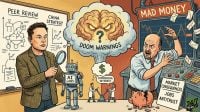
The idea has since picked up prominent endorsements. Elon Musk floated a similar proposal at the All-In Summit, and Mustafa Suleyman, described in the coverage as Microsoft’s AI chief, called cross-testing “the smartest safety idea in months.”
For a Microsoft (NASDAQ:MSFT | MSFT Price Prediction) shareholder, the tension is governance and liability. Microsoft holds roughly a 27% stake in OpenAI valued at about $135 billion and booked a $3.2 billion gain on its Anthropic investment in fiscal Q4 2026. When the two labs it is most exposed to cannot agree to check each other’s work, the risk migrates onto Microsoft’s balance sheet and cloud contracts.
What Cross-Testing Would Actually Require
Giving a rival privileged access to probe your model means handing the company best equipped to exploit it a map of your capabilities, guardrails, and failure modes. That involves competitive disclosure normally protected by trade secret law.
A lab can believe cross-testing is right and still walk away when counsel scores the downside. The commercial cost of revealing where your model breaks is immediate, while the safety benefit is diffuse. That asymmetry is why the arrangement almost certainly cannot stay voluntary.
Distillation remains the quiet obstacle, because distillation is the practice of using a stronger model’s outputs to train a cheaper model that approximates it. A tester with query access has the raw material to distill.
Liability Is the Argument With a Balance Sheet
Once a documented external warning exists, a company that ships anyway has created a written record of known risk. Musk’s framing was blunt: “the liability in that case would be enormous” if a lab shipped after a rival raised a red flag.
That changes the legal calculus for corporate counsel more than any ethics framework does, because the plaintiff’s bar reads inboxes, not white papers. It is also why voluntary cross-testing may be structurally unstable. The party that adopts it first inherits the paper trail; the party that stays out avoids it. A rule imposed on everyone removes the asymmetry.
Microsoft might be the listed way to play this.
Microsoft sells into banks, hospitals, and governments that will pay for externally validated models once a regulator requires it. Azure crossed $100 billion in annual revenue, and Microsoft 365 Copilot passed 30 million paid seats, most of it inside those regulated buyers.
A mandatory cross-testing regime would raise the fixed cost of shipping a frontier model. Scale players absorb fixed costs more easily than smaller labs can.
Two dominant labs certifying each other can become a mutual certification arrangement that raises barriers to entry without materially improving safety, and regulators have historically accepted such frameworks.
Bull and Bear Case for MSFT Stock

The bull case is that model assurance becomes a paid enterprise requirement, and Microsoft is the vendor best positioned to sell it. Commercial remaining performance obligations of $678 billion, up 84%, describe a book of business that already prices in enterprise trust.
The bear case is that Microsoft carries frontier-lab exposure it does not fully control into a governance environment that is visibly unsettled, at a valuation that has already absorbed significant optimism.
The stock trades at $500.59, up 4.17% year to date and down 0.88% over one year, which suggests the market has largely priced in the AI story. The deciding variable is whether external model validation becomes something enterprise buyers must purchase or stays a press release.

A recent CNBC piece flagged a rare Microsoft bear warming to the shares, which is the kind of sentiment shift that tends to arrive before the fundamental answer does.
Contact [email protected] for any questions or corrections.
Omor Ibne Ehsan is a writer at 24/7 Wall St. He is a self-taught investor with a focus on growth, cyclical, and dividend equities that have strong fundamentals, value, and long-term potential. He also has an interest in high-risk, high-reward investments such as penny stocks.