Cisco Stock: One Number Could Tell Investors Where It’s Headed Next
Cisco shares have surged nearly 40% this year on an AI-driven networking boom, but one valuation figure will determine whether the rally has room to run or has already priced in the good news.


Cisco Systems (NASDAQ: CSCO | CSCO Price Prediction) has had a landmark 2026. Shares are up 39.07% year to date and 59.57% over the past year, powered by what CEO Chuck Robbins calls a “networking super cycle” tied to agentic AI. The stock recently cooled, falling 4.2% in the past month after Piper Sandler trimmed its price target on growth concerns.
With hyperscaler AI orders exploding and a multi-year campus refresh underway, the question is how much upside remains. Let’s look at what it would take for Cisco to hit $130 per share in 2027.

Wall Street Warms to Cisco’s AI Story
The Street is unusually engaged. The FY2027 EPS consensus has jumped from $4.7599 ninety days ago to $5.1426 today, with 22 upward revisions and zero downward revisions in the trailing 30 days.
Revenue estimates for the fiscal year cluster around $73.16 billion, in line with management’s own guidance of $72.2 billion to $73.4 billion. Cisco has also extended its EPS beat streak to five consecutive quarters, meaning actual results have a habit of running ahead of the model.

Path to $130: Here’s the Math
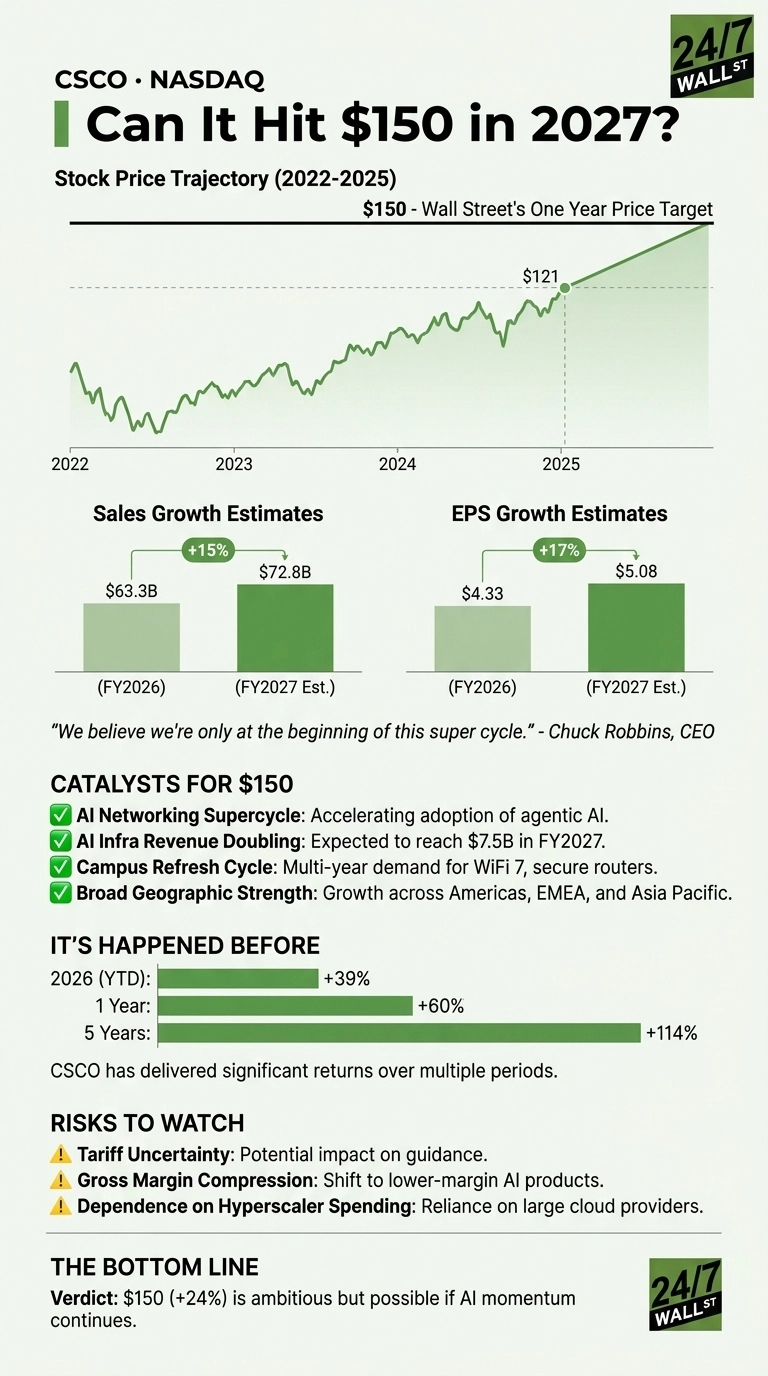
At today’s price of roughly $105.60, Cisco trades at about 21x the FY2027 EPS midpoint of $5.08. Push shares to $130 and the multiple expands to roughly 25x forward earnings.
That is a modest premium to the S&P 500’s forward P/E around 21x to 23x, and it is well within range for a large-cap networking leader guiding to 15% revenue growth and 17% EPS growth.
What could push Cisco to $130?
- The AI infrastructure ramp. Hyperscale AI revenue is guided to $7.5 billion in FY2027, roughly double FY2026’s $4 billion. Q4 alone booked $4 billion in AI orders, and full-year AI orders of $9.3 billion ran about 4.5 times FY2025.
- Rising estimates. FY2028 consensus climbed from $5.2338 to $5.6023 in three months, giving analysts room to keep marking targets higher.
- Order breadth. Q4 total product orders rose 35%, with enterprise up 21%, public sector up 30%, and networking marking its eighth consecutive quarter of double-digit growth.

- Capital returns. Cisco returned $12.7 billion to shareholders in FY2026 and raised its dividend for the 15th consecutive year, with $8.1 billion remaining on the buyback.
- Platform leverage. Robbins argues the super cycle rests on integrating “systems, silicon, optics, security, observability” into one stack, a bundle rivals struggle to match.

History Says a 23% Move Is in Range
Getting from $105.60 to $130 requires roughly a 23% gain.
Cisco has already delivered 39.07% year to date in 2026 and 114.15% over five years, so a mid-20s move over the next twelve months would extend the current trend. It is a stretch for a $416 billion company, but not the kind of leap that requires a market miracle.
Bottom Line on $130
Hitting $130 would require Cisco to gain about 23% and trade near 25x FY2027 earnings.
The setup is credible: guidance calls for record revenue between $72.2 billion and $73.4 billion, AI infrastructure revenue is set to nearly double (we profiled seven companies powering that same data-center buildout, from power to networking, in a free report you can grab here), analyst estimates keep climbing, and the beat streak is intact.
Risks are real, including margin pressure from a hardware-heavy mix (gross margin slipped to 66.3% from 68.4%) and dependence on hyperscaler spending. Returns at this level should not be expected every year, but we’ve outlined the blueprint for how Cisco could see outsized returns in 2027.
Contact [email protected] for any questions or corrections.
Vandita Jadeja is a financial publisher with over a decade of experience writing about financial topics, including investment, savings, retirement, insurance and banking. Vandita is a Chartered Accountant who loves to debunk financial concepts for readers.
Her work has appeared on sites that include The Motley Fool, InvestorPlace, and Benzinga. She covers investing and focuses on stock picks and price prediction for 24/7 Wall St.
When not looking for the next stock investment opportunity, she can be found traveling, reading, chasing sunsets and enjoying her iced latte.