Hollywood Is Blaming AI for Its Job Losses. Merger Paperwork Says Otherwise.
Merger filings from one of Hollywood's biggest consolidations tell a very different story about job losses than the one studio executives keep repeating in public. The real culprits are hiding in the debt schedules and settlement terms.

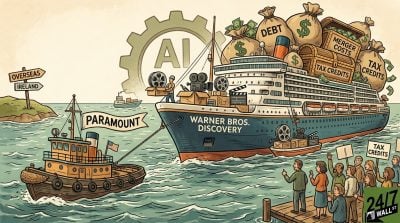
Paramount Skydance (NASDAQ:PSKY | PSKY Price Prediction) has a stock market value of about $11.3 billion. Warner Bros. Discovery (NASDAQ:WBD), the company it has agreed to buy, is worth about $77.4 billion, and the deal is valued at roughly $110 billion. The smaller company is taking over the far larger one, and it has to borrow to do it.


The deal has not closed. Twelve states and the Writers Guild agreed to settle on September 21. A federal judge has held off on approving the proposed consent decree. Court-ordered settlement talks are still scheduled, and Warner’s filing said closing is on hold until June 1, 2027, at the latest.
Hollywood tends to blame AI for its job losses. The paperwork behind this deal points to three other causes: debt, consolidation, and tax arbitrage.
A Settlement That Sends Production Overseas
Under California Attorney General Rob Bonta’s terms, Paramount must ensure 20% of all film production takes place in the United States for the first two years, rising to more than 30% over the next three years. A working television writer described U.S. network game shows and studio comedies being filmed in Ireland, with American contestants flown out. Neither the settlement nor the writer mentions AI.
The settlement shows why. Domestic production grows only if Congress passes a federal film tax credit. Bonta said commitments could rise by up to 700% with a federal credit. Tax credits, not AI models, decide whether a game show films in Dublin or Burbank.
Filings Show Where the Jobs Go
Paramount’s gross debt rose to $15.5 billion in the first quarter, up from $13.7 billion at year-end. It drew $2.15 billion on its revolver, a standing corporate credit line, to help cover the $2.8 billion termination fee, the penalty Warner owed Netflix for walking away from their earlier merger agreement.
Companies call cost-cutting goals “run-rate efficiencies”: annual savings once cuts are fully in place. In August, Paramount raised its target to more than $2.70 billion by year-end, up from $2.5 billion. Andy Gordon, chief strategy and operating officer, explained how: combining cable and broadcast to “reduce redundancies, centralize shared services and institute best practices.” Paramount expects about $800 million in transformation costs this year and does not expect investment-grade debt metrics until the end of 2027.
AI will cost jobs in below-the-line crafts, and Paramount chief executive David Ellison expects “significant efficiencies as AI is deployed across the business.” But the decline started earlier. Warner reported domestic pay-TV subscriber losses of 9% in mid-2025, and the settlement itself sets up a fund for workers displaced by the merger.
Writers Settle Because They Cannot Afford to Fight
The Writers Guild dropped its lawsuit for $17.5 million for its health fund and a five-year ban on writer layoffs at CBS News. It still says the deal “will cause damage to writers and the industry at large.” As a nonprofit, it could not afford to fight the merger alone.
The settlement requires 30 theatrical releases a year. Paramount’s first-quarter filing already described a minimum 30 films annually across both studios. What exactly did Paramount give up?
Signals to Watch Before Year-End
Three things to watch:
- The judge’s ruling on the consent decree
- The settlement talks still on the calendar
- Whether Paramount’s efficiency target moves again in its next quarterly report
Another increase would tell you more about Hollywood jobs than any AI announcement.
Contact [email protected] for any questions or corrections.
Trey has been an editor and author at 24/7 Wall St. for more than a decade, where he has published thousands of articles analyzing corporate earnings, dividend stocks, short interest, insider buying, private equity, and market trends. His comprehensive coverage spans the full spectrum of financial markets, from blue-chip stalwarts to emerging growth companies.
Beyond 24/7 Wall St., Trey has created and edited financial content for Benzinga and AOL's BloggingStocks, contributing additional hundreds of articles to the investment community.
Trey's editorial expertise extends across multiple publishing environments. He served as production editor at Dearborn Financial Publishing and development editor at Kaplan, where he helped shape financial education materials. Earlier in his career, he worked as a writer-producer at SVE. His freelance editing portfolio includes work for prestigious clients such as Sage Publications, Rand McNally, the Institute for Supply Management, the American Library Association, Eggplant Literary Productions, and Spiegel.
Outside of financial journalism, Trey writes fiction and has been an active member of the writing community for years, moderating workshop sessions at regional conventions.