Meta Price Targets Raised as Muse AI Gains Momentum and Opens New Monetization Opportunities
Three Wall Street firms just raised their Meta price targets after Connect, and the reason has nothing to do with advertising. Whether Muse AI can actually deliver on projections stretching to 2031 may define the stock's next chapter.

This post may contain links from our sponsors and affiliates, and Flywheel Publishing may receive compensation for actions taken through them.

Three Wall Street firms raised their price targets on Meta Platforms (NASDAQ:META | META Price Prediction) after the company’s Connect event.
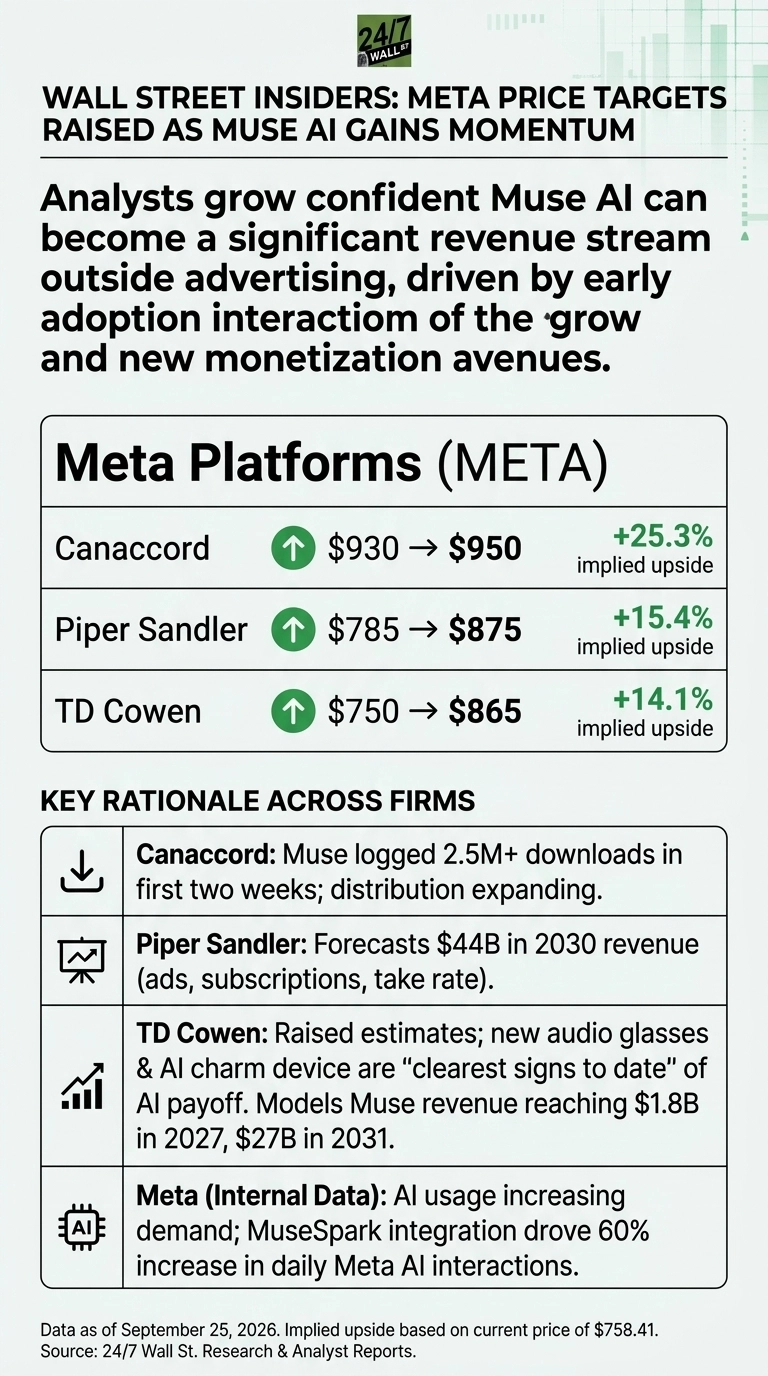
Canaccord lifted its target to $950 from $930, Piper Sandler moved to $875 from $785, and TD Cowen went to $865 from $750.
All three kept bullish ratings. Together, the raises show Wall Street growing more confident that Muse AI can become a real revenue stream outside advertising.
| Ticker | Company | Firm | Action | Old Rating | New Rating | Old Target | New Target |
|---|---|---|---|---|---|---|---|
| META | Meta Platforms | Canaccord | Price Target Raised | Buy | Buy | $930 | $950 |
| META | Meta Platforms | Piper Sandler | Price Target Raised | Overweight | Overweight | $785 | $875 |
| META | Meta Platforms | TD Cowen | Price Target Raised | Buy | Buy | $750 | $865 |

Why Three Firms Now See Muse as Meta’s Next Revenue Engine
Canaccord pointed to adoption. Muse logged more than 2.5M downloads in its first two weeks. Distribution is also expanding across retail, glasses, Mac and a dedicated device, which gives Meta several possible ways to make money from it.
Piper Sandler’s estimates leave Muse out entirely. Even so, the firm laid out a forecast showing $44B in 2030 revenue, coming from advertising, subscriptions and take rate. It added that product launches and sharper strategic focus could drive multiple expansion.
TD Cowen raised its revenue, EBITDA and earnings estimates. The firm called the new audio glasses and AI charm device the “clearest signs to date” that Meta’s AI spending could pay off. It models Muse AI revenue rising from $55M in 2026 to $1.8B in 2027 and $27B in 2031.
Meta’s Core Business Is Funding a Massive AI Buildout
Second-quarter revenue made $60.80 billion, up 27.96% year over year. Diluted EPS of $6.18 missed the $7.2214 estimate. That was the first miss after a six-consecutive-quarter streak of beats. Capex rose 82.1%, and free cash flow fell to $784 million.

Early Muse results look encouraging. After MuseSpark was integrated, the number of people using Meta AI each day rose 60%.
Stock’s Rally Raises the Bar for Muse
Shares traded at $758.41, up 33.14% over the past month. The consensus target is $786.8, and the stock trades at about 22 times forward earnings. Barron’s argued that the easy gains are gone. CNBC reported that Meta has hit a standoff with Amazon over Muse, which suggests distribution may meet some resistance.

Earnings estimates have been moving the other way. Over the past 30 days, 2026 EPS estimates saw 4 upward revisions and 45 downward. The raised targets rest on long-term Muse potential, while near-term profit expectations keep falling.

What Long-Term Investors Should Weigh Before Muse Scales
The new targets give retirement-focused investors more reason to believe Meta’s AI spending may eventually pay off beyond ads. Still, the forecasts from TD Cowen and Piper run years into the future. Meta’s 2026 capex guidance is $130-145 billion, and youth-related trials scheduled for 2026 may result in material losses.
Watch the next earnings report for any disclosure of Muse revenue, subscription uptake and free cash flow trends. Those numbers will show whether the analysts’ optimism holds up.
Contact [email protected] for any questions or corrections.
Vandita Jadeja is a financial publisher with over a decade of experience writing about financial topics, including investment, savings, retirement, insurance and banking. Vandita is a Chartered Accountant who loves to debunk financial concepts for readers.
Her work has appeared on sites that include The Motley Fool, InvestorPlace, and Benzinga. She covers investing and focuses on stock picks and price prediction for 24/7 Wall St.
When not looking for the next stock investment opportunity, she can be found traveling, reading, chasing sunsets and enjoying her iced latte.