If You Invest $10,000 in Microsoft Today, Here’s What It Could Be Worth by 2030
Azure just crossed a milestone that reshapes how analysts think about Microsoft's ceiling, and the five-year math behind a modest stake today tells a story Wall Street's consensus target barely hints at.

Microsoft has become the default proxy for the enterprise AI trade, and after a record fiscal year the question every investor is asking is a simple one: what could a $10,000 stake in Microsoft (NASDAQ:MSFT | MSFT Price Prediction) grow into over the next several years?
Shares trade around $498.51, giving the software giant a market cap near $3.70 trillion. With Azure now a $100 billion annual business and Microsoft 365 Copilot at 30 million paid seats, the setup for a long horizon look is unusually rich.

Base Case Answer for a $10,000 Stake
Anchoring to the nearest modeled horizon, a five-year projection ending September 2031, the base case says a $10,000 investment in Microsoft could be worth about $20,731, a total return of 107.31%, or an annualized 15.7%.
That base case is built on a modeled per-share price of $1,032.38. As an illustrative checkpoint aligned with the calendar 2030 target, the same base path passes through $956.80 on September 23, 2030, which would put the stake at roughly $19,213.
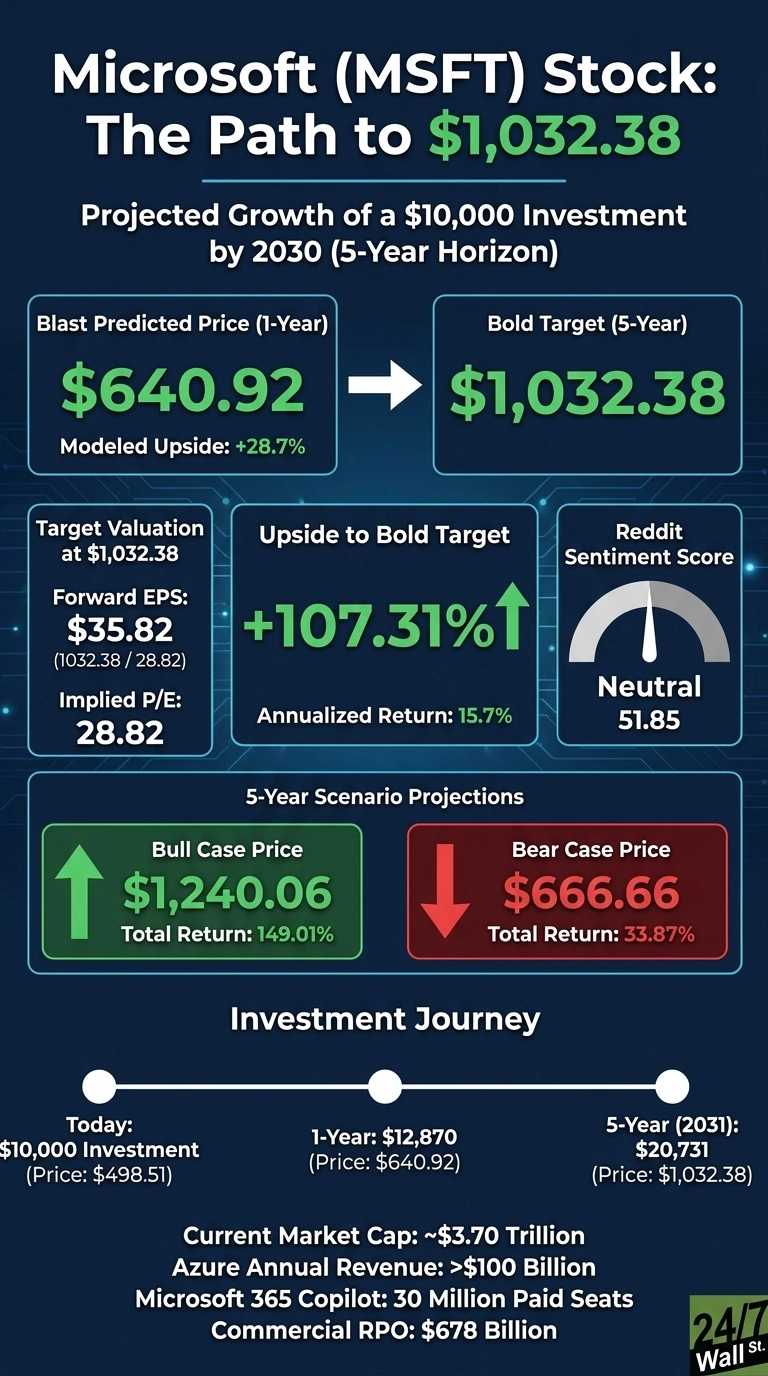
On a nearer term view, the model’s one-year target is $640.92, implying a 28.7% upside and a $10,000 stake growing to about $12,870 over the next twelve months. The recommendation on the security is buy, with a model confidence rating of high.

Bull, Base, and Bear Scenarios Through 2030
The five-year model output frames a wide range of outcomes. The table below shows the modeled per-share target, the total return, and where a $10,000 stake ends up in each case at the modeled horizon. Figures for the calendar 2030 checkpoint are illustrative interpolations from the same series.
| Scenario | 5-Year Target Price | Total Return | $10,000 Becomes |
|---|---|---|---|
| Bull | $1,240.06 | 149.01% | $24,901 |
| Base | $1,032.38 | 107.31% | $20,731 |
| Bear | $666.66 | 33.87% | $13,387 |
At the illustrative September 2030 waypoint, the bull path runs through $1,152.17 (about $23,136) and the bear path through $624.46 (about $12,539).
Wall Street’s consensus target sits at $575.34, backed by 14 strong buy, 38 buy, and 3 hold ratings, with 95% of analysts bullish.

Why the Model Sees Durable Upside
The base case rests on three drivers investors have been watching all year. First, Azure crossed $100 billion in annual revenue, up 41%, and management guided fiscal first quarter Azure growth to approximately 45% in constant currency.
Demand still exceeds supply, with CFO Amy Hood noting “There are still constraints in the system.” The buildout behind that demand, power, cooling, and networking, is exactly the trade we mapped in a free report on seven AI infrastructure names beyond the chipmakers: here.
Second, the commercial backlog is a rare visibility asset. Remaining performance obligations climbed to $678 billion, up 84%, with approximately 30% expected to convert to revenue within twelve months and the remainder pushing well into the decade.
Third, Copilot monetization is expanding, with paid seats topping 30 million and enterprise deployments like EY at 400,000 employees and HSBC at 200,000 seats layering on top of usage-based billing.
CEO Satya Nadella said, “I’ve never been more confident in Microsoft’s opportunity to drive durable long-term growth.”
What Could Sink the Projection
The bear scenario is not a fringe outcome. Fiscal 2026 capital expenditure hit $115.95 billion, up 79.62%, and management now expects FY27 capex near $175 billion. If AI monetization lags that build, return on invested capital compresses.
Hood said the largest share of that spend is short-lived assets such as CPUs and GPUs, which gives Microsoft flexibility, but the risk of overbuilding, rising component costs, or a slower Copilot ramp is real.
Add regulatory scrutiny of AI, cybersecurity exposure at hyperscale, and a beta of 1.108 that leaves shares tied to broader tech sentiment, and the path is anything but linear.
What It Means for Your $10,000
Across the modeled five-year window, a $10,000 stake in Microsoft ranges from about $13,387 in the bear case to $20,731 in the base case and up to $24,901 in the bull case. The illustrative 2030 checkpoints fall inside that same band.
These are scenario projections, not guarantees, and this article is not investment advice. What the numbers do capture is the range Microsoft’s cash engine, backlog, and AI platform reasonably support if execution stays on the current track.
Contact [email protected] for any questions or corrections.
Vandita Jadeja is a financial publisher with over a decade of experience writing about financial topics, including investment, savings, retirement, insurance and banking. Vandita is a Chartered Accountant who loves to debunk financial concepts for readers.
Her work has appeared on sites that include The Motley Fool, InvestorPlace, and Benzinga. She covers investing and focuses on stock picks and price prediction for 24/7 Wall St.
When not looking for the next stock investment opportunity, she can be found traveling, reading, chasing sunsets and enjoying her iced latte.