Whether You Buy Tesla Depends On The Chances That Tesla Actually Becomes an AI Firm
Tesla trades at software valuations while still earning most of its money selling cars, and whether that gap is genius or delusion depends entirely on a handful of product bets that have not paid off yet.

At $377.94, Tesla (NASDAQ:TSLA | TSLA Price Prediction) is a Hold. The entire investment case rests on one question: does this company become an AI, autonomy, and robotics platform, or remain an auto manufacturer trading at software multiples? The stock hinges on execution timelines for Robotaxi, Optimus, and in-house silicon, and neither the bull nor the bear case has been settled by the numbers yet.
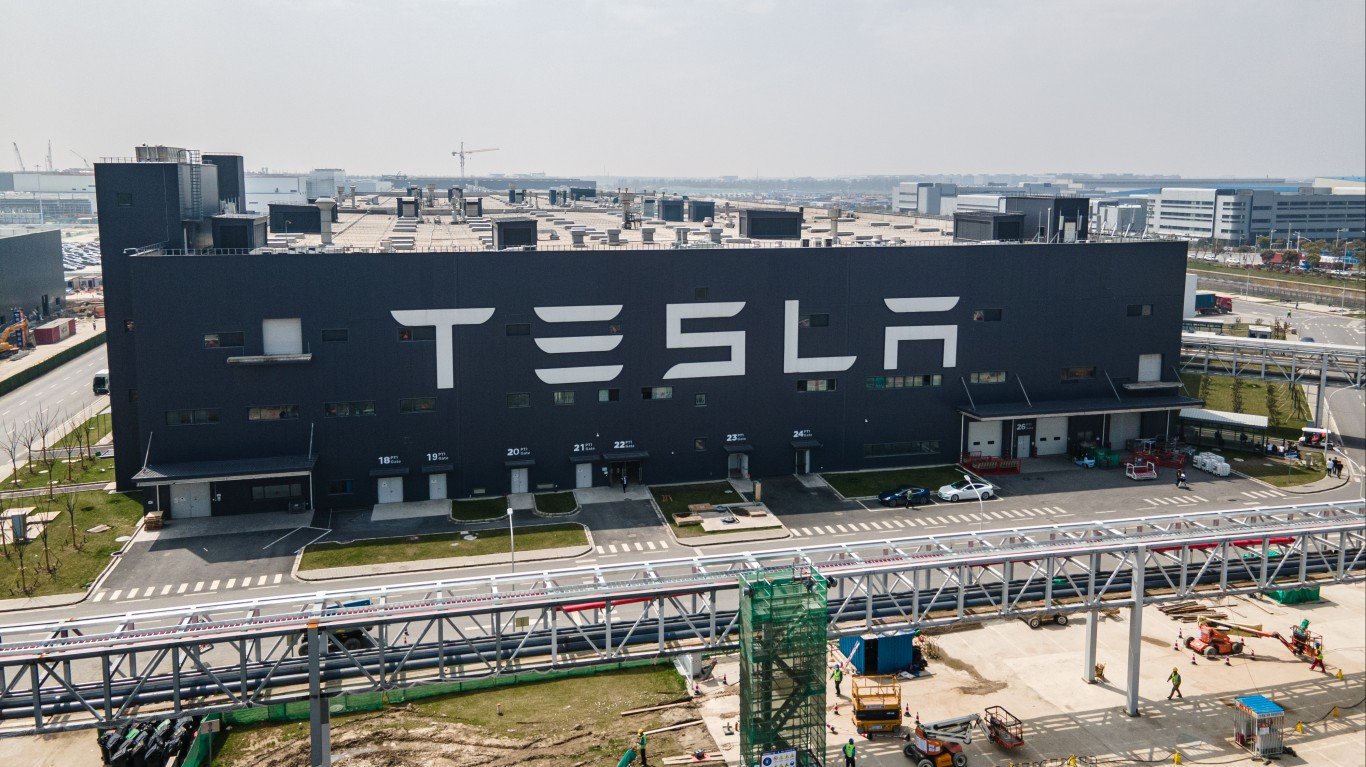
Tesla still sells cars for a living. Automotive Sales generated $20.0 billion of the $28.24 billion in Q2 revenue, while Energy Generation and Storage contributed $3.14 billion and Services and Other added $4.58 billion. CFO Vaibhav Taneja said 2026 capital expenditures will exceed $25 billion, funding a semiconductor fab, Optimus lines, Cortex 2 compute, and Robotaxi expansion. The market is being asked to pay for a business that does not yet exist in the income statement.
Why the AI Optionality Could Reprice the Stock
Bulls point to real operating traction. Active FSD subscriptions reached 1.48 million in Q2, up 56% YoY, with attach rates above 55% on new North American deliveries. Robotaxi logged more than 380,000 unsupervised miles across seven metros with zero notable incidents claimed, and Musk said weekly mileage is compounding at over 10%. Energy storage hit 13.5 GWh in Q2, up 41% YoY. If Optimus and CyberCab scale as described, the $1.50 trillion market cap looks defensible.
Why the Multiple Looks Indefensible Today
The bear case is arithmetic. Trailing PE sits at 346, forward PE at 159, and operating margin has compressed to 1.41%. Free cash flow flipped to negative $1.09 billion in Q2 as capex jumped 141.8%, and Q2 non-GAAP EPS of $0.33 missed the $0.5367 consensus. The 2027 EPS average has seen 19 downward revisions in 30 days against only 4 upward. Prediction markets price just a 12.6% probability that Optimus releases by year-end 2026.
Why Patience Beats Conviction Right Now
Neither side has enough evidence yet. Automotive is funding the AI buildout with deteriorating margins and softening deliveries. The AI businesses show early proof points but generate no separately disclosed revenue. The next four quarters will produce the data that resolves this: CyberCab volume production, Optimus Gen 3 output, the AI5 chip timeline, and whether Robotaxi mileage keeps compounding without a safety event.
Where the Data Actually Points
Tesla trades at $377.94 against a consensus analyst target of $396.94, implying roughly 5% upside, though targets are one data point rather than a promise. The 46 covering analysts break down as 6 Strong Buy, 16 Buy, 19 Hold, 3 Sell, and 2 Strong Sell, a distribution that itself reads as a Hold. Performance tells the harder story: TSLA is down 15.96% year to date while the SPDR S&P 500 ETF Trust (NYSEARCA:SPY) has returned 12.52%, a wide gap of underperformance against the broader market.
Verdict: Hold Until the AI Numbers Show Up
The bull and bear theses are both credible, and the deciding evidence has not yet arrived. Investors are being asked to underwrite a manufacturing miracle at a valuation that already prices in partial success. The cost of waiting is missing an early rerating if execution lands. The cost of acting is anchoring capital to a name where automotive revenue fell 10% for full-year FY25 while capex is set to grow for another two to three years.
Watch quarter by quarter: Robotaxi mileage growth and any safety incident, FSD subscription attach rates, Optimus production line output at Fremont, CyberCab volume ramp, and free cash flow. A Buy becomes defensible when unsupervised Robotaxi mileage crosses into the millions with clean data and Optimus ships at commercial volume. A Sell becomes urgent if capex keeps climbing while FSD subscription growth stalls or a Robotaxi incident forces regulatory retreat.
Tesla hinges on execution, and the disciplined stance on execution questions that have not yet resolved is to wait.
Contact [email protected] for any questions or corrections.
Alex Sirois is a financial writer with experience spanning both retail and institutional investing. He has written for InvestorPlace and held roles at BNY Mellon and Bernstein, giving him a perspective that bridges Main Street portfolios and Wall Street analysis.
Alex holds an MBA from George Washington University and has built his career across multiple industries, including e-commerce, education, and translation — a breadth of experience that informs how he breaks down complex financial topics for everyday investors. His writing is conversational, actionable, and grounded in long-term, buy-and-hold investing principles.
At 247 Wall St., Alex focuses on delivering analysis that is both accessible and useful, with a clear emphasis on helping readers make more informed decisions with their money.