Wall Street Is Divided on Tesla’s Next Move: Buy, Sell or Hold?
Tesla just posted record deliveries and a massive revenue beat while simultaneously cratering its own earnings and flipping free cash flow negative. Wall Street's 47 analysts cannot agree on what that contradiction means, and the next move in shares may…

At $342.27, Tesla (NASDAQ:TSLA | TSLA Price Prediction) sits at the center of one of Wall Street’s sharpest analyst splits, with the consensus rating landing at hold. The stock sits at the center of one of the sharpest analyst splits on Wall Street after a Q2 report that beat on revenue and missed badly on earnings.
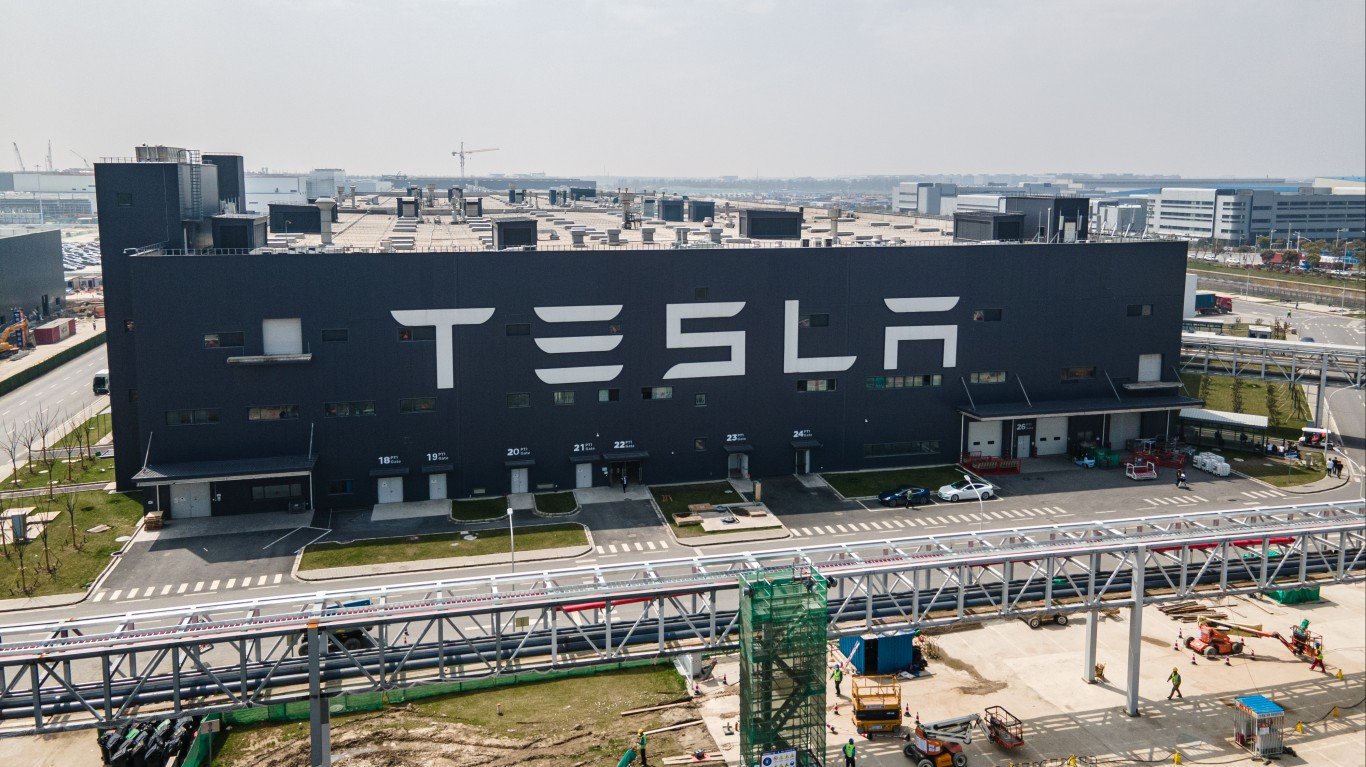
Tesla remains the world’s most valuable automaker, but the business it is being valued as looks less like a car company every quarter. Automotive still anchors the model, with $20.006 billion in Q2 vehicle sales, while Services and Other revenue jumped 50% and energy storage climbed to 13.5 GWh. Robotaxi, Optimus, and FSD monetization are now the story the multiple depends on.
Shares are down 13.23% over the past month and 23.89% year to date, setting up the current standoff.
Why the Bulls See a Reloaded Growth Story
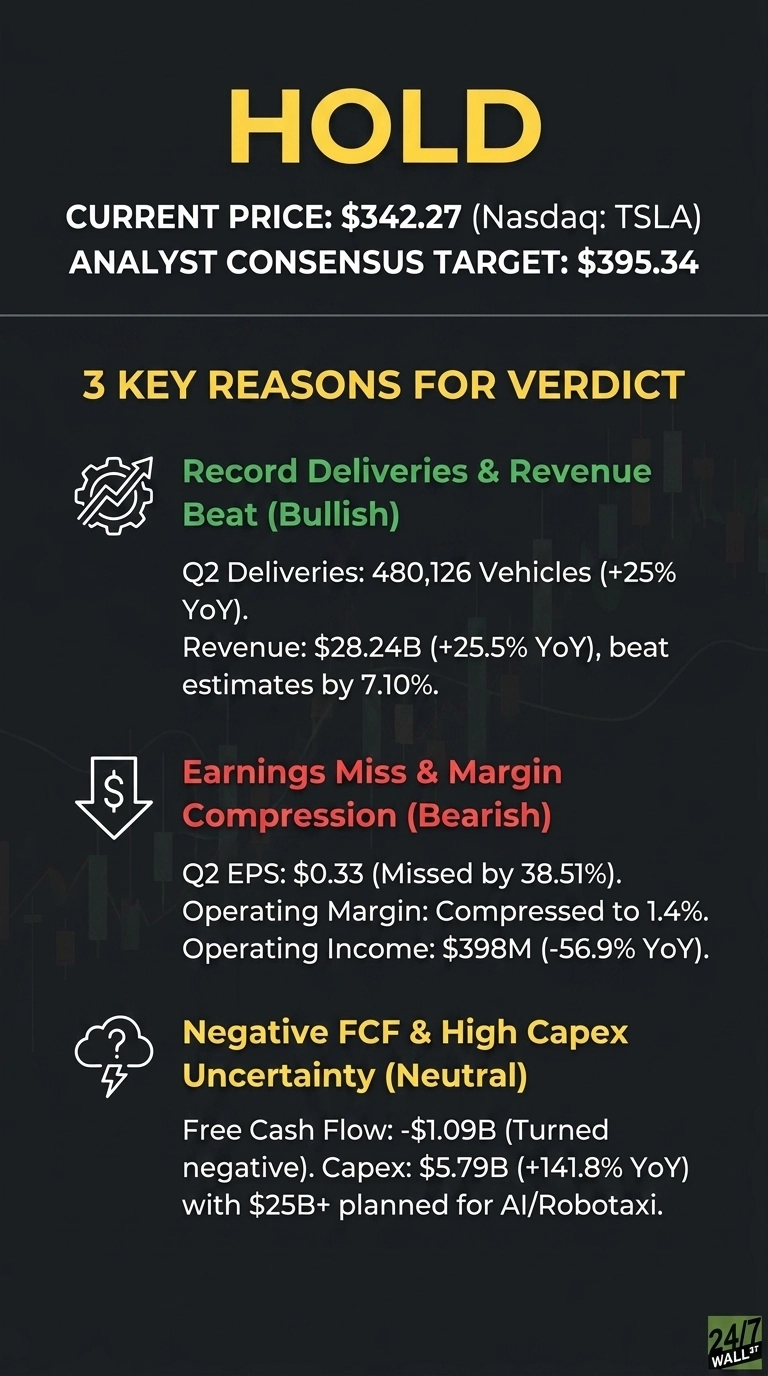
The bull case starts with volume. Tesla posted record Q2 deliveries of 480,126 vehicles, up 25% year over year, and revenue of $28.236 billion, beating estimates by 7.10%. CFO Vaibhav Taneja said the company “exited Q2 with our largest order backlog since 2023.”
Software is the second pillar. FSD reached 1.48 million active subscriptions, up 56% YoY, with a 55%+ attach rate on new North American deliveries. Robotaxi has driven more than 380,000 unsupervised miles across six cities with what management called an impeccable safety record.
Analysts targeting the AI-first thesis anchor to a consensus price target of $395.34, backed by 23 Buy or Strong Buy ratings out of 47.
Why the Bears See a Broken Margin Structure
The bear case is written on the income statement. Operating income fell 56.88% YoY to $398 million, operating margin compressed to 1.4%, and EPS of $0.33 missed by 38.51%. Free cash flow flipped to negative $1.092 billion as capex more than doubled.
Valuation makes those numbers harder to defend. Tesla trades at a trailing P/E of 311 and a forward P/E of 175, with automotive margins excluding credits sliding from 19.2% to 16.3%.
An in-house AI price model pegs fair value at $303.08, implying 11.45% downside. Prediction markets give only a 19% chance robotaxis launch in California by year-end and a 10.5% chance Optimus ships.
Why Patience May Be the Cleanest Trade
Neither side has won the argument yet. Deliveries and FSD attach rates are accelerating, but profitability is deteriorating, and management has warned that operating expenses will continue to grow in 2026 and beyond. The next real read on whether the AI investment cycle is paying off arrives with Q3 earnings on October 21.
Investors watching for a tipping point should track auto gross margin, robotaxi city expansion, and first Optimus production milestones. Until one of those breaks decisively, the risk of buying an AI premium that has not yet earned it matches the risk of shorting a company sitting on $43.5 billion in cash.
What the Numbers Actually Say
Tesla currently trades at $342.27 against a consensus target of $395.34, implying roughly 15.5% upside if analysts are right. Coverage is broad but split, with 47 analysts distributed across the ratings spectrum.
- Strong Buy: 6
- Buy: 17
- Hold: 18
- Sell: 4
- Strong Sell: 2
Analyst targets are one input, not a promise. Shares are up 1.99% over the past year, while the S&P 500 proxy has gained roughly 5.2% since the July earnings filing alone. Valuation sits at a P/B of 15.56 and EV/EBITDA of 110, with the stock trading below both its 50-day ($371.09) and 200-day ($406.08) moving averages.
The Verdict: Wait for the Margin Signal
At $342.27, the analyst consensus lands at Hold.
The bull thesis and the bear thesis both hinge on the same question, and that question will not be answered before Q3. Buying here requires believing that a company earning $1.10 in trailing EPS deserves a triple-digit forward multiple because Robotaxi and Optimus will eventually justify it. Selling here requires believing that the $25 billion capex program is a value trap. Neither is disproven.
Prediction markets are pricing consolidation, not conviction, clustering August outcomes around $360 at 54.5% probability. The stock is already 23.89% below where it started the year, meaning much of the AI-narrative froth has been pressed out without the fundamentals confirming a bottom.
The signal to act arrives when auto gross margin ex-credits either stabilizes above 17% or breaks below 15%, when robotaxi miles compound into a measurable revenue line, or when Optimus ships in commercially meaningful volume.
Until then, the cost of patience is small relative to the cost of picking the wrong side of a 15-point rating split. The consensus stance reads as Hold because the numbers say wait, and the calendar says the answer is coming.
Contact [email protected] for any questions or corrections.
Vandita Jadeja is a financial publisher with over a decade of experience writing about financial topics, including investment, savings, retirement, insurance and banking. Vandita is a Chartered Accountant who loves to debunk financial concepts for readers.
Her work has appeared on sites that include The Motley Fool, InvestorPlace, and Benzinga. She covers investing and focuses on stock picks and price prediction for 24/7 Wall St.
When not looking for the next stock investment opportunity, she can be found traveling, reading, chasing sunsets and enjoying her iced latte.