Suze Orman Warns: Married Couples Who Do This Are Putting Their Finances at Risk
One of the biggest risks facing married couples is a persistent, and often unspoken, imbalance in who handles the family finances. Suze Orman has pointed directly to this gap, citing a New York Life survey that found more than 6…

This post may contain links from our sponsors and affiliates, and Flywheel Publishing may receive compensation for actions taken through them.

One of the biggest risks facing married couples is a persistent, and often unspoken, imbalance in who controls the family finances. Financial expert Suze Orman has pointed squarely to this gap, citing a New York Life Wealth Watch survey conducted February 23 through February 25, 2024, among 2,227 U.S. adults. That survey found 61% of married men report making all or most of the financial decisions in their household. Only 38% of married women said the same. And 43% of married women said they wished they had a larger role in those decisions.
Orman’s reaction to those numbers is characteristically blunt: “Maybe some of that is bluster, but I think it is generally true.” Every household divides financial labor differently, and no single arrangement fits all couples. The pattern she identifies, however, shows up consistently across multiple large research efforts, and the consequences of leaving it unaddressed are both real and measurable.
The more important question is why Orman argues this dynamic needs to change, and what the practical consequences are for couples who let it persist. Married women, she contends, are far less likely to be involved in the decisions that carry the greatest long-term weight: managing investment and retirement accounts, choosing insurance coverage, and navigating mortgage decisions. Those are precisely the areas where disengagement carries the steepest long-term cost.
Orman has framed the stakes plainly: “To not engage in and understand your family’s finances is to embrace weakness. You can’t be financially secure if you don’t know what decisions are being made, and don’t understand the ramifications of those decisions.”
One detail from the New York Life survey sharpens the irony. Both married men and women report spending an average of six hours per week managing household finances. The time commitment is essentially equal. The decision-making authority is not. That gap between effort and control is exactly what Orman argues makes the arrangement so risky for women over the long run.
The longevity dimension adds genuine urgency to the argument. According to CDC Data Brief No. 548, published in January 2026 using final 2024 mortality data, American men have an average life expectancy of 76.5 years, compared to 81.4 years for women. That 4.9-year gap means most wives will eventually manage household finances on their own, often for years at a time. As Orman has put it: “Even if your husband has made fantastic choices and has left a detailed blueprint of your financial records, you are going to be miserable if you find yourself engaging with all of that for the first time as a widow.”
UBS: Only 1 in 5 Couples Make Long-Term Financial Decisions Together
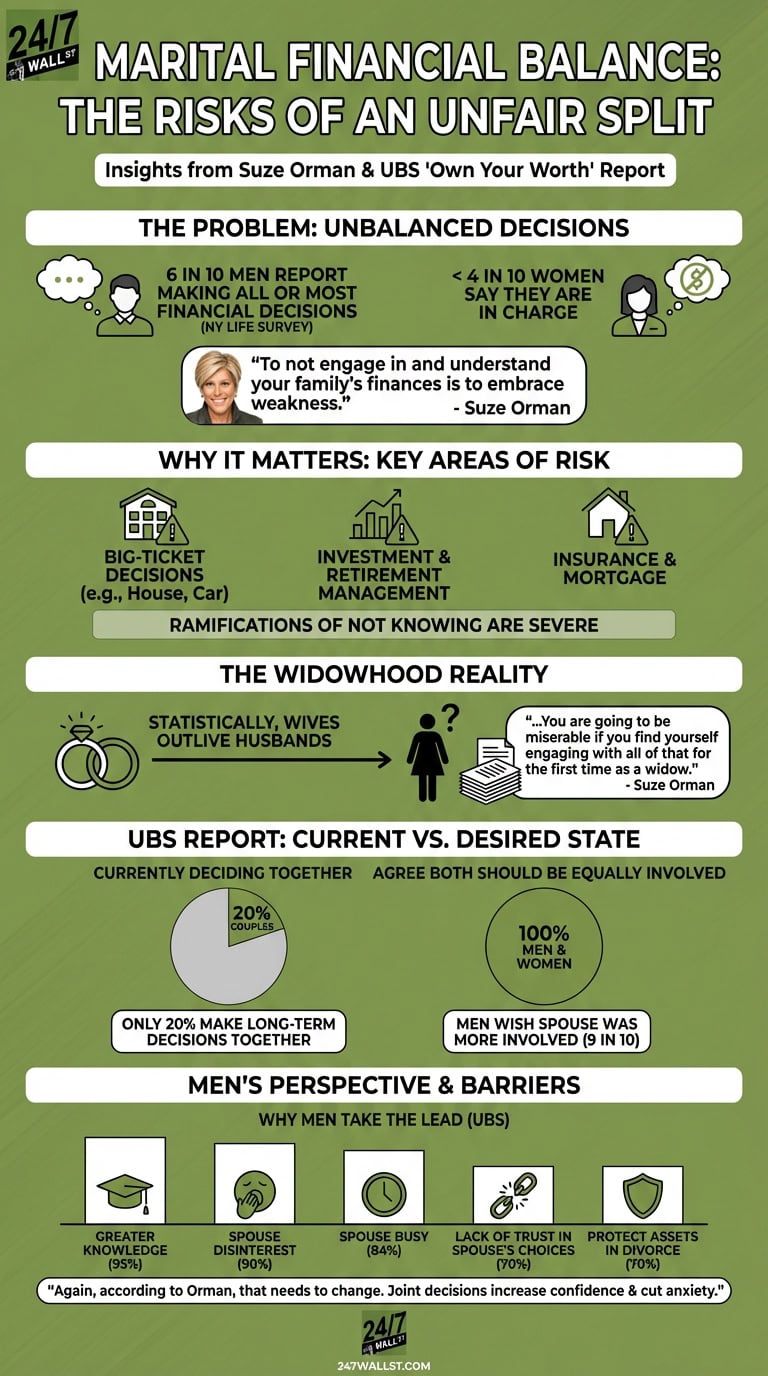
The research behind this problem extends well beyond any single survey. UBS’s 2021 “Own Your Worth” report, which surveyed 1,500 high-net-worth men and women in marriages or long-term partnerships, found that only 20% of couples actually make long-term financial decisions together. This was despite the fact that nearly all respondents said both spouses should be equally involved. The gap between what couples believe and what they actually do is difficult to ignore.
Seven in 10 men in that study reported taking the lead on those long-horizon decisions, and nine in 10 of those same men said they wished their spouse was more engaged. Among men who assume sole responsibility, the explanations follow consistent lines: 95% believe they have greater financial knowledge than their spouse, 90% attribute their partner’s non-participation to disinterest, and 84% think their spouse is too occupied with household obligations. The trust gap is even wider, with 70% saying they do not trust their spouse to make sound financial choices. These perceptions may reflect genuine gaps in shared experience, but they also reinforce those gaps the longer the pattern continues.
The downstream consequences of that imbalance are now well documented. UBS’s 2025 “Own Your Worth” report, titled “Heir Dynamics: Money in Motion,” focused on the coming generational wealth transfer and surveyed 2,000 women with at least $1 million in investable assets. It found that 83% of recently widowed women encountered serious difficulties when they assumed sole control of household finances. One in four of those women said they did not know where all of their partner’s wealth was before he passed.
The scale of what is coming makes those findings hard to set aside. Cerulli Associates projects that an estimated $124 trillion will change hands between now and 2048, with $54 trillion of that passing first to widowed spouses. Fully 95% of that spousal inheritance is expected to flow to women, and roughly $40 trillion of it will go specifically to Baby Boomer women who outlive their husbands. UBS also notes that many women will face two separate wealth transfer events: one when they inherit from parents, and again when they outlive a spouse. Arriving at either of those moments without financial fluency is a costly way to learn.
Women who have already navigated widowhood are among the most consistent voices on what others should do differently. According to the UBS 2025 report, 91% of widows who took over sole financial control recommend that women take an active role in understanding household finances while still married. A nearly equal share, 88%, recommend meeting with a financial advisor while both spouses are alive, and 87% say couples should develop a formal wealth transfer plan before it becomes urgent. The math of financial exclusion becomes clearest at the moment it can least be undone. Orman’s argument is not ultimately about fairness in the present. It is about whether a surviving spouse will have the knowledge and confidence to protect what took a lifetime to build.
Editor’s note: This version adds the New York Life survey’s specific field dates (February 23-25, 2024) and sample size (2,227 U.S. adults), and identifies the UBS 2021 “Own Your Worth” report by year as the source of the finding that only 20% of couples make long-term financial decisions together.
Contact [email protected] for any questions or corrections.
Ian Cooper is a veteran market analyst and investment strategist with more than 20 years of experience covering stocks, commodities, and macro trends. Since 1999, he has helped investors identify market opportunities using a blend of technical analysis, fundamental research, and market sentiment.
He is the creator of the ADD News Flow Strategy, which focuses on trading market reactions to major news events and investor psychology. Cooper was also among the analysts who warned about the 2008 financial crisis and major financial institution collapses ahead of the broader market.
Before joining 247 Wall St., Cooper wrote extensively for InvestorPlace and other financial publications, covering market trends, trading strategies, and investment opportunities.