How Long Would It Take $1,000 Invested in Apple to Become $10,000?
Apple already turned $1,000 into more than $12,000 once, but doing it again from today's price is a very different challenge. The math on how long a 10x return actually takes reveals just how much has changed for this stock.

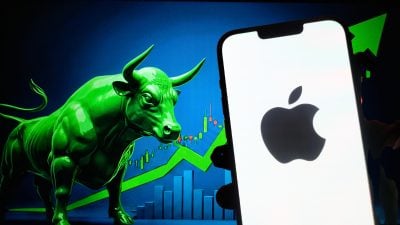
A 10x return means turning $1,000 into $10,000. It has already been done once by Apple (NASDAQ:AAPL | AAPL Price Prediction). Over the past decade the stock returned 1181.3%, so a $1,000 investment grew to about $12,813. Shares traded at $331.22 in Tuesday’s session.
The price model starts from the prior close of $338.25. Our longest forecast period ends in 2031, so every concrete figure below is linked to that five-year window.

What $1,000 in Apple Could Become by 2031
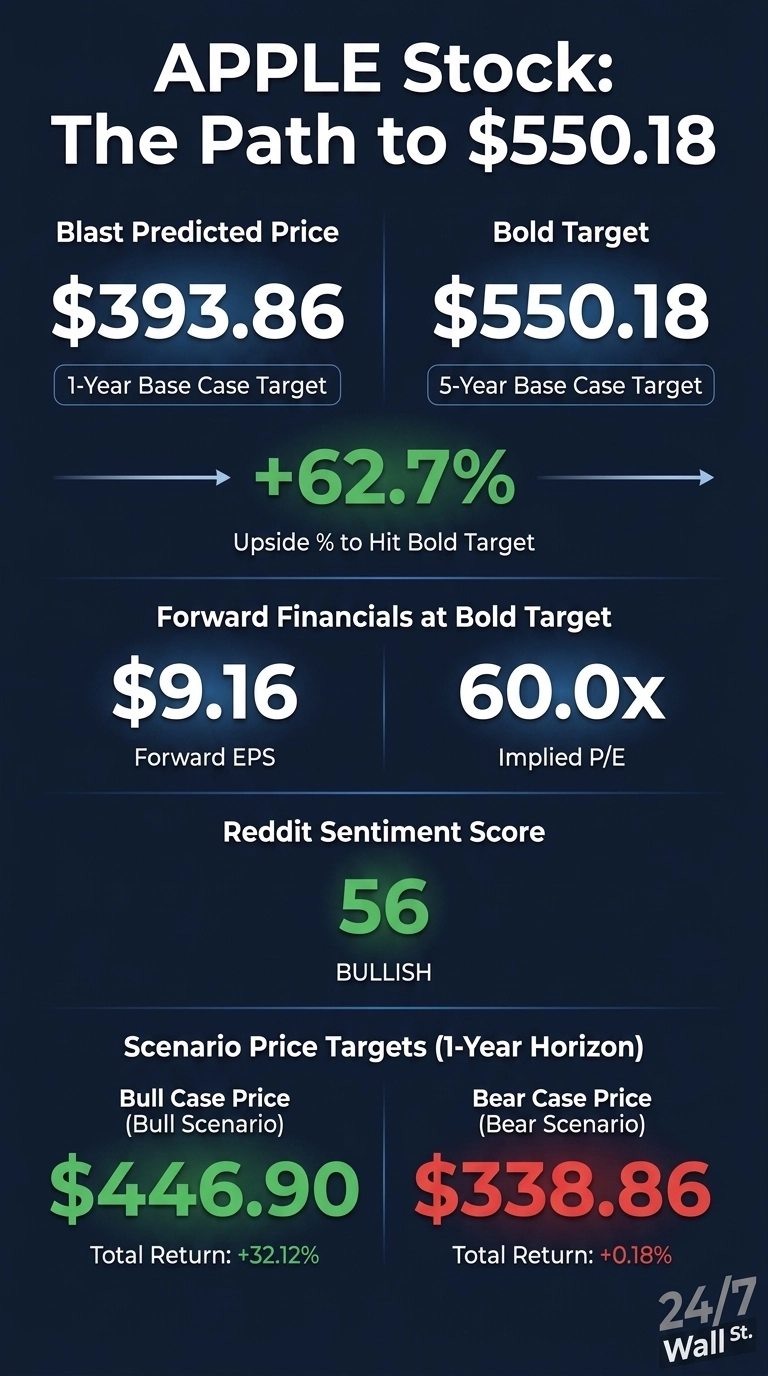
Under the central scenario, a $1,000 investment could be worth about $1,626.60 by 2031. The total return comes to 62.66%. It rests on a five-year per-share target of $550.18, which works out to an annualized return of 10.22%.
So how long until the investment hits $10,000? This part is illustrative only, because the model does not forecast that far out. If Apple kept growing at the base-case pace, a 10x gain would take about 23.6628 years.
At the bull-case pace it would take 17.1491 years. At the bear-case pace it would take 84.8765 years. A company this large growing more slowly than it did during its last tenfold run.
Bull, Base and Bear Scenarios for a $1,000 Stake
| Scenario (5-Year, 2031) | Target Price | Total Return | Annualized | Value of $1,000 |
|---|---|---|---|---|
| Bull | $661.78 | 95.65% | 14.37% | $1,956.50 |
| Base | $550.18 | 62.66% | 10.22% | $1,626.60 |
| Bear | $387.38 | 14.52% | 2.75% | $1,145.20 |
The one-year view is shorter. The most best scenario reaches $446.90 ($1,321.20 for the investment). The central scenario reaches $393.86 ($1,164.40). The most worst scenario reaches $338.86 ($1,001.80).
The model rates its confidence as high (0.9). Because Apple is a mega-cap, the model also applies a 50% reduction to its growth adjustment. It is a projection, not investment advice.

Three Drivers Behind the Upside Case
Earnings Keep Beating Expectations
Apple has exceeded EPS estimates for 10 consecutive quarters. In fiscal Q3 it earned $2.02 per share against a $1.8914 estimate. Revenue came in at $109.42B, up 16.36% from a year earlier. iPhone revenue rose 22% on the iPhone 17 family. The CEO called it “the most powerful and most popular iPhone lineup we’ve ever had.”
Services and Siri AI Build Recurring Revenue
Services brought in $30.7 billion, up 12%, and paid subscriptions passed 1.5 billion. Apple introduced a redesigned Siri AI at WWDC. Management plans iCloud+ upgrade options for heavy users, which could add a new subscription revenue stream.
Cash Returned to Shareholders
The board authorized an additional $100B buyback and raised the quarterly dividend to $0.27. Buybacks reduce the share count, so each remaining share gets a larger piece of earnings. It also relies on forward EPS of $9.1636 and a forward P/E of about 37x.
What Wall Street Analysts Expect
Sentiment leans positive. Analysts rate Apple 6 strong buy, 19 buy, 14 hold, 3 sell and 2 strong sell. The consensus target of $328.22 sits below the current share price, though.
In other words, analysts on average see the stock as close to fully valued right now. The model’s upside comes mostly from earnings growth, while the consensus target means little room for the valuation multiple to rise.

Risks That Could Shrink Your Returns
Valuation leaves little room for error. Apple trades at about 44 times trailing earnings. Supply is also tight: management expects constraints to “increase significantly” across iPhone, Mac and iPad. The CEO described rising memory prices as “a 100-year flood on the memory pricing.”
Recent results also got a one-time lift. Tariff refunds added about 2 pts to gross margin and $0.11 to EPS, and that benefit will not repeat. For the September quarter, guidance calls for revenue growth of 9% to 11%. That is slower than recent quarters.
Regulation is another pressure point. Siri AI still needs more work before it can launch in China, and in the EU its availability depends on talks with the European Commission. App Store decisions are already weighing on Services.
Competition in AI is heating up too: Bank of America noted an AI threat to Apple from Meta’s Muse. If these pressures build up, the most worst scenario of $1,145.20 becomes the more realistic outcome.
How Long Until $1,000 Becomes $10,000
The model’s five-year scenarios put $1,000 in Apple between $1,145.20 and $1,956.50 by 2031. The central scenario is $1,626.60.
Reaching $10,000 at the forecast pace would take well over a decade, and that timeline is only illustrative. They are scenarios, not guarantees. The next earnings report, along with updates on supply and memory costs, will show which path Apple is on.
Contact [email protected] for any questions or corrections.
Vandita Jadeja is a financial publisher with over a decade of experience writing about financial topics, including investment, savings, retirement, insurance and banking. Vandita is a Chartered Accountant who loves to debunk financial concepts for readers.
Her work has appeared on sites that include The Motley Fool, InvestorPlace, and Benzinga. She covers investing and focuses on stock picks and price prediction for 24/7 Wall St.
When not looking for the next stock investment opportunity, she can be found traveling, reading, chasing sunsets and enjoying her iced latte.