Nvidia Knows It Could Trigger a Credit Risk Shock and Collapse Markets
Nvidia now guarantees financing for the AI customers buying its chips, and management openly admits some will call the arrangement circular. What happens to the stack when the weakest link cannot cover its interest bill?


NVIDIA (NASDAQ:NVDA | NVDA Price Prediction) and CoreWeave (NASDAQ:CRWV) reported second-quarter results in August. NVIDIA sells GPUs; CoreWeave borrows to buy them and leases computing power. NVIDIA now guarantees customer financing, so stress at the neocloud level travels back up the chain.
Blackwell Throws Off Cash While CoreWeave Piles on Debt
NVIDIA’s revenue reached $96.22 billion, up 105.8%. The Blackwell Ultra ramp raised Data Center sales to $89.02 billion. Networking rose 138% to $40.31 billion, which shows customers are buying entire AI factories. Jensen Huang summed it up: “Now, compute is revenue.”
CoreWeave grew revenue 112.3% to $2.58 billion with a $104 billion backlog. Interest expense rose to $640 million from $267 million, and net loss widened to $626 million. Q3 interest expense guidance: $860 to $940 million. Debt costs are compounding the losses.
| Business Driver | NVIDIA | CoreWeave |
|---|---|---|
| Growth Engine | Blackwell Ultra and networking | Rented GPU capacity |
| Quarterly Free Cash Flow | $21.34 billion | -$5.74 billion |
NVIDIA Starts Underwriting Its Own Customers
Management said frontier AI labs “are growing faster than what their balance sheets and credit profiles can support.” NVIDIA’s response includes $279 billion in supply commitments and guarantee obligations limited at $108.5 billion. For neoclouds, NVIDIA promises to pay for part of capacity whether used or not. In exchange, it takes revenue share and management said “we get paid twice.”
Management admitted “some will call this circular financing.” Labs relying on NVIDIA’s balance sheet will make up “roughly a quarter of our business next year.” Days sales outstanding stretched to 60 from 45. NVIDIA has approached insurers about credit default and depreciation insurance. Neoclouds pledge chips as collateral for loans.
CoreWeave carries $72.05 billion in liabilities against $5.02 billion of equity. It plans $35 to $39 billion of capex in 2026. If rental prices slip, both companies feel it, the kind of mania-stage setup we unpacked in a free handbook on riding a bubble without giving the gains back.
CoreWeave’s Interest Bill Is the Next Stress Test
I will keep an eye on whether CoreWeave hits its Q3 revenue guidance of $3.45 to $3.6 billion, a steep rise. I also want to see adjusted operating margins reach the “low teens in Q4.” A July price increase of about 25% across SKUs should help. For NVIDIA, track gross margin. Management expects it to bottom at 71% to 72% in Q4 as memory costs rise.
Why NVIDIA’s Seat Atop the Stack Offers More Cushion
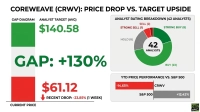
Year to date, NVIDIA is up 22.74% and CoreWeave is up 21.66%. Over one year, CoreWeave is down 36.34%. NVIDIA’s huge cash generation can absorb losses if guarantees go bad. CoreWeave’s shareholders effectively stand behind its debt load. Its outlook improves if managed inference, now above $100 million in annual recurring revenue, grows fast enough to reduce borrowing needs.
Contact [email protected] for any questions or corrections.
Alex Sirois is a financial writer with experience spanning both retail and institutional investing. He has written for InvestorPlace and held roles at BNY Mellon and Bernstein, giving him a perspective that bridges Main Street portfolios and Wall Street analysis.
Alex holds an MBA from George Washington University and has built his career across multiple industries, including e-commerce, education, and translation — a breadth of experience that informs how he breaks down complex financial topics for everyday investors. His writing is conversational, actionable, and grounded in long-term, buy-and-hold investing principles.
At 247 Wall St., Alex focuses on delivering analysis that is both accessible and useful, with a clear emphasis on helping readers make more informed decisions with their money.