Vistra’s Price Dropped 30% in 1 Year: Why One Wall Street Analyst Predicts 115% Returns From Here
Vistra has shed nearly 30% while Wall Street analysts keep raising their price targets, creating a gap that one top analyst thinks is worth 115% upside. The catch sits inside two words that management itself flagged as a problem: ERCOT…

This post may contain links from our sponsors and affiliates, and Flywheel Publishing may receive compensation for actions taken through them.

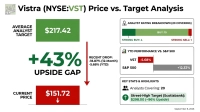
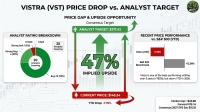
Vistra (NYSE:VST | VST Price Prediction) trades at $138.36. The average analyst price target is $217.58, which implies about 57% upside to where Wall Street thinks it belongs.
Vistra is a Texas-based independent power producer. It runs nuclear, natural gas and solar plants in ERCOT and PJM. AI hyperscalers want round-the-clock baseload power, and Vistra has signed with them: 20-year Meta (NASDAQ:META) PPAs covering 2,600+ MW and a 1,200 MW AWS deal at Comanche Peak.
The most bullish analyst sees far more upside than consensus. Scotiabank’s Andrew Weisel holds a Street-high $298.00 target with a Sector Outperform rating. That implies about 115% upside. When even the consensus gap tops 40%, investors need to know which side has it right.
Cheaper Texas Power Knocked Down Vistra’s 2027 Outlook
The biggest problem is falling ERCOT forward prices. On the second-quarter call, management said 2027 ERCOT curves were “meaningfully lower”. It added that higher PJM prices and hedging “don’t fully offset the ERCOT headwind.” Vistra now expects to land near the lower end of its 2027 range of $7.40 billion to $7.80 billion. Texas prices have averaged $30 a megawatt hour, and CEO Jim Burke said directly that “$30 is not going to get new stuff built.”
The stock traded lower at each earnings report: $176.96 at the fourth-quarter report, $159.64 at the first-quarter report, and $143.87 at the second-quarter report. Texas regulators are reviewing the large-load interconnection queue, which management expects to pause for a few months. Unrealized hedging losses of $472M pulled net income to $305M, even as Adjusted EBITDA rose more than 30% to $1.77B.
Analysts Are Looking Past ERCOT to Meta, Cogentrix and Helix
Scotiabank’s thesis rests on three elements: hyperscaler PPAs at nuclear and gas plants, wider spark spreads and higher capacity prices in ERCOT and PJM, and Energy Harbor synergies funding buybacks. The second pillar runs into what management itself says about Texas today.
The 2027 numbers still leave out two catalysts. CFO Chris Moldovan said Cogentrix and the Meta PPAs could add “roughly $700 million to our midpoint opportunity.” FERC has approved the Cogentrix deal, which brings a ~5,500 MW gas portfolio. Vistra is also the preferred power provider for Helix, a joint venture with NVIDIA and KKR, and has committed up to $1.0B. Buybacks have reduced the share count by ~30%, with ~$1.2B left on the authorization.
Analysts remain bullish. Four rate the stock Strong Buy, 15 rate it Buy, none rate it Hold or Sell, and one rates it Strong Sell. Their estimates tell a softer story than their ratings. The 2027 EPS consensus has fallen to $10.3811 from $11.3019 60 days ago, with six downward revisions and zero upward revisions in the past 30 days. The next test comes on the third-quarter call, when management will update guidance.
Every Big Power Producer Fell, and NRG Fell Hardest
Constellation Energy (NASDAQ:CEG) is down 22.37% over the year. At $254.02 against a $347.28 target, it has about 37% upside, less than Vistra. Analysts hold 19 bullish ratings and 3 Holds.
NRG Energy (NYSE:NRG) dropped 40.21%. At $95.67 against a $188.56 target, implied upside is about 97%. It has 13 bullish ratings and 3 Holds.
Talen Energy (NASDAQ:TLN) is off 26.49%. At $312.69 against $460.59, it offers about 47% upside, which is also below Vistra’s.
NRG has the largest implied upside in the group. Vistra comes second, with cleaner contracted growth and investment-grade credit. Price targets are estimates and no guarantee.
A 29% Slide While the S&P 500 Gained 14%
Vistra trades at $138.36, and 20 analysts set an average target of $217.58, about 57% above the current price. The shares are down 28.96% over the past year and 13.85% year to date. Over the same periods, the S&P 500 rose 14.48% and 11.84%.
The stock sits below both its 50-day average of $144.91 and its 200-day average of $155.39. It trades at a forward P/E of 13, a low multiple for a company with 20-year contracts with tech giants.
I Lean Toward Vistra, but Texas Prices Have to Turn
Things look more bullish if Cogentrix closes smoothly, Meta PPAs add to EBITDA in 2027, and Texas data-center load connects to the grid. If all three happen, the about $700 million in extra EBITDA becomes real and the consensus target looks reachable. The bear case gains ground if ERCOT prices stay near $30 and the queue review delays projects past 2027. Falling estimates would then drag targets down to meet the stock.
I lean bullish. At 13 times forward earnings, with large contracted deals and continued buybacks, the market is pricing in a lot of bad news. I’d treat Scotiabank’s $298 as the best-case scenario, though, and the consensus target as the more realistic one.
Contact [email protected] for any questions or corrections.
Alex Sirois is a financial writer with experience spanning both retail and institutional investing. He has written for InvestorPlace and held roles at BNY Mellon and Bernstein, giving him a perspective that bridges Main Street portfolios and Wall Street analysis.
Alex holds an MBA from George Washington University and has built his career across multiple industries, including e-commerce, education, and translation — a breadth of experience that informs how he breaks down complex financial topics for everyday investors. His writing is conversational, actionable, and grounded in long-term, buy-and-hold investing principles.
At 247 Wall St., Alex focuses on delivering analysis that is both accessible and useful, with a clear emphasis on helping readers make more informed decisions with their money.